
Estimates only. Actual earnings depend on APY changes, compounding frequency, and account terms. Interest compounded daily in this calculator.
- Best Overall Rate — Varo Money leads at 5.00% APY (first $5K), but Axos Bank and Newtek Bank offer solid 4.20%+ rates with no tier caps
- Zero Fees — All top accounts charge no monthly fees or minimum deposit requirements (except Wealthfront’s $1 minimum)
- FDIC Protection — Your deposits are federally insured up to $250K per account, so there’s zero risk of losing principal
- Rates Are Declining — Peak HYSA rates hit 5.35% in 2024; expect gradual compression through 2026 as Fed rate cuts ripple through
- Rate Shopping Pays — The difference between a 3.80% account (Ally) and a 4.21% account (Axos) is roughly $41 per year on every $10K
Best High-Yield Savings Accounts Comparison
| Bank | APY | Min Deposit | Monthly Fee | FDIC Insured | Best For |
|---|---|---|---|---|---|
| Varo Money | 5.00% (up to $5K, then 3.00%) | $0 | $0 | Yes | Highest rate for small balances |
| Axos Bank | 4.21% | $0 | $0 | Yes | No-strings, no-cap high APY |
| Newtek Bank | 4.20% | $0 | $0 | Yes | Set-and-forget savers |
| Wealthfront | 4.00% | $1 | $0 | Yes | Cash management + investing |
| Marcus by Goldman Sachs | 3.90% | $0 | $0 | Yes | Big-bank reliability |
| Ally Bank | 3.80% | $0 | $0 | Yes | All-around banking |
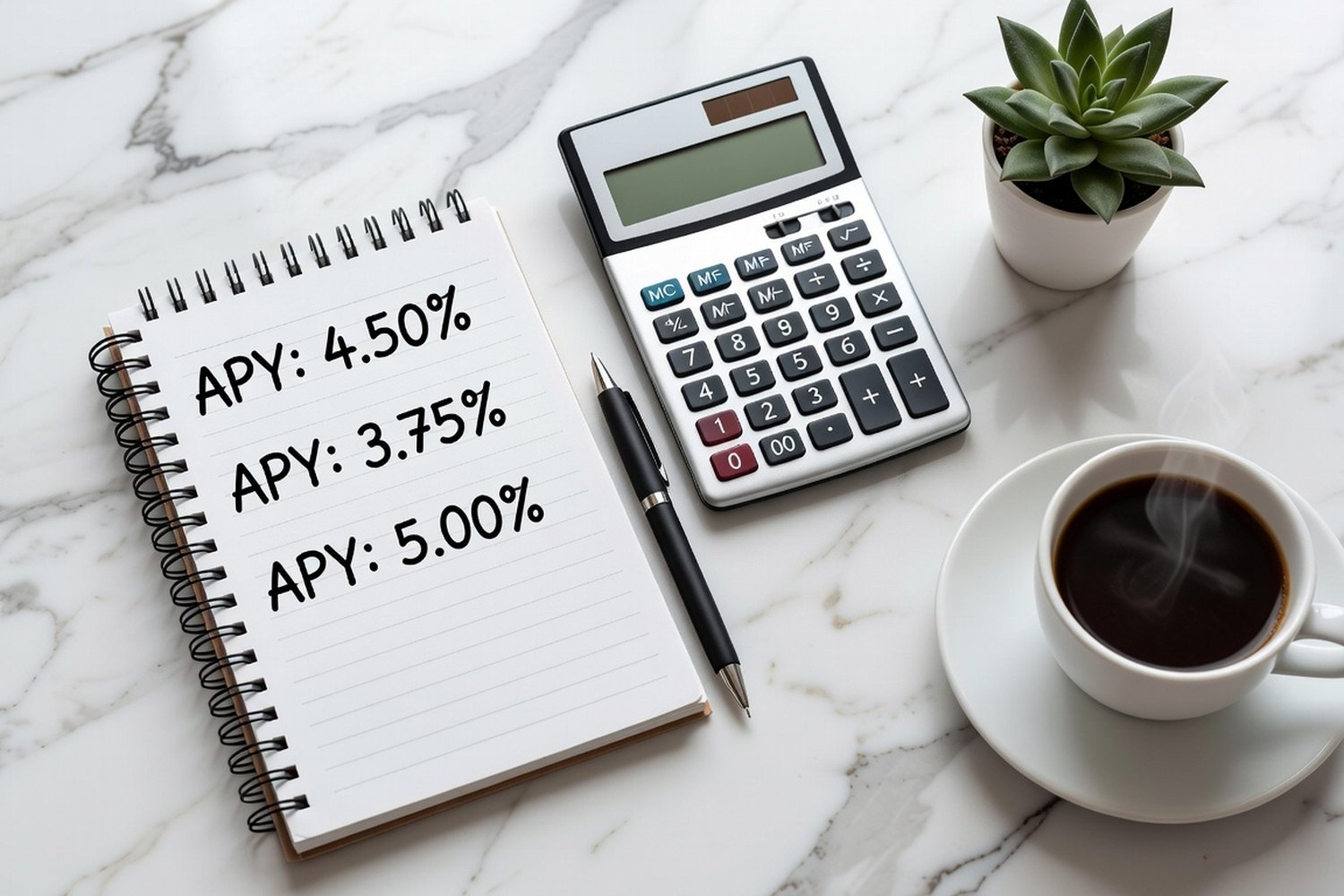
What Makes a Savings Account “High-Yield”?
A high-yield savings account (HYSA) is a deposit account offered by banks—usually online-only banks—that pays significantly more interest than your standard brick-and-mortar savings account. We’re talking 10–20 times the interest.
Here’s the math: a traditional savings account at your local bank might pay 0.01% APY, while the best HYSAs are paying 4%–5% APY. That difference compounds fast. On a $10,000 balance, a 0.01% account earns $1 per year. A 4% account earns $400. Same money, totally different outcome.
Why such a big gap? Online banks have lower overhead costs—no branch buildings, no tellers, no regional staff. They pass those savings to you in the form of higher yields. It’s a win-win: they attract your deposits at a reasonable cost, and you actually earn meaningful interest.
FDIC Insurance: All legitimate HYSAs are FDIC-insured up to $250,000 per depositor, per bank. That means if the bank fails, your money is protected by the federal government. You’re not taking on risk by chasing yields.
How APY is Calculated: APY (Annual Percentage Yield) accounts for daily compounding of interest. If a bank quotes you 4% APY, that’s the actual return you’ll earn in a year, assuming the rate doesn’t change and you don’t withdraw anything. It’s the “true” interest rate, unlike the plain “interest rate,” which doesn’t account for compounding.
Best High-Yield Savings Accounts: Full Reviews
| Bank | APY | Pros | Cons | Best For |
|---|---|---|---|---|
| Varo Money | 5.00% | Highest headline rate. No fees, no minimums. Slick mobile app. Links to existing checking. | Rate drops to 3.00% above $5K. Only best for smaller balances. | Small emergency funds under $5,000 |
| Axos Bank | 4.21% | No rate tiers or caps. Earn 4.21% on every dollar. No fees, no minimums. FDIC-insured. | Slightly lower than Varo’s peak rate. Limited branch presence. | No-gimmick, reliable savings at any balance |
| Newtek Bank | 4.20% | No tiers or caps. Historically stable rates. FDIC-insured. Minimal fees. | Sometimes has a waitlist. Smaller bank with fewer app features. | Hands-off, set-and-forget savers |
| Wealthfront | 4.00% | Integrates with Wealthfront investment platform. No fees, $1 minimum. Clean UX. | Slightly lower rate. Best if already a Wealthfront investor. | Cash management alongside investing |
| Marcus by Goldman Sachs | 3.90% | Goldman Sachs backing. Zero fees, zero minimums. Polished app. Historically stable rates. | Lower rate than competitors. Online-only, no branches. | Savers who value big-bank reliability |
| Ally Bank | 3.80% | Zero fees, zero minimums. Also offers checking, CDs, and money market. Clean, easy app. | Lower rate than top competitors. Jack-of-all-trades, not best-in-class on rate. | All-in-one banking with a single provider |
Pro Tip: Watch Out for Rate Tiers
Varo Money’s 5.00% APY only applies to the first $5,000 of your balance. Above that, the rate drops to 3.00%. Always read the fine print. Axos and Newtek have no tiers—earn their full rate on every dollar. Rate tiers can be sneaky, so compare apples to apples.
How to Choose the Right High-Yield Savings Account
APY isn’t everything. Here’s how to think about it:
1. Rate Stability: Some banks—like Newtek—hold rates longer. Others—like Varo—adjust rates more frequently as Fed policy shifts. If stability matters to you, read reviews about past rate history.
2. Fee Structure: Most HYSAs are free. But some charge maintenance fees, transfer fees, or withdrawal limits. Always scan the fine print. If a bank is charging you, they’re not high-yield.
3. Accessibility & Transfers: How easy is it to move money in and out? Do they integrate with your current bank? Can you set up automatic transfers? Every day you don’t have money in your HYSA is a day you’re earning zero interest elsewhere.
4. Bank Reputation: Check customer reviews on Trustpilot and similar sites. How do they handle disputes? What’s their customer service like? A 0.5% higher rate means nothing if you can’t get your money when you need it.
5. Mobile App Quality: If you’re moving money around frequently, a clunky app will drive you crazy. Try the mobile experience before committing.
Pro Tip: Open Multiple Accounts to Maximize FDIC Coverage
FDIC insurance covers $250K per account at each bank. If you have more than $250K to save, open accounts at two or three different banks and maximize both coverage and rate diversity. Open a $250K account at Axos (4.21%), another at Newtek (4.20%), and a third at Marcus (3.90%) for $100K. You’re fully insured and capturing multiple competitive rates. This is one of the easiest ways to bump your overall yield.
High-Yield Savings vs Other Options
Savings accounts are just one tool. Here’s how HYSAs stack up against alternatives:
| Account Type | Typical APY | Liquidity | Risk | FDIC Insured | Best For |
|---|---|---|---|---|---|
| High-Yield Savings | 3.80% – 5.00% | Immediate access | None (FDIC) | Yes | Emergency funds, short-term goals |
| Money Market Account | 3.70% – 4.50% | Immediate + check writing | None (FDIC) | Yes | Higher balance with check access |
| Regular Savings Account | 0.01% – 0.50% | Immediate access | None (FDIC) | Yes | Avoid—rates are abysmal |
| 1-Year CD | 4.50% – 5.00% | Locked 1 year (penalty if early) | None (FDIC) | Yes | Fixed timeline, maximize rate |
| Treasury Bills (T-Bills) | 4.60% – 5.20% | Locked at purchase, liquid after | None (backed by US govt) | N/A (govt guarantee) | Ultra-safe yields, no federal tax |
HYSA vs Money Market: Money market accounts often pay similar rates to HYSAs but let you write checks and access your money multiple ways. They’re good if you want higher balances with flexibility. Both are FDIC-insured and risk-free.
HYSA vs CD: A one-year CD might pay 4.80%–5.00%, which sounds better than HYSA rates. But your money is locked for the term. If you need emergency access, you’ll pay an early withdrawal penalty. HYSAs are for money you might need; CDs are for money you know you won’t touch.
HYSA vs T-Bills: U.S. Treasury bills are backed by the full faith and credit of the U.S. government—zero risk. They’re currently paying 4.60%–5.20% depending on term. The downside: you can’t access the money until the bill matures (3-month, 6-month, 1-year terms available). Plus, you buy them through Treasury Direct in $100 increments, which requires more legwork. For everyday emergency funds, HYSA wins. For longer-term bucket of safe money, T-Bills are underrated.
What’s Happening With Savings Rates in 2026
The headline: rates are trending down, but they’re not collapsing. Here’s why.
In 2024, the best HYSAs were paying 5.25%–5.35% APY. Today, the best are at 4.20%–5.00%. That’s a drop, but not catastrophic. The Federal Reserve held its benchmark rate at 3.50%–3.75% in March 2026, but market expectations are for gradual cuts through the year if inflation continues to cool.
Why Rates Are Declining: The Fed hiked rates aggressively from 2022–2023 to combat inflation. Those rate increases take time to work through the economy. Banks are now competing for deposits at lower rates because they have fewer borrowers at those high rates. Supply and demand—rates fall when demand for loans drops.
The 2026 Outlook: My take is that we’re in a transition phase. You’re unlikely to see 5%+ become mainstream again in 2026. But 4%–4.50% seems stable through mid-year. By Q4 2026, if the Fed cuts rates more aggressively, expect HYSAs to settle in the 3.50%–4.00% range. Not terrible, but noticeably lower than today.
What Savers Should Do Now: If you’ve got cash sitting in a 0.01% savings account, move it today. The difference between 0.01% and 4.21% is massive. Lock in current rates while they’re available. Don’t overthink it—you’re not picking the rate that’ll be best in 12 months; you’re capturing today’s available yield. Rate-shop among the six accounts above, open two or three if you want to diversify banks and stay under FDIC limits, and revisit rates quarterly to rebalance.
What Is the Best High-Yield Savings Account Right Now?
As of late March 2026, the top high-yield savings accounts are paying between 4.20% and 5.00% APY with no minimum balance requirements and no monthly fees. Online-only banks dominate the leaderboard because they operate without branch overhead and pass those savings to depositors. The best accounts combine a competitive APY with practical features like no minimum deposit, no monthly maintenance fee, FDIC insurance up to $250,000, and easy electronic transfers to your existing checking account.
When evaluating accounts, look beyond the headline APY. Some banks offer promotional rates that drop after 3–6 months, while others maintain consistent rates over time. Check whether the account charges fees for excess withdrawals (the old federal six-withdrawal limit was lifted in 2020, but some banks still enforce their own caps). Also verify that the bank is FDIC-insured — not all online platforms are banks, and some fintech apps route deposits through partner banks with varying levels of protection. See our full comparison table above for today’s top-rated accounts with detailed feature breakdowns.
What Is a Good APY for a Savings Account?
In today’s rate environment, a “good” APY for a savings account is anything above 4.00%. The FDIC national average for savings accounts is just 0.39% APY, which means most Americans are earning essentially nothing on their cash. The best high-yield savings accounts pay 4.20%–5.00% APY — more than 10 times the national average. For a $25,000 balance, the difference between 0.39% and 4.40% is roughly $1,003 per year in additional interest.
Context matters, though. A “good” rate is one that beats inflation after taxes. With core inflation running around 2.6% and the top marginal federal tax rate at 37%, a 4.40% APY yields roughly 2.77% after federal taxes — still above inflation. Compare that to a traditional bank at 0.39% APY, which loses purchasing power every month after inflation. If the Fed cuts rates later in 2026, “good” may shift to 3.75%–4.00%, but for now, any HYSA above 4.00% puts you well ahead. The key benchmark: your savings rate should exceed the current inflation rate, or your money is shrinking in real terms.
Are High-Yield Savings Accounts Worth It?
For emergency funds and short-term cash, high-yield savings accounts are one of the best places to park money in 2026. They offer a rare combination: competitive yields (4.00%–5.00% APY), full liquidity (withdraw anytime without penalty), and FDIC insurance protecting up to $250,000 per depositor. No other product matches all three. CDs offer higher rates on some terms but lock your money away. Money market funds may offer similar yields but lack FDIC coverage. Treasury bills are competitive but require purchasing through a brokerage and have maturity dates.
The math is straightforward: if you have $20,000 in a checking account or traditional savings earning 0.01%–0.39%, moving it to a high-yield account at 4.40% APY earns you $800–$878 more per year with no additional risk. Opening an account takes about 10 minutes online, and electronic transfers between your banks typically settle in 1–2 business days. The only real downside is that HYSA rates are variable — they can go down when the Fed cuts — but even in a lower-rate environment, the best HYSAs will still pay 5–10x the national average. For money you might need on short notice, an HYSA is the clear winner over keeping cash idle.
Will Savings Account Rates Go Down in 2026?
Most likely yes, but gradually. The Federal Reserve held its benchmark rate at 3.50%–3.75% at the March 2026 meeting, and the FOMC dot plot projects one more 25-basis-point cut this year. Futures markets price in up to two cuts, most likely at the June and September meetings. Since high-yield savings account rates track the federal funds rate closely, each 25bp Fed cut typically translates to a 15–25bp decline in HYSA yields within 2–4 weeks as banks adjust their pricing.
Under the base-case scenario of one Fed cut, expect top HYSA rates to settle in the 3.75%–4.25% range by year-end. Under a more aggressive two-cut scenario, rates could dip to 3.50%–4.00%. Either way, the best HYSAs will continue to pay significantly more than the national average and more than inflation — making them still worthwhile. The practical takeaway: don’t wait for rates to “stabilize” before opening an account. Every month you keep cash in a 0.01% checking account, you’re forfeiting roughly $35–$37 per $10,000 in lost interest compared to a 4.40% HYSA. Open now, earn today’s rate, and adjust later if needed. If you want to hedge against rate declines, consider moving some portion into a short-term CD to lock in today’s yield.
Frequently Asked Questions About High-Yield Savings Accounts
How Much Should I Keep in a High-Yield Savings Account?
The standard guideline is 3–6 months of living expenses for emergencies. If your monthly expenses run $5,000, that means $15,000–$30,000 in a high-yield savings account. At today’s top rate of 4.40% APY, a $25,000 emergency fund earns roughly $1,100 per year — money that would earn just $10 at a traditional bank. Beyond your emergency fund, consider putting excess cash to work in investments or CDs for higher locked-in rates. The key principle: an HYSA is for money you might need access to on short notice, not for long-term wealth building.
Are High-Yield Savings Accounts Safe?
Yes — as safe as any deposit account in the United States. FDIC insurance covers up to $250,000 per depositor, per bank, per ownership category. If the bank fails, the federal government reimburses you in full. Online banks like Axos and Ally carry the same FDIC protection as Wells Fargo or Bank of America — the delivery channel (online vs. branch) makes no difference to the insurance. The only thing to verify before opening any account is that the institution is FDIC-insured, which you can confirm on the FDIC’s BankFind tool. All six banks recommended on this page are fully insured.
How Often Do HYSA Rates Change?
Banks can adjust HYSA rates at any time — weekly, daily, or even multiple times per day in competitive periods. The biggest driver is the Federal Reserve: when the FOMC raises or lowers its benchmark rate, banks typically reprice savings accounts within a few days. Major economic data releases like CPI or jobs reports can also trigger changes as banks anticipate the Fed’s next move. Right now the Fed is holding rates steady at 3.50%–3.75%, which is keeping HYSA rates relatively stable. A good habit is to compare rates quarterly and switch if a competitor offers meaningfully higher yields — moving your money between HYSAs is free and takes just a few business days.
Can I Lose Money in a High-Yield Savings Account?
No. Your principal is fully protected by FDIC insurance up to $250,000. The worst-case scenario is that the bank lowers its APY and you earn less interest than expected — but you never lose a dollar of your deposit. This is what makes HYSAs “risk-free” in the traditional sense: unlike stocks, bonds, or even money market funds, there is zero chance of principal loss. The only real risk is opportunity cost — if you park too much cash in a savings account instead of investing, you may miss out on higher long-term returns. But for money you need liquid and safe, an HYSA is the gold standard.
What’s the Difference Between APY and Interest Rate?
APY (Annual Percentage Yield) is the real number to compare because it accounts for the effect of compound interest. The interest rate (or nominal rate) is the raw percentage before compounding is factored in. For example, a bank paying 4.00% interest compounded daily actually delivers an APY of about 4.08% — slightly higher because your interest earns interest throughout the year. Banks are legally required to disclose APY under Regulation DD, making it the standard for apples-to-apples comparison. Always compare APY, never the nominal interest rate.
Should I Choose a High-Yield Savings Account or a CD?
It depends on when you’ll need the money. An HYSA gives you instant access with no penalties — ideal for emergency funds and short-term savings you might tap within the year. CDs pay a slightly higher rate (currently 4.50% APY for the best 1-year CD vs. 4.40% for the best HYSA), but your money is locked up for the full term and early withdrawal costs you 3–6 months of interest. Most financial advisors recommend having both: an HYSA for your 3–6 month emergency fund and CDs for money you know you won’t need for a specific period. A CD ladder strategy can give you the best of both worlds — higher rates with staggered access.
What Are the Best Credit Union Savings Rates?
Credit unions often compete closely with online banks on savings rates, and some consistently beat them. As of March 2026, top credit unions are offering high-yield savings rates between 4.00% and 5.00% APY — comparable to the best online bank rates listed above. The key difference is that credit unions are member-owned nonprofits, so they tend to return more value to depositors through higher rates and lower fees. However, credit unions typically require membership eligibility based on your employer, location, or a qualifying organization. Deposits are insured up to $250,000 by the NCUA, which provides the same federal protection as FDIC insurance at banks. If you qualify for membership, it’s worth comparing credit union rates alongside online banks.
References
- FDIC National Rates & Rate Caps – Official federal rates for deposit accounts
- Federal Reserve – Open Market Operations – Fed policy and benchmark rates
- FDIC Official Website – Deposit insurance information and bank search
- CFPB – What is a Savings Account? – Consumer guide to savings basics
- Treasury Direct – U.S. Treasury bills, notes, and bonds
- IRS Topic 403 – Interest Income – Tax implications of savings account interest
- Investor.gov – SEC-backed investor education and protection
- CME FedWatch Tool – Tracks FOMC rate expectations
- FRED Economic Data – St. Louis Fed historical economic data
- NCUA – Credit Union Administration – Credit union insurance and oversight
Keep Reading
- Savings Rates Hub – Browse all savings products and rates
- Best CD Rates 2026 – Lock in longer-term yields
- CD vs Savings Account – When to choose each
- CD Ladder Strategy – Maximize rate and liquidity
- CD Rates Hub – Compare all CD terms and rates
- Prime Rate – Understand the benchmark affecting all rates
- Mortgage Rates – Compare home loan options
- Savings Goal Calculator – Plan your savings journey