
- A new HVAC system costs $5,000-$15,000 for a standard replacement — a full system swap (furnace + AC + ductwork) can hit $12,000-$20,000+, making financing necessary for most homeowners
- Personal loans are the best emergency option: 1-3 day funding, no collateral, fixed rates from 6-36% — when your AC dies in July or your furnace fails in January, speed matters more than squeezing the absolute lowest rate
- Contractor “same-as-cash” 0% financing is free only if you pay it off on time — these are deferred interest plans at 25-29% APR that charge all retroactive interest if you’re even $1 short at the deadline
- Federal tax credits under the Inflation Reduction Act offer up to $2,000 for qualifying heat pumps and $600 for central AC — this effectively reduces your financing need by $600-$2,000
- The repair-vs-replace rule: if repair costs exceed 50% of replacement cost, or your system is 15+ years old, replacing usually makes more financial sense — financing a new efficient system can actually lower your combined monthly costs (loan payment + energy bills)
What HVAC Systems Actually Cost
HVAC replacements have a unique financial characteristic: they’re almost always emergencies. Unlike a kitchen remodel where you can plan for months, your AC doesn’t send a calendar invite before dying on the hottest day of the year. That urgency limits your financing options to the fast ones — and makes it critical to understand costs before the crisis hits.
Here’s what replacement actually costs by component. Central AC unit only (condenser + evaporator coil): $3,500-$7,500 installed. This is the most common replacement — the outdoor unit fails, the indoor furnace still works. Furnace only: $2,500-$6,500 for a standard 80-95% AFUE gas furnace, installed. Full system (AC + furnace + coil): $7,000-$15,000, the most common option when your existing system is 15+ years old and both components are aging. Heat pump (replaces both AC and furnace): $8,000-$18,000 for a ducted system, $3,000-$8,000 per zone for ductless mini-splits. Heat pumps qualify for the largest federal tax credits.
The variables that inflate the price beyond the base quote: ductwork modification or replacement ($2,000-$5,000 if your existing ducts are undersized, leaking, or incompatible with the new system), electrical panel upgrade ($1,500-$3,000 if switching from gas to electric heat pump on an older panel), thermostat upgrade ($200-$500 for a smart thermostat, but some are included with the system), and permit fees ($100-$500 depending on your municipality). Most contractors include basic installation in their quotes but charge extra for “attic installs” (units in the attic cost 15-25% more because of access difficulty) and “hard starts” (replacing a system in a tight mechanical closet or crawl space).
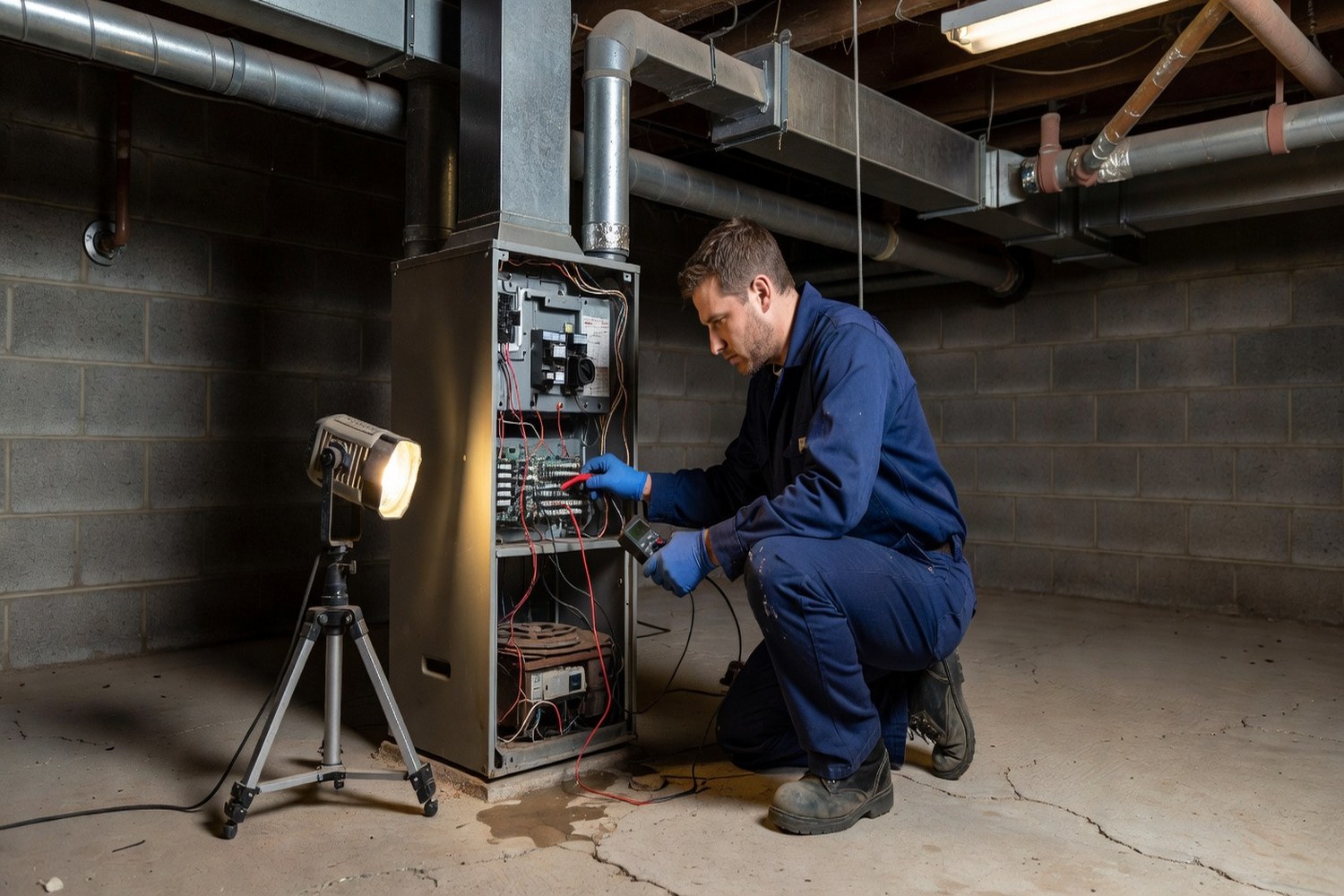
Most HVAC replacements are unplanned emergencies — having financing pre-qualified before your system fails gives you leverage and options when the crisis hits.
Financing Options Ranked
1. Personal loan (best for most HVAC replacements, especially emergencies). When your AC dies on a 105-degree day, you need money fast — not a 3-week HELOC application. Personal loans fund in 1-3 days. No collateral, fixed rates (6-36% depending on credit), terms of 2-12 years. On a $10,000 full system replacement at 9% over 60 months: $208/month, $2,449 total interest. Most lenders offer soft-pull pre-qualification in 5 minutes. The smart move: pre-qualify before you need it, so when the emergency hits, you just click “accept” and the money moves.
2. 0% APR credit card (best for AC-only replacements under $7,000). If your project is a condenser replacement or a single mini-split zone ($3,500-$7,000), a 0% intro APR card for 15-21 months is the cheapest financing available — $0 total cost if paid off in time. Chase Slate Edge, Citi Simplicity, Wells Fargo Reflect. Unlike contractor “same-as-cash,” these true 0% cards don’t charge retroactive interest when the promo ends — interest only applies to the remaining balance going forward. That distinction matters enormously.
3. Contractor “same-as-cash” financing (use only if you can absolutely pay it off). Trane, Carrier, Lennox, and most HVAC companies offer 0% for 12-24 months through Wells Fargo, Synchrony, or GreenSky. These are deferred interest plans. The 0% is real — but only if you pay the full balance before the deadline. Miss it by a day on a $10,000 system at 26.99%, and you owe $2,699-$5,399 in retroactive interest (depending on the promo length). These plans work beautifully for disciplined borrowers who will absolutely pay on time. For everyone else, a personal loan at 9-12% is safer and cheaper in the worst case.
4. Home equity loan or HELOC (best for $15K+ full system + ductwork). If you’re replacing the full system plus ductwork ($12,000-$20,000) and you have 20%+ equity, a home equity loan at 7-9% saves money on large projects. But closing costs ($2,000-$5,000) and 2-4 week timelines make this impractical for emergencies. Best for planned replacements where you know the system has 1-2 years left and you want to lock in the lowest rate before it fails.
5. LIHEAP and Weatherization Assistance (for qualifying low-income homeowners). The Low Income Home Energy Assistance Program helps with heating/cooling costs, and the Weatherization Assistance Program can cover HVAC replacement for qualifying households. These are federal programs administered by states — eligibility is income-based, and funding is limited. Apply through your state’s energy assistance office. It’s worth checking even if you’re not sure you qualify — the programs cover more households than most people realize.
Lender Comparison Table
| Option | Rate | Best For | Speed | Risk | Cost on $10K/5yr |
| LightStream | 6.49%-25.49% | Good credit, planned | Same day | No home risk | $1,716 (7%) |
| SoFi | 8.74%-29.99% | Job uncertainty | Same day | No home risk | $2,449 (9%) |
| Upgrade | 8.49%-35.99% | Fair/bad credit | 1-3 days | No home risk | $3,587 (16%) |
| 0% APR Card | 0% (15-21 mo) | Under $7K, fast payoff | Instant | Low | $0 (if paid in promo) |
| Contractor 0% | 0% (then 25-29%) | Disciplined borrowers | Same day | Deferred interest | $0 or $2,699+ |
| Home Equity | 7%-9% fixed | $15K+ planned | 2-4 weeks | Home is collateral | $2,060 (8%) |
Cost estimates for $10,000 over 5 years at representative rates. Contractor 0% assumes 12-month deferred interest at 26.99% if deadline missed. Early 2026.
Best Personal Loans for HVAC
LightStream — top pick for planned replacements with good credit. If you know your system has a year or two left and you want to replace it on your timeline (not during an emergency), LightStream’s 6.49% starting rate and same-day funding make it the cheapest personal loan option. On an $8,000 AC + furnace at 7% over 60 months: $158/month, $1,497 total interest. Zero fees, Rate Beat Program. Need 695+ credit.
SoFi — best for emergency replacements with job concerns. Your furnace dies in February, you’re between jobs, and you need heat today. SoFi’s unemployment protection pauses payments up to 12 months. Rates from 8.74%, same-day funding, no origination fee. On $10,000 at 9% over 48 months: $249/month, $1,944 total interest.
Upgrade — the go-to for 580-699 credit during HVAC emergencies. Your AC fails, your credit is 620, and the contractor is quoting $7,000 for a new condenser and coil. Upgrade gets you funded within days at 580+ credit. Origination fee applies (1.85-9.99%). On $7,000 at 15% over 36 months: $243/month, $1,722 total interest. Compare that to the contractor’s deferred interest at 26.99% if you miss the deadline: $1,889 retroactive interest on a 12-month promo. The personal loan is safer even at 15%.
Contractor Financing: The Deferred Interest Trap
HVAC contractors love offering financing because it removes the price objection and closes the sale on the spot. “Zero percent for 12 months” — who wouldn’t sign? But the mechanics of deferred interest are designed to generate revenue from the people who don’t pay on time. And statistically, a meaningful percentage don’t.
Here’s exactly how it works. You buy a $10,000 Trane system with “0% for 12 months” through Wells Fargo. Interest at 28.99% APR accrues from day one — it’s just deferred, sitting in a ledger, waiting. If you pay the full $10,000 before month 12 ends: the deferred interest is forgiven. Total cost: $10,000. If you have $500 remaining on the balance at month 12: the full $2,899 in deferred interest (28.99% of $10,000 for 12 months) gets added to your balance. You now owe $3,399 at 28.99% going forward. The minimum payment barely covers interest, and you’re stuck for years.
The math comparison that matters: a personal loan at 10% on $10,000 for 12 months = $879/month, $549 total interest. The contractor’s deferred interest, if you pay on time = $834/month, $0 interest. The contractor’s plan saves $549 if everything goes perfectly. But if anything goes wrong — a medical bill, job disruption, you simply forget a payment — the contractor’s plan costs $2,899 versus the personal loan’s $549. The personal loan is insurance against the worst case.
When contractor financing works: (1) the promo period is 18-24 months (more breathing room), (2) you divide the total by the number of months and set up autopay from day one, (3) you’ll have the final payment ready 2 months before the deadline (buffer for surprises), and (4) you’ve confirmed it’s “same-as-cash” with deferred interest — not a true installment plan (which would be better). If all four conditions are met, contractor financing can be genuinely free. But you need to be honest about whether those conditions apply to your financial life.

Ductless mini-splits qualify for federal heat pump tax credits up to $2,000 — effectively reducing your financing need and improving ROI on the upgrade.
Tax Credits & Rebates That Lower Your Cost
The Inflation Reduction Act provides meaningful tax credits for qualifying HVAC equipment — and these directly reduce your financing need.
Heat pumps (ducted or ductless mini-splits): up to $2,000 federal tax credit per year. This is the biggest incentive and the reason heat pumps have exploded in popularity. A $12,000 heat pump system effectively costs $10,000 after the credit — finance $10,000 instead of $12,000, and your monthly payment drops by $42/month on a 5-year loan at 9%.
Central air conditioning: up to $600 federal tax credit for qualifying ENERGY STAR units. Smaller than the heat pump credit, but still worth claiming. On a $7,000 AC replacement, the credit reduces your effective cost to $6,400.
Furnaces: up to $600 for qualifying natural gas furnaces that meet ENERGY STAR Most Efficient criteria. Combined with an AC credit, you could save $1,200 on a full system replacement.
State and utility rebates: Many states and utility companies offer additional rebates on top of the federal credits — sometimes $500-$3,000 for heat pump installations. Check DSIRE (dsireusa.org) or your utility’s website for local programs. These rebates are often point-of-sale (applied at purchase), which directly reduces the amount you need to finance.
The total savings: a heat pump installation with federal credit ($2,000) + state rebate ($1,000) + utility rebate ($500) = $3,500 off a $15,000 system. You finance $11,500 instead of $15,000, saving roughly $900 in interest over a 5-year loan.
How to Finance Your HVAC System
Step 1: Determine repair vs. replace. The 50% rule: if the repair costs more than 50% of a new system, replace. The age rule: systems over 15 years old are living on borrowed time — one repair leads to another. The efficiency rule: if your current system is 10 SEER or below, a 16+ SEER replacement pays for itself in energy savings within 5-7 years.
Step 2: Get 3 contractor quotes with matching specifications. Specify: system size (tonnage for AC, BTU for furnace), efficiency rating (SEER for AC, AFUE for furnace), brand options, ductwork scope (repair vs. replace), and whether the quote includes thermostat, permit, and disposal of old equipment. Quotes should be within 15-20% of each other — if one is wildly different, check the specs.
Step 3: Check tax credit eligibility. Confirm the proposed equipment qualifies for federal tax credits. Ask the contractor for the ENERGY STAR certification and model numbers. Heat pumps (up to $2,000 credit) vs. central AC ($600) vs. furnace ($600). Subtract the credit from your financing amount.
Step 4: Pre-qualify for a personal loan (soft pull). LightStream (via Credible), SoFi, Upgrade — 5-10 minutes each. Know your rate before the contractor offers financing. If the contractor’s 0% deferred plan is 12 months and your personal loan is 9% over 36 months, calculate: can you absolutely pay $834/month for 12 months? If yes, the 0% plan wins. If there’s any doubt, the personal loan is safer.
Step 5: Fund and schedule installation. Personal loan funds in 1-3 days. Schedule the install, pay the contractor (typically 50% at start, 50% on completion). File for your tax credit when you do your taxes the following year. Apply the refund as an extra principal payment on your loan.
Frequently Asked Questions
What’s the best way to finance a new HVAC system?
For emergencies: a personal loan from LightStream (6.49%+ same-day funding) or SoFi (unemployment protection). For planned replacements under $7K: a 0% APR credit card. Contractor financing works only if you can definitely pay it off within the promo period. Always compare rates before accepting the contractor’s offer.
How much does a new HVAC system cost?
AC only: $3,500-$7,500. Furnace only: $2,500-$6,500. Full system (AC + furnace): $7,000-$15,000. Heat pump: $8,000-$18,000 ducted, $3,000-$8,000 per zone ductless. Add $2,000-$5,000 if ductwork needs replacement.
Can I get HVAC financing with bad credit?
Yes. Upgrade accepts 580+ credit. Many contractor financing programs approve 600+ through GreenSky or Synchrony. Expect 15-30% APR at lower credit tiers. For low-income households, LIHEAP and the Weatherization Assistance Program may cover HVAC replacement at no cost.
Is contractor 0% financing really free?
Only if you pay the full balance before the promotional deadline. Most HVAC contractor financing uses deferred interest — 25-29% APR accrues from day one and is charged retroactively if any balance remains at the deadline. A $10,000 system with 12-month deferred interest can generate $2,699+ in surprise charges.
Should I repair or replace my HVAC system?
Replace if: repair cost exceeds 50% of replacement cost, system is 15+ years old, refrigerant is R-22 (phased out — repairs increasingly expensive), or energy bills are unusually high due to low efficiency. A high-efficiency replacement can actually lower your combined monthly costs (loan payment + energy bills).
References
- DOE, “Inflation Reduction Act Tax Credits for HVAC,” energy.gov
- CFPB, “What You Need to Know About Deferred Interest,” consumerfinance.gov
- HHS, “Low Income Home Energy Assistance Program,” hhs.gov
- EPA, “ENERGY STAR Certified Heating & Cooling,” energystar.gov
Keep Reading
- Best Personal Loans: Compare Rates & Apply Online
- Best Home Improvement Loans & Financing
- Best Roof Financing Options
- Best Plumbing Financing Options
- Best Personal Loans for Bad Credit
Rates and terms are subject to change. This is not financial advice. All information is for educational and comparison purposes only. HVAC cost estimates based on national averages as of early 2026. Tax credit amounts are subject to IRS eligibility rules. Always get multiple contractor quotes and verify current lender rates before committing to financing.