
Last Updated: January 2026
Key Takeaways
- Construction businesses are capital-intensive. A single excavator costs $100,000–$500,000, a concrete pump runs $200,000+, and project-based cash flow means you often spend money months before you collect it. The right loan structure is the difference between winning contracts and watching from the sidelines.
- Five loan types serve construction companies: SBA 7(a) and 504 for the best long-term rates, equipment financing for machinery purchases, business lines of credit for cash flow gaps, short-term loans for urgent project needs, and invoice factoring to unlock tied-up receivables.
- Equipment financing is the workhouse: 100% financing is available for new and used equipment, the equipment itself serves as collateral, and rates for strong borrowers run 6–12% in the current environment. No additional collateral required beyond the machinery.
- Seasonal cash flow is the construction industry’s biggest financing challenge. Look for lenders who offer seasonal payment structures — lower payments during winter slowdowns, higher payments during peak building months. Not every lender understands this; construction-specialist lenders do.
- The SBA recently expanded its 7(a) Working Capital Pilot Program with project-based lines of credit up to $5 million for contractors and homebuilders — up to 100% financing of direct project costs including labor, materials, and subcontractors.
Table of Contents
- Why Construction Businesses Need Specialized Financing
- 6 Best Loan Types for Construction Companies
- Equipment Financing: The Backbone of Construction Lending
- Managing Seasonal Cash Flow With a Line of Credit
- SBA Loans for Construction Companies
- How to Qualify: What Construction Lenders Want to See
- How to Choose the Right Loan for Your Project
- Frequently Asked Questions
Why Construction Businesses Need Specialized Financing
Construction is one of the most capital-intensive industries in the American economy. A general contractor bidding on a $2 million commercial project might need $300,000–$500,000 in equipment, materials, and labor before the first progress payment arrives. That front-loaded cost structure — spend now, collect later — creates a financing gap that standard small business loans are not designed to handle.
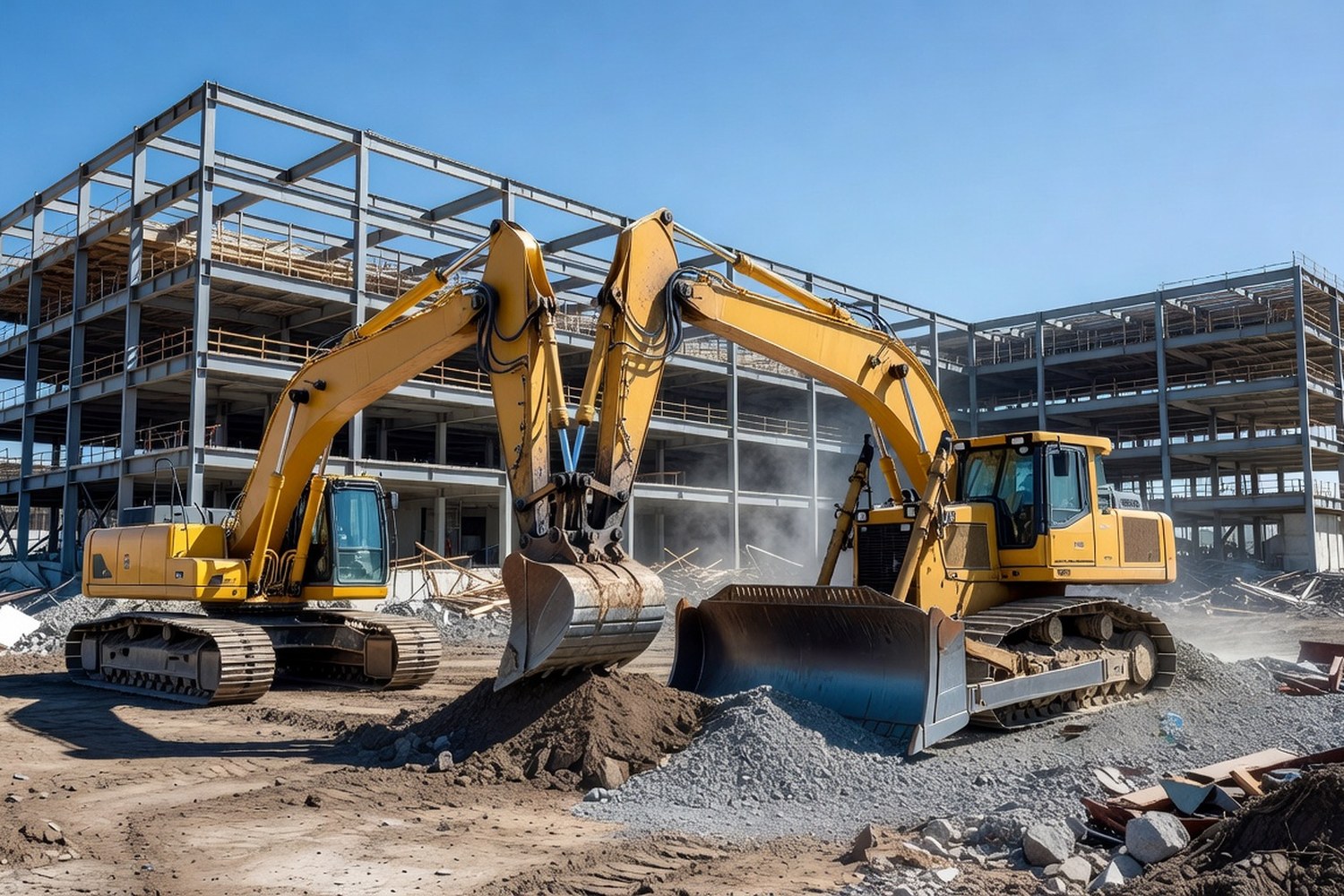
The numbers are stark. An excavator costs $100,000–$500,000. A concrete pump runs $200,000+. A fleet of work trucks is another $200,000–$400,000. Add materials, permits, insurance, bonding, and payroll for a crew of 15–50 workers, and the capital requirements make construction one of the hardest businesses to bootstrap without financing.
On top of that, construction revenue is seasonal and project-based. Residential builders see 40–60% of annual revenue between April and October. Commercial contractors may wait 60–90 days for progress payments after completing project milestones. This irregular cash flow pattern confuses conventional lenders who want to see steady monthly revenue — which is why construction-specialist financing matters.
6 Best Loan Types for Construction Companies
| Loan Type | Typical Rates | Amounts | Terms | Best For |
|---|---|---|---|---|
| Equipment Financing | 6–12% | Up to 100% of value | 3–7 yr | Excavators, trucks, cranes, concrete equipment |
| SBA 7(a) Loan | 9.75–13.25% | Up to $5M | 7–25 yr | Working capital, equipment, real estate, acquisition |
| SBA 504 Loan | ~5.7–5.9% fixed | Up to $5.5M | 10–20 yr | Commercial property, heavy fixed assets |
| Business Line of Credit | 8–24% | $10K–$500K | Revolving | Cash flow gaps, materials, payroll between payments |
| Short-Term Loan | 10–30% | $5K–$500K | 3–18 mo | Urgent project needs, bridge funding |
| Invoice Factoring | 1–5% per invoice | Up to 90% of receivables | Ongoing | Unlocking 60–90 day receivables immediately |
Rates are approximate ranges for qualified borrowers as of January 2026. Actual rates depend on creditworthiness, time in business, and loan structure.
Equipment Financing: The Backbone of Construction Lending
For most construction companies, equipment financing is the first and most frequent loan type they use. The structure is simple: the lender finances 80–100% of the equipment purchase price, the equipment itself serves as collateral (just like a car loan), and you repay over 3–7 years with fixed monthly payments.
What makes equipment financing particularly attractive for contractors is the self-collateralizing nature. You do not need to pledge your house, your savings, or any other business assets. The excavator you are buying IS the collateral. If you default, the lender repossesses the machine. This means approval is often faster and easier than other loan types, especially for businesses with shorter operating histories.
In the current rate environment, strong borrowers (680+ credit, 2+ years in business, solid revenue) see equipment financing rates of 6–12%. Newer businesses or those with credit challenges pay 12–20%. Many lenders offer 100% financing with no down payment for the best-qualified applicants. Used equipment is also financeable, though terms may be shorter and rates slightly higher than for new machinery.
The tax advantage is significant. Under Section 179, you can deduct the full purchase price of qualifying equipment in the year you buy it — up to $1,220,000 for tax year 2024 (adjusted annually for inflation). On a $250,000 excavator at a 25% tax bracket, that is a $62,500 tax savings in year one. Consult your CPA to determine how financing impacts your specific tax situation.
Before financing equipment, calculate the ROI per machine. If a $150,000 excavator allows you to bid on contracts worth $80,000–$120,000 per year in additional revenue — and the loan payment is $3,200/month ($38,400/year) — the equipment pays for itself within a year. Equipment that does not directly increase your bidding capacity or reduce subcontracting costs may not justify the debt.
Managing Seasonal Cash Flow With a Line of Credit
Construction cash flow is lumpy. You might collect $200,000 in June and $15,000 in January. Payroll, insurance, equipment payments, and yard rent do not follow the same seasonal pattern — they are due every month regardless of revenue. A business line of credit bridges these gaps without the commitment of a term loan.
With a line of credit, you have an approved borrowing limit ($50,000–$500,000 is typical for small-to-mid construction companies) that you draw from as needed and repay as cash comes in. You only pay interest on the amount you have drawn, not the full credit limit. During busy months when payments roll in, you pay down the line. During slow months, you draw on it to cover overhead.
Rates range from 8–24% depending on your credit profile and the lender. Some construction-specialist lenders offer seasonal payment structures — reduced minimum payments during Q1 winter months with higher payments during the Q2–Q3 building season. This alignment with actual construction cash flow patterns is a major advantage over rigid monthly payment schedules.
For contractors who are regularly waiting 60–90 days on progress payments, invoice factoring is another tool. A factoring company advances 80–90% of your outstanding invoices immediately, then collects the full amount from your client. The fee is 1–5% of the invoice value. On a $100,000 progress payment that would otherwise take 75 days, factoring gives you $85,000–$90,000 within 48 hours. Compare business loan options on our business loans page.

SBA Loans for Construction Companies
SBA loans offer the best long-term rates for construction companies that can meet the qualification standards. Two programs stand out:
SBA 7(a): Up to $5 million for equipment, working capital, real estate, or acquiring another construction company. Variable rates currently max at prime + 3–6.5% (roughly 9.75–13.25% with prime at 6.75%). The SBA recently expanded the 7(a) Working Capital Pilot Program specifically for homebuilders and contractors — project-based lines of credit up to $5 million with up to 100% financing of direct project costs.
SBA 504: Fixed rates around 5.7–5.9% for commercial real estate (your own office, warehouse, or yard) and heavy fixed assets. Requires only 10% down payment vs. 20–30% for conventional commercial mortgages. The fixed rate provides payment predictability that is especially valuable for long-term facility investments where variable rates would create budget uncertainty.
The trade-off: SBA loans take 4–12 weeks to close, require extensive documentation (tax returns, financial statements, business plans), and demand personal guarantees from any owner with 20%+ stake. For a deeper comparison of all SBA programs, see our SBA loans guide.
How to Qualify: What Construction Lenders Want to See
Time in business: Most lenders want 2+ years of operating history with filed tax returns. Startups can access SBA Microloans (up to $50K) or equipment financing (where the equipment is the collateral), but working capital loans and lines of credit typically require an established track record.
Revenue and backlog: Lenders evaluate both historical revenue (tax returns) and forward-looking pipeline (signed contracts, letters of intent). A $500,000/year contractor with $800,000 in signed contracts for the next 6 months is a stronger applicant than a $1M/year contractor with no backlog. Always present your project pipeline alongside your financials.
Credit score: Equipment financing starts at 600+ for some lenders. SBA 7(a) typically requires 680+. Online working capital lenders may accept 580+. The better your score, the lower the rate and the more options you have. Review our poor credit business loans guide if your score is below 620.
Bonding capacity: For construction companies that bid on bonded projects, your bonding capacity is directly linked to your financial strength — including your outstanding debt load. Before taking on new financing, evaluate whether the additional debt will affect your ability to secure performance bonds. Some lenders understand this relationship and structure loans to preserve bonding capacity.
Insurance and licensing: Lenders verify that your business carries adequate insurance (general liability, workers comp, equipment coverage) and holds all required state and local contractor licenses. Missing or lapsed coverage can delay or kill a loan application.
Build your loan application package before you need money. Have your accountant prepare financial statements quarterly, keep a running list of signed contracts and project backlog, and maintain an updated equipment list with current values. When an opportunity arises — a piece of equipment comes available or a large contract requires upfront capital — you can apply immediately with a complete package instead of scrambling to gather documents under deadline pressure.
How to Choose the Right Loan for Your Project
Buying equipment? Equipment financing. The machinery collateralizes itself, rates are competitive (6–12% for strong borrowers), and approval is often faster than other loan types. For equipment over $150,000, also get an SBA 7(a) quote — the rate may be lower for longer terms.
Buying commercial property (office, yard, warehouse)? SBA 504 is the clear winner. Fixed rates around 5.8%, 10% down, and 20-year terms. No other product comes close for owner-occupied commercial real estate.
Need working capital for a specific project? SBA 7(a) Working Capital Pilot for homebuilders and contractors (up to $5M). For non-SBA options, a business line of credit gives you flexible draw-and-repay access. For comparison, see our fast business loans page.
Waiting on progress payments? Invoice factoring unlocks 80–90% of your receivables within 48 hours. The 1–5% fee is often cheaper than the cost of missing payroll or delaying materials purchases while you wait 60–90 days for payment.
Need money in under a week? Short-term online business loans fund in 1–3 days but cost 15–30% APR. Use them as bridge financing, then refinance into an SBA or long-term business loan once you have time to go through the full underwriting process.
Frequently Asked Questions
What type of loan is best for a construction company?
It depends on the purpose. Equipment financing for machinery (self-collateralizing, 6–12% rates). SBA 504 for commercial real estate (fixed ~5.8%, 10% down). SBA 7(a) for working capital and general purposes (9.75–13.25%). Business line of credit for seasonal cash flow management (8–24% on drawn amount only).
Can a new construction company get a loan?
Yes, but options are more limited. Equipment financing is the easiest path for startups because the equipment serves as collateral. SBA Microloans (up to $50K) are available through community intermediaries. For larger amounts, you will need a strong business plan, personal credit above 680, and ideally some signed contracts or project commitments. See our SBA loans guide for startup paths.
How do I finance construction equipment?
Apply with an equipment financing lender (many specialize in construction). You will need: 2+ years in business (ideal), 600+ credit score, business bank statements, and details on the equipment you want to buy. Many lenders offer 100% financing for strong borrowers and can approve in 24–48 hours. The equipment itself serves as collateral.
What credit score do I need for a construction business loan?
Equipment financing: 600+ (some lenders accept lower). SBA 7(a): 680+ (some preferred lenders accept 650+). Online working capital: 580+. Business line of credit: 650+. The higher your score, the better your rate and the more options available to you.
How does seasonal cash flow affect construction loan approval?
Lenders familiar with construction expect seasonal fluctuations. Provide at least 2 years of bank statements and tax returns to show the full annual cycle. Highlight your peak revenue months and explain the seasonal pattern. Some lenders offer seasonal payment structures. Avoid applying during your slowest month if possible — recent bank statements showing strong deposits help your case.
References
- SBA.gov — Loan Programs
- SBA.gov — Working Capital Pilot for Homebuilders
- IRS — Section 179 Deduction