
Treasury Cash at the Fed Tops $967 Billion as Bank Reserves Hit 39-Week Low
Treasury held $967.9 billion at the Fed in the week ended September 2, a four month high, pulling bank reserves to $2.895 trillion, their lowest in 39 weeks.



Last Updated: March 2026
A FICO score of 650 puts you in what the credit industry calls “fair” credit territory — specifically the 580 to 669 range. You are above the “poor” threshold (below 580) but below “good” (670 and above). According to CFPB data, roughly 17 percent of Americans have FICO scores in this range.
Here is what that means in practical terms: you will get approved for personal loans from many mainstream lenders, but you will not get their best rates. Lenders view you as a moderate risk — statistically more likely to default than a 750-score borrower, but far more reliable than someone at 550. That risk assessment shows up directly in the APR you are offered.
The good news is that 650 is a workable score. You are not in the territory where you are limited to predatory lenders or forced into payday loans. Multiple reputable online lenders have built their business models around serving this exact credit band, and competition among them means you have real options to compare. The key is understanding what drives the rate you are offered and how to position yourself for the best possible terms.
One thing lenders at this tier look at closely beyond your score: your debt-to-income ratio. A borrower with a 650 score but a DTI under 30 percent will typically get a significantly better offer than someone with the same score carrying 45 percent DTI. Your income stability matters too — W-2 employment for two or more years signals lower risk than irregular freelance income, even at the same annual earnings.

Personal loan rates in early 2026 are coming down from their recent peaks, thanks to the Federal Reserve cutting rates three times in late 2025. The prime rate now sits at 6.75 percent, and with additional cuts expected this year, the overall rate environment is trending favorably for borrowers. But fair credit borrowers still pay a meaningful premium over those with higher scores.
Here is the realistic rate landscape for a 650 credit score in March 2026:
Best case (strong income, low DTI, established employment): 12–16% APR. This is the range if everything else about your application is solid and you are at the top end of the fair credit band (660–669).
Typical case (average income, moderate DTI): 16–22% APR. This is where most 650-score borrowers land. Still significantly better than credit card rates (averaging 21–24% APR), which makes personal loans a strong option for debt consolidation.
Higher risk (lower income, higher DTI, short credit history): 22–30% APR. At this level, you are approaching credit card territory and need to carefully evaluate whether the loan makes financial sense — especially after factoring in origination fees.
To put these numbers in real dollars: on a $10,000 personal loan with a 3-year term, the difference between 15% and 25% APR is dramatic. At 15%, your monthly payment is $347 and total interest is $2,480. At 25%, your monthly payment jumps to $397 and total interest hits $4,300 — nearly $1,820 more over the life of the loan. That gap is why comparison shopping is not optional at this credit tier. It is essential.
Pre-qualify with at least 3 lenders before choosing. Pre-qualification uses a soft credit pull that does not affect your score, and if you apply to multiple lenders within a 14-day window, the credit bureaus typically count it as a single inquiry. There is no reason not to shop around.
These lenders specifically serve fair credit borrowers and offer pre-qualification with no credit score impact. Rates and terms are current as of March 2026.
| Lender | APR Range | Loan Amounts | Min. Credit | Origination Fee | Best For |
|---|---|---|---|---|---|
| Upgrade | 7.74–35.99% | $1,000–$50,000 | 580 | 1.85–9.99% | Debt consolidation (direct pay to creditors) |
| Upstart | 7.80–35.99% | $1,000–$50,000 | 600 | 0–12% | Thin credit history, recent graduates |
| LendingClub | 8.98–35.99% | $1,000–$40,000 | 600 | 3–8% | Joint/co-borrower applications |
| Best Egg | 8.99–35.99% | $2,000–$50,000 | 600 | 0.99–9.99% | Secured loan option for lower rates |
| Prosper | 8.99–35.99% | $2,000–$50,000 | 640 | 1–9.99% | Peer-to-peer lending, flexible terms |
| Avant | 9.95–35.99% | $2,000–$35,000 | 580 | Up to 4.75% | Fast funding, low minimum requirements |
Rates from lender websites as of March 2026. Your actual APR will depend on credit score, income, DTI, and loan amount. All lenders offer pre-qualification with no credit score impact.
At the 650 credit level, small differences in your application can translate to big differences in your rate. These strategies can genuinely move the needle:
Check your credit reports for errors first. According to FTC research, roughly one in five credit reports contains an error significant enough to affect your score. Pull your free reports at AnnualCreditReport.com and dispute anything inaccurate. A single corrected error can boost your score 20 to 40 points — potentially enough to move you from fair to good credit territory, which opens up dramatically better rates.
Lower your credit utilization before applying. If you are using more than 30 percent of your available credit card limits, paying down those balances before applying for a personal loan can improve your score quickly. Credit utilization is the second most important factor in your FICO score after payment history. Dropping from 50 percent utilization to 25 percent can add 20 or more points within a billing cycle.
Consider a co-borrower or co-signer. LendingClub specifically offers joint loan applications where a co-borrower with better credit shares responsibility for the loan. This can significantly lower the APR you are offered. The trade-off: your co-borrower is equally liable for the debt, so choose someone who trusts you to make payments reliably.
Look into secured personal loans. Best Egg offers a secured option where you pledge collateral — typically a vehicle or, for homeowners, permanent home fixtures. Because the lender has something to recover if you default, secured loans typically carry APRs 2 to 5 percentage points lower than unsecured loans for the same borrower profile.
Use Upgrade’s direct pay feature for debt consolidation. If you are consolidating credit card debt, Upgrade can pay your creditors directly. Lenders often offer lower rates for direct pay because it eliminates the risk that you will borrow the consolidation loan and keep spending on your cards.

Fair credit borrowers are prime targets for lenders who load up loans with fees that can dramatically increase the true cost of borrowing. Watch for these carefully:
Origination fees above 6 percent. Most reputable lenders charge between 1 and 6 percent. An origination fee of 8 to 10 percent on a $10,000 loan means you receive only $9,000 to $9,200 but repay interest on the full $10,000. At the upper range, the fee alone adds hundreds of dollars to your cost. Always compare the APR — which includes fees — not just the interest rate.
Prepayment penalties. Most major online lenders (Upgrade, LendingClub, Upstart, Best Egg, Prosper) charge no prepayment penalties. If a lender penalizes you for paying off your loan early, that is a red flag. Prepayment penalties lock you into expensive debt even when you have the ability to eliminate it.
Mandatory add-on products. Some lenders push credit insurance, payment protection plans, or other add-on products during the application process. These are almost never worth the cost, especially on a personal loan with a fixed term. Decline them.
Payday loan alternatives disguised as personal loans. If the term is under 6 months, the APR exceeds 36 percent, or the lender does not report to credit bureaus, you are likely dealing with a high-cost short-term product, not a genuine personal loan. The CFPB provides resources to help identify predatory lending practices.
Always compare APR, not just the interest rate. The APR includes origination fees and gives you the true annual cost of borrowing. A loan with an 18% interest rate and a 6% origination fee has an APR significantly higher than 18% — and may actually cost more than a competing loan advertising a 20% rate with no origination fee.
Here is something many fair credit borrowers overlook: a personal loan, used strategically, is one of the most effective tools for building your credit score. It works through three mechanisms.
Payment history. This is the single biggest factor in your FICO score (35 percent of the total). Every on-time monthly payment on your personal loan gets reported to all three credit bureaus. Twelve months of perfect payments on a personal loan can improve your score by 30 to 50 points, potentially moving you from fair credit into the “good” range (670+) where lending terms improve dramatically.
Credit mix. FICO rewards having a diversity of credit types (10 percent of your score). If your credit history is entirely credit cards, adding an installment loan to the mix improves your credit profile. This alone can add 5 to 15 points.
Lower utilization through consolidation. If you use a personal loan to pay off high credit card balances, your credit card utilization drops immediately — even though your total debt stays the same. The scoring models treat installment debt (personal loans) differently from revolving debt (credit cards), and lower card utilization can boost your score 20 or more points within a month.
The combination of these three effects means that a well-managed personal loan can realistically raise a 650 score into the 700+ range within 12 to 18 months. At that point, you qualify for significantly better rates on everything — future personal loans, mortgages, auto loans, and credit cards.
Yes. A 650 score qualifies you for personal loans from multiple mainstream lenders including Upgrade (min. 580), Upstart (min. 600), LendingClub (min. 600), Best Egg (min. 600), and Avant (min. 580). Expect APRs between 15 and 26 percent depending on your income, debt-to-income ratio, and the lender.
Anything under 18 percent APR is a strong offer for a 650 credit score in 2026. The absolute best rates for this tier start around 12 to 15 percent for borrowers with strong income and low DTI. Rates above 25 percent are on the high end and worth comparing against other options before accepting.
Most lenders will approve loans up to $25,000 to $35,000 for borrowers with a 650 score, provided your income supports the monthly payments. Upgrade offers up to $50,000, but qualifying for the maximum typically requires a higher score or a co-borrower. For amounts above $35,000, improving your score to 680 or above before applying significantly improves your options.
Pre-qualifying uses a soft credit pull that has zero impact on your score. Only when you formally accept a loan offer does the lender run a hard inquiry, which typically reduces your score by 2 to 5 points temporarily. If you apply with multiple lenders within a 14 to 45 day window, credit bureaus typically count it as a single inquiry for scoring purposes.
A balance transfer card with 0 percent intro APR is better if you can pay off the full balance within the introductory period (typically 12 to 18 months) and qualify for the card. A personal loan is better for larger balances that need 3 to 5 years to pay down, or if your credit score is too low to qualify for the best balance transfer cards (most require 670+).
Focus on the APR (which includes fees), not just the interest rate. Then compare total cost over the full term, monthly payment amount, origination fee, prepayment penalties (avoid lenders that charge them), and whether the lender reports to all three credit bureaus. Pre-qualify with at least 3 lenders and choose the offer with the lowest total cost for the payment amount you can comfortably afford.
Treasury held $967.9 billion at the Fed in the week ended September 2, a four month high, pulling bank reserves to $2.895 trillion, their lowest in 39 weeks.

The U.S. prime rate has held at 6.75% for 270 days. After August payrolls rose 162,000, futures price roughly even odds of a hike on September 16.

Treasury sells $119 billion of notes and bonds on September 8, 9 and 10 while the Fed observes its pre-meeting blackout. The three-year yields 4.45%.

U.S. employers added 162,000 jobs in August and the BLS revised June and July up by a combined 55,000, erasing the reported July decline days before the September 15-16 FOMC meeting.
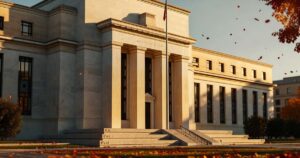
Fed Governor Christopher Waller said he would back a September hold if August inflation keeps cooling, citing three-month core inflation of 3.05 percent, and a hike if it does not.

The Fed’s September 2 Beige Book found prices increased moderately in eight of twelve Districts, with the pace unchanged in eight and slower in only three.