
- An in-ground pool costs $35,000-$100,000+ depending on type, size, and features — concrete/gunite averages $50,000-$80,000, fiberglass $30,000-$60,000, and vinyl liner $25,000-$45,000
- Personal loans are the fastest, safest pool financing: no collateral, 1-3 day funding, fixed rates from 6-36% — LightStream offers home improvement rates starting at 6.49% with terms up to 12 years
- A home equity loan or HELOC is worth considering only for pools over $50,000 with 20%+ equity — below that, closing costs ($2,000-$5,000) eat the interest rate savings
- Pool contractor financing through Lyon Financial or HFS sounds convenient, but always compare their rate to a personal loan pre-qualification — you may save 2-4% APR by going direct to a lender
- Budget 15-25% over the base pool quote for surprises: soil conditions, rock removal ($5,000-$15,000), permit fees ($500-$2,500), fencing requirements ($3,000-$8,000), and the landscaping repairs you’ll need after the excavator tears up your yard
What Swimming Pools Actually Cost
The pool builder’s quote is where the sticker shock begins — but it’s not where it ends. Every homeowner I’ve talked to who built a pool says the same thing: the final cost was 20-40% higher than the original quote. Not because the builder was dishonest, but because pools involve excavation, and excavation involves discovering what’s actually in your soil. Rock, high water tables, clay, root systems, buried utilities — the surprises are literally underground.
Here’s the baseline by pool type. Vinyl liner pools are the budget option: $25,000-$45,000 installed for a standard 12×24 or 16×32 rectangular pool. The shell is a steel or polymer frame with a vinyl liner that needs replacement every 7-12 years ($3,000-$5,000 each time). Fiberglass pools run $30,000-$60,000 — a pre-formed shell that’s dropped into the excavated hole. Fastest installation (2-4 weeks), lowest maintenance, but you’re limited to the manufacturer’s shapes and sizes. Concrete/gunite pools are the premium option: $50,000-$80,000 base for a standard size, and they can hit $100,000-$150,000+ with custom shapes, tanning ledges, spillover spas, and water features. Fully customizable, lasts 50+ years, but takes 3-6 months to build.
Now add the costs that aren’t in the base quote. Fencing: required by code in every state, typically $3,000-$8,000 for aluminum or wrought iron that meets the 4-foot minimum height and self-closing gate requirements. Electrical: a dedicated 240V circuit for the pump, heater, and lights runs $1,500-$3,000. Permits: $500-$2,500 depending on your municipality. Landscaping repair: the excavator will destroy your yard, driveway edge, and possibly your sprinkler system — budget $2,000-$5,000 to put it all back. And the one that catches everyone: pool equipment. The pump, filter, heater, salt system, automation controls, and pool cover are often quoted separately from the shell — together they add $5,000-$15,000.
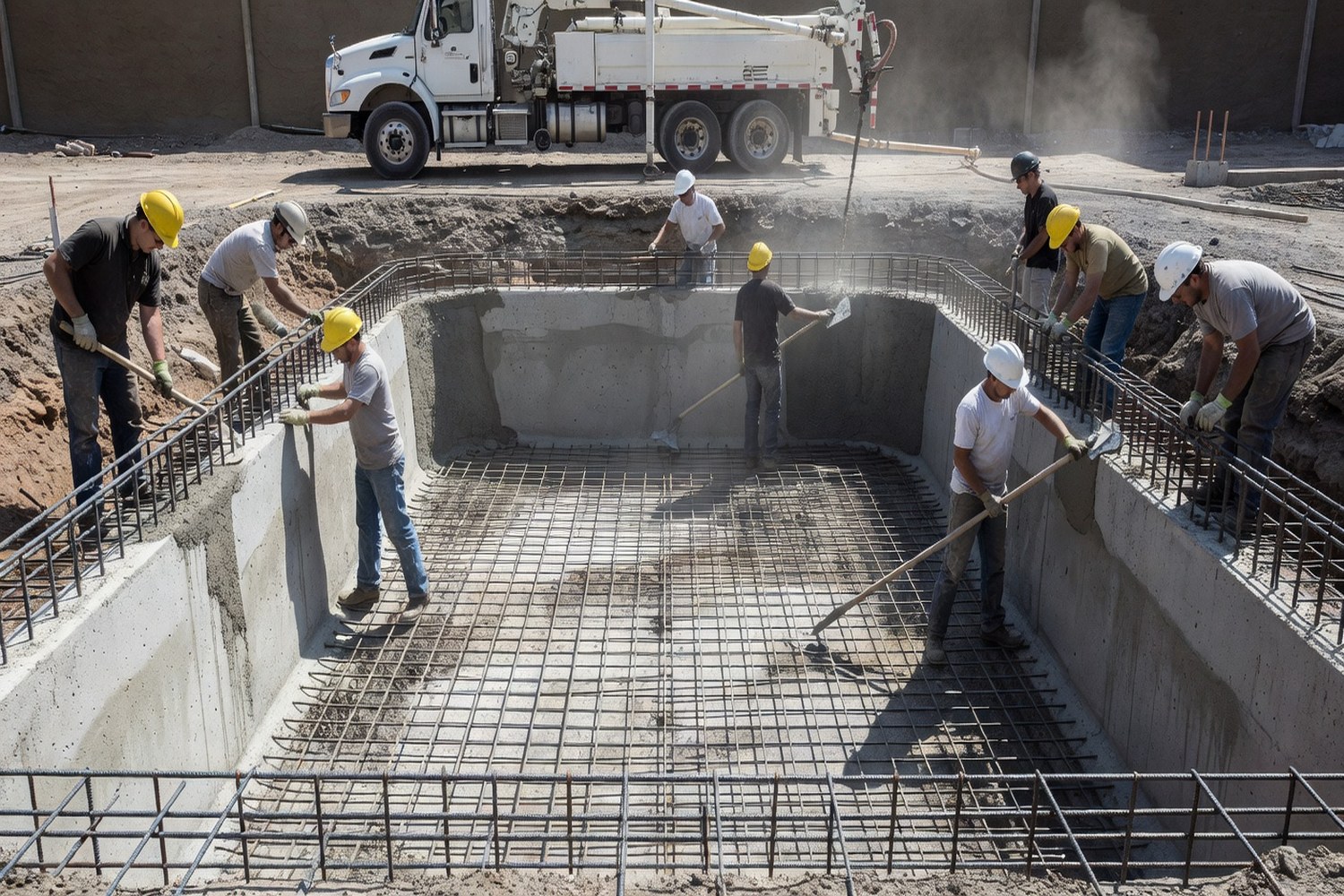
Gunite pool construction involves rebar, shotcrete, plumbing, and weeks of curing — the most expensive pool type, but fully customizable and built to last 50+ years.
Financing Options Ranked
1. Personal loan (best for pools under $75K, which covers most projects). The workhorse of pool financing. No collateral — your home isn’t at risk if the project goes over budget or your financial situation changes mid-build. Fixed rates from 6-36% depending on credit. Terms of 2-12 years (LightStream goes to 12 for home improvement). Funding in 1-3 days. On a $50,000 gunite pool at 8% over 84 months: $781/month, $15,567 total interest. The application takes 15 minutes, and most lenders offer soft-pull pre-qualification so you can see your rate before committing.
2. Home equity loan (best for $50K+ pools when you have significant equity). If you’ve built 20%+ equity in your home, a home equity loan at 7-9% fixed can save meaningful money on large pool projects. On the same $50,000 at 7.5% over 120 months: $594/month, $21,253 total interest. Lower monthly payment, but you pay more total interest because of the longer term — and your home is collateral. Closing costs of $2,000-$5,000 apply. The breakeven point where equity loan savings offset closing costs is roughly $40,000-$50,000.
3. HELOC (best for uncertain scope or phased pool projects). If you’re building the pool now but adding the patio, landscaping, and outdoor kitchen over the next year, a HELOC’s revolving credit line lets you draw funds as each phase starts. Variable rates of 7-9% for strong credit. Draw period of 10 years, repayment of 20. The flexibility is the advantage — but variable rate risk and your home as collateral are real downsides.
4. Pool company financing (compare carefully). Specialty pool lenders like Lyon Financial, HFS Financial, and Viking Capital offer pool-specific loans with terms up to 20 years. HFS advertises fixed rates from 7.8%. Lyon Financial markets itself as the industry standard. These can be convenient — the pool builder handles the application — but the rates are often 1-3% higher than what you’d get applying directly to LightStream or SoFi. Always pre-qualify with a personal loan lender first, then compare. The convenience premium might cost $3,000-$8,000 over the life of a $50,000 pool loan.
5. Cash-out refinance (only in specific circumstances). Replacing your current mortgage with a larger one and taking the difference as cash. This only makes sense if: (a) current mortgage rates are at or below your existing rate, (b) you need $75,000+, and (c) you plan to stay in the home 10+ years. Closing costs of 2-5% of the entire new loan amount, 4-6 weeks to close, and you’re extending your mortgage for a swimming pool. For most homeowners, a personal loan or home equity loan is the better math.
Lender Comparison Table
| Lender | APR Range | Loan Amount | Term | Min. Credit | Best For |
| LightStream | 6.49%-25.49% | $5K-$100K | 2-12 years | ~695 | Lowest rate, no fees |
| SoFi | 8.74%-29.99% | $5K-$100K | 2-7 years | 680 | Unemployment protection |
| Upgrade | 8.49%-35.99% | $1K-$50K | 2-7 years | 580 | Fair/bad credit |
| HFS Financial | 7.8%-20%+ | $5K-$300K | 1-20 years | Varies | Pool-specific, long terms |
| Home Equity Loan | 7%-9% fixed | Up to 85% LTV | 5-30 years | 680 | Large pools with equity |
Rates reflect general ranges as of early 2026. Your rate depends on credit, income, and loan amount. Pre-qualify to compare specific offers.
Best Personal Loans for Pools
LightStream — the clear winner for good-credit pool buyers. Their home improvement category starts at 6.49% with autopay, and the 12-year term is crucial for pool financing. A $60,000 gunite pool at 7% over 144 months: $539/month. Compare that to a 60-month term at the same rate: $1,188/month. The longer term cuts the payment by more than half — making an otherwise unaffordable pool manageable. Zero fees of any kind. Same-day funding. And their $100,000 maximum covers all but the most extravagant pool projects. The catch: need roughly 695+ credit to qualify. No soft-pull pre-qualification on their site — use Credible to check first.
SoFi — best safety net for a 3-6 month construction project. Pool builds are long, messy, and occasionally disruptive enough to affect your work (try doing conference calls while a jackhammer breaks rock 30 feet from your home office). SoFi’s unemployment protection pauses payments up to 12 months if you lose your job during the chaos. Rates start at 8.74%, no origination fee, $100K max. On $45,000 at 9% over 84 months: $726/month.
Upgrade — the option for 580-699 credit. Pool dreams don’t require perfect credit. Upgrade accepts scores as low as 580 with multiple rate discounts. The $50,000 maximum covers fiberglass and vinyl liner pools comfortably, and smaller gunite projects. Origination fee (1.85-9.99%) is deducted from proceeds. On $40,000 at 14% over 84 months: $703/month, $19,071 total interest. Expensive, but still cheaper than a pool company’s 18-20% financing for the same credit tier.

Pre-qualify with 2-3 lenders before your builder meeting — knowing your rate gives you leverage to evaluate pool company financing honestly.
When Home Equity Makes Sense
The math on personal loan vs. home equity for pools is different than for smaller home improvement projects — because pool costs are higher and loan terms are longer, the rate difference compounds significantly.
At $35,000 (fiberglass or vinyl liner): Personal loan at 8% over 84 months = $547/month, $10,927 total interest, $0 closing costs. Home equity loan at 7% over 120 months = $407/month, $13,771 total interest, $3,000 closing costs. Despite the lower rate, the equity loan costs more total because the longer term accumulates more interest. And you’ve risked your home. Personal loan wins.
At $60,000 (midrange gunite): Personal loan at 8% over 84 months = $937/month, $18,733 total interest. Home equity at 7% over 120 months = $696/month, $23,553 total interest, $3,500 closing. The equity loan still costs more in total, but the monthly payment is $241/month lower. If cash flow matters more than total cost, the equity loan starts looking attractive. Depends on your priority.
At $80,000+ (premium gunite with features): Personal loan at 8% over 84 months = $1,249/month — a payment most households can’t sustain. Home equity at 7% over 180 months = $719/month, far more manageable but $49,400 total interest. At this level, the home equity loan’s longer term and lower monthly payment make it the practical choice — you’re financing a permanent addition that adds value to the property it’s secured against. Home equity wins on cash flow.
Hidden Costs Nobody Warns You About
Rock removal: $5,000-$15,000. Your soil survey said “some rock.” When the excavator hits it, “some” turns into a ledge that requires a hydraulic breaker to remove. Rock removal is the single biggest surprise cost in pool construction. Some builders include a rock clause in their contract capping their responsibility — read it carefully. If the clause says “rock removal billed at $1,200/day plus disposal,” and it takes 5 days, that’s $6,000 you didn’t budget. Ask every builder: what happens if we hit rock? Get the answer in writing.
High water table: $2,000-$5,000. In many coastal and low-lying areas, the water table is only 3-4 feet below grade. Excavating a 6-foot-deep pool means pumping ground water continuously during construction (dewatering) and installing a hydrostatic relief valve in the finished pool. Both add cost, and dewatering can delay the project by weeks if the groundwater flow is heavy.
Annual operating costs: $3,000-$6,000. This isn’t a hidden cost of financing, but it changes the affordability calculation dramatically. Electricity for the pump ($75-$150/month), chemicals ($50-$100/month), water to fill and top off ($200-$500/year), opening/closing service ($300-$600/year), and equipment repairs. A $50,000 pool with a $781/month loan payment actually costs $1,031-$1,281/month when you add operating expenses. Make sure your budget accounts for both.
Insurance premium increase: $300-$800/year. Your homeowners insurance will go up because a pool increases liability risk. An umbrella policy ($200-$400/year for $1M coverage) is also strongly recommended — one accident in the pool can produce a lawsuit that exceeds your homeowners liability limits.
How to Finance Your Pool
Step 1: Get 3 builder quotes with identical scope. Specify pool type, size, depth, equipment package, decking (concrete, pavers, or travertine), fencing, electrical, and permits. Make sure each quote includes — or explicitly excludes — the same items. The price spread between builders can be 20-40% for identical pools.
Step 2: Add 20% contingency for site surprises. Your financing amount = highest quote × 1.20. If the average quote is $55,000, apply for $66,000. The contingency covers rock removal, dewatering, soil issues, permit complications, and the inevitable “while we’re at it” upgrades you’ll want once construction starts. Borrowing 20% extra at 8% costs $1,056 in interest per year on the surplus — far less than the cost of a second loan mid-project.
Step 3: Pre-qualify at 2-3 lenders (soft pull). LightStream (via Credible), SoFi, and one pool-specific lender like HFS. Compare APR, monthly payment, term options, and total cost. This takes 20-30 minutes and can save $5,000-$10,000 over the life of the loan.
Step 4: Compare personal loan rate vs. builder financing vs. HELOC. Calculate total cost for each. If the builder offers financing through Lyon or similar, ask for the exact APR and total interest — not just the monthly payment. A lower monthly payment on a 20-year term can cost double the total interest of a 10-year personal loan.
Step 5: Fund, sign the contract, and establish a payment schedule. Pool contracts typically use a milestone payment structure: 10-20% deposit, payments at excavation, plumbing/electrical, gunite/shell, interior finish, and final balance on completion. Never pay more than 10-20% before work begins, and hold 10% until the punchlist is complete. Your personal loan funds go directly to your bank account — you control when and how the builder gets paid.
Frequently Asked Questions
What’s the best way to finance a swimming pool?
A personal loan from LightStream (6.49%+ for good credit, up to $100K, 12-year terms) or SoFi (unemployment protection) for pools under $75K. For pools over $50K with significant home equity: a home equity loan offers lower monthly payments but longer repayment. Always pre-qualify before accepting pool company financing.
How much does an in-ground pool cost?
Vinyl liner: $25,000-$45,000. Fiberglass: $30,000-$60,000. Concrete/gunite: $50,000-$80,000 base, $100,000-$150,000+ with custom features. Add 20% for site surprises (rock removal, fencing, permits, landscaping repair, equipment).
Can I get a pool loan with bad credit?
Yes. Upgrade accepts 580+ credit scores up to $50K. HFS Financial works with various credit profiles up to $300K. Expect 14-25% APR at lower credit tiers. On $40,000 at 18% over 84 months: $756/month, $23,495 total interest. Consider whether improving credit first would save more than the wait costs.
Is a pool a good investment?
Pools typically add 5-8% to home value in warm-climate markets and less in cold climates. The ROI is lower than kitchens or bathrooms. A pool is primarily a lifestyle investment — the financial return rarely covers the full installation and operating costs. Finance it as a quality-of-life decision, not an investment decision.
How long does it take to build an in-ground pool?
Fiberglass: 2-4 weeks from excavation to swim. Vinyl liner: 4-8 weeks. Concrete/gunite: 3-6 months. Weather, permits, and site conditions can extend any timeline. Factor this into your financing — you’ll be making payments for weeks or months before the first swim.
References
- CPSC, “Pool and Spa Safety,” cpsc.gov
- CFPB, “What Is a Home Equity Loan?” consumerfinance.gov
- IRS, “Publication 936: Home Mortgage Interest Deduction,” irs.gov
Keep Reading
- Best Personal Loans: Compare Rates & Apply Online
- Best Home Improvement Loans & Financing
- Best Hot Tub Financing Options
- Best Personal Loans for Good Credit
- Best Personal Loans for Fair Credit
Rates and terms are subject to change. This is not financial advice. All information is for educational and comparison purposes only. Pool cost estimates based on national averages as of early 2026. Always get multiple builder quotes and verify current lender rates before committing to financing.