
- $3,000 is a microloan — too small for most banks and SBA 7(a) lenders, but perfectly sized for SBA microloans (8-13% APR through nonprofit intermediaries), Kiva (0% interest, crowdfunded), and online lenders like Fundbox and Bluevine
- SBA microloans are the best deal at $3,000: rates of 8-13%, terms up to 6 years, and many intermediaries accept credit scores as low as 575-620 — plus you often get free business coaching included
- A business credit card with a 0% intro APR is often the simplest path to $3,000 — no application process beyond card approval, 0% interest for 12-21 months, and you build business credit simultaneously
- At $3,000, the total interest even at high rates is manageable: 25% APR over 12 months costs $417 in interest ($3,417 total) — the real danger isn’t the rate, it’s getting trapped in revolving debt that never gets paid down
- Avoid merchant cash advances and payday-style products for $3,000 — their effective APRs (100-400%+) can turn a $3,000 need into $4,500-$6,000 in repayment within months
Who Needs a $3,000 Business Loan
Three thousand dollars doesn’t sound like much in the business lending world — and that’s exactly why it’s hard to find. Banks don’t want to underwrite a $3,000 loan because the processing cost often exceeds their profit on the interest. Most SBA 7(a) lenders won’t bother with amounts this small because the guarantee fee barely covers the paperwork. So the businesses that need $3,000 find themselves in a frustrating gap: the amount is too large for a personal credit card cash advance (expensive and risky), but too small for any lender to get excited about.
And yet, $3,000 is exactly what a lot of small and micro-businesses need. The food truck operator who needs to replace a broken refrigeration unit before the weekend market. The freelance photographer who needs a new lens and a website refresh. The Etsy seller who needs to stock up on materials before the holiday season. The lawn care business that needs a commercial mower to replace the residential one that just died. These aren’t luxury purchases — they’re revenue-critical investments where every day without the capital is a day of lost income.
The good news: there are legitimate, affordable paths to $3,000 for small businesses. The bad news: the most heavily advertised options (merchant cash advances, online “fast funding” products) are also the most expensive. A $3,000 MCA with a 1.4 factor rate costs you $4,200 in total repayment — $1,200 in fees for borrowing $3,000 for 3-6 months. That’s an effective APR north of 80%. Meanwhile, an SBA microloan at 10% over 2 years costs $3,318 total — $318 in interest. Same money, $882 difference. At $3,000, choosing the wrong product can cost you 30-40% of the loan amount in unnecessary fees.

At $3,000, the wrong funding source can cost you 30-40% of the loan in unnecessary fees — always compare before borrowing.
Best Options for $3,000
1. Business credit card with 0% intro APR (cheapest). If you have decent personal credit (670+), a business credit card with a 0% introductory APR for 12-21 months is hands-down the cheapest way to access $3,000. You charge the expense, pay it off within the promo period, and the total cost is $0 in interest. Cards to look at: Chase Ink Business Unlimited (0% for 12 months), American Express Blue Business Cash (0% for 12 months), Capital One Spark Cash Plus. Bonus: you build business credit history simultaneously. The risk: if you don’t pay it off before the promo ends, the regular APR (18-26%) kicks in.
2. Kiva — 0% interest, crowdfunded. Kiva is a nonprofit that offers interest-free microloans up to $15,000. You apply, invite your personal network to fund a portion (proving creditworthiness), then Kiva opens it to their broader lending community for 30 days. Repayment: up to 36 months. The catch: the process takes 3-6 weeks from application to funding, and you need a network willing to contribute. But if you can wait, $3,000 at 0% over 36 months is free money — your payment is just $83/month with zero interest.
3. SBA Microloan — 8-13% APR. SBA microloans go up to $50,000 (average is $13,000), so $3,000 is well within range. These are administered by nonprofit community lenders — not banks — which means more flexible qualification. Rates: 8-13%. Terms: up to 6 years. Credit requirements vary by intermediary, but many accept 575-620. The added benefit: many microlenders include free business training, mentoring, and technical assistance. Timeline: 30-60 days. Find intermediaries in your area via the SBA microlender directory at sba.gov.
4. Community Development Financial Institution (CDFI). CDFIs are nonprofit lenders focused on underserved communities and small businesses. Many offer microloans starting as low as $500. Rates are typically 5-15% — competitive with SBA microloans. Organizations like Grameen America (for women entrepreneurs, starting at $2,500), Accion Opportunity Fund ($5K-$250K), and LiftFund serve specific populations and geographies. CDFIs often have the most flexible qualification criteria of any legitimate lender.
5. Online business line of credit — 10-35%. Fundbox (lines up to $150K, 3+ months in business required) and Bluevine (up to $250K, 2+ years preferred) offer revolving credit you can draw $3,000 from as needed. You only pay interest on what you draw. For a $3,000 draw at 15% repaid over 6 months, total interest is about $134. The advantage: once approved, you can draw again without reapplying. Useful for businesses with recurring small-capital needs.
6. Personal loan for business use. If your business is a sole proprietorship or you’re just starting out, a personal loan from SoFi ($5K minimum), LendingClub ($1K minimum), or Upstart ($1K minimum) can fund a $3,000 business expense. Rates: 8-36% depending on credit. The trade-off: the debt appears on your personal credit report, not your business credit. For sole proprietors, this is often fine. For LLCs or corporations, keep business and personal borrowing separate.
Comparison Table
| Option | Rate / Cost | Term | Speed | Min. Credit | Total Cost on $3K |
| 0% APR Biz Card | 0% (12-21 mo) | Revolving | Instant | 670+ | $3,000 |
| Kiva | 0% | Up to 36 mo | 3-6 weeks | None | $3,000 |
| SBA Microloan | 8%-13% | Up to 6 yr | 30-60 days | 575+ | $3,318 (10%/2yr) |
| CDFI | 5%-15% | 1-5 yr | 2-6 weeks | Varies | $3,241 (8%/2yr) |
| Online LOC | 10%-35% | Revolving | 1-3 days | 600+ | $3,134 (15%/6mo) |
| MCA (avoid) | 1.2-1.5x factor | 3-12 mo | 1-2 days | 500+ | $3,600-$4,500 |
Total cost estimates for a $3,000 borrowing amount at representative rates. March 2026.
What $3,000 Actually Costs
At $3,000, the total interest in dollar terms is small enough that some borrowers don’t bother comparing. That’s a mistake — because the percentage differences are enormous, and predatory products at this size can cost you 20-50% of the loan in fees.
0% APR credit card (12 months): $250/month. Total interest: $0. Total cost: $3,000. This is free money if you pay it off before the promo expires. If you miss the deadline and the rate jumps to 22%, the remaining balance starts accruing interest at that rate immediately.
SBA microloan at 10% over 2 years: $138/month. Total interest: $318. Total cost: $3,318. For a micro-business doing $2,000+/month in revenue, the $138 payment is barely noticeable. And the 2-year term means you’re building a 24-month payment history with an SBA-affiliated lender — which strengthens your profile for future, larger borrowing.
Online line of credit at 20% over 12 months: $278/month. Total interest: $332. Total cost: $3,332. Not drastically different from the SBA microloan in total cost, but you get the money in 1-3 days instead of 30-60. The speed premium at $3,000 is relatively small in dollar terms.
Merchant cash advance at 1.35 factor rate (avoid): Daily payments, typically repaid in 4-6 months. Total repayment: $4,050. That’s $1,050 in fees on $3,000 — a 35% cost of capital in under 6 months, equivalent to roughly 80-100% APR. For $3,000, there is almost never a legitimate reason to use an MCA when an SBA microloan, credit card, or online line of credit exists.
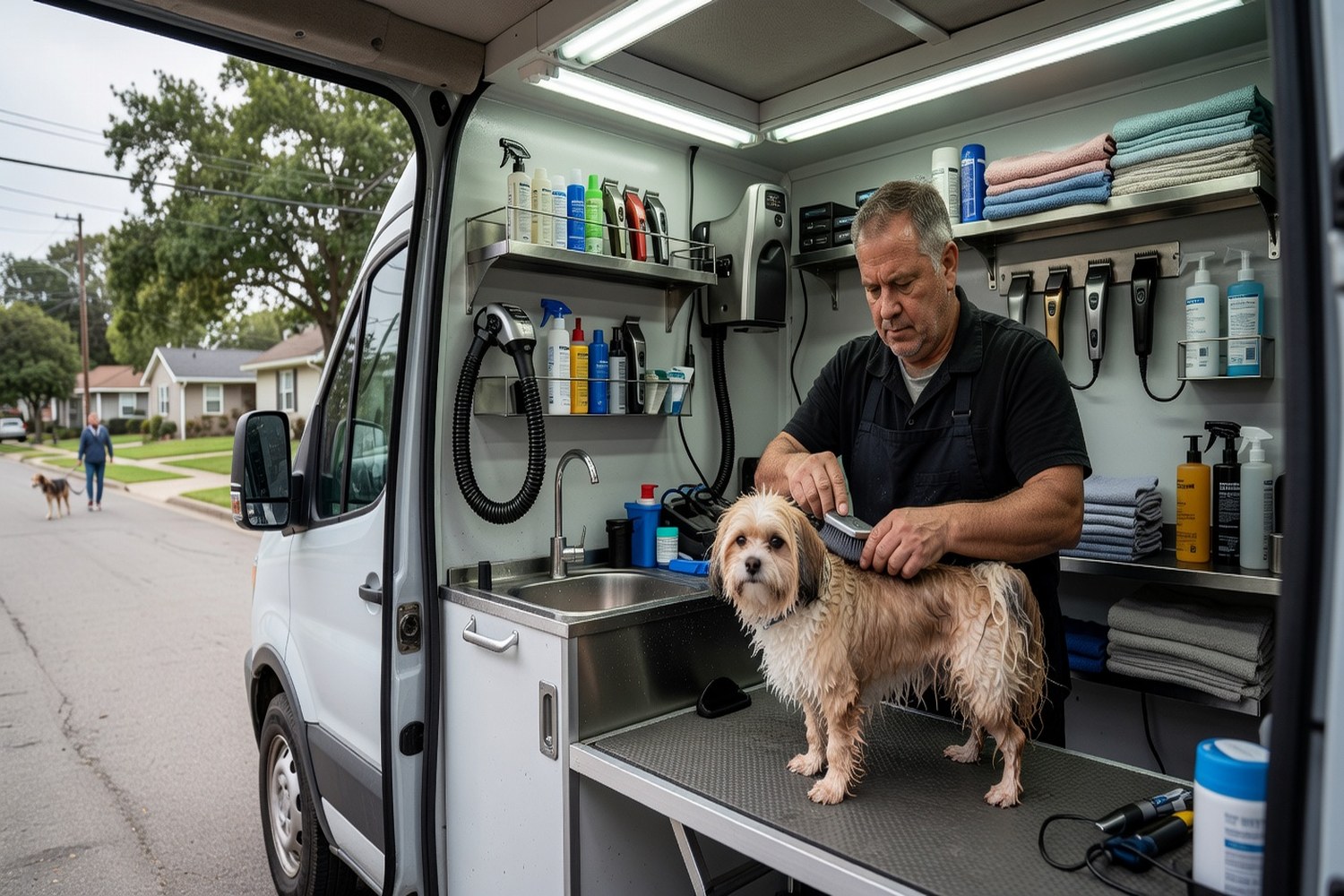
Mobile service businesses — grooming, cleaning, landscaping, photography — are the most common users of $3,000 microloans for equipment and supply purchases.
How to Qualify
Credit score. The bar at $3,000 is lower than any other loan amount on this site. SBA microloan intermediaries accept 575-620. Kiva has no credit score requirement at all. Online lines of credit start at 600. Business credit cards need 670+. If your score is above 600, you have multiple options. Below 575, Kiva and some CDFIs are still accessible.
Time in business. SBA microloans and CDFIs work with startups — even pre-revenue businesses in some cases. Kiva explicitly serves startups. Online lenders like Fundbox need 3+ months of operating history. Business credit cards typically want 1+ year, though some approve new businesses based on personal credit alone. At $3,000, the time-in-business barrier is the lowest of any business financing amount.
Revenue. Many microlenders don’t have hard revenue minimums at $3,000. They want to see that you have a plausible path to repaying $100-$200/month — which could be personal income, a side gig, or a startup with initial sales. Online lenders typically want $10,000+/month in revenue for their lines of credit, so if you’re pre-revenue, skip online and go straight to SBA microloan, Kiva, or CDFI.
Documentation. Lighter than any other loan size. SBA microloans: personal ID, basic business plan (1-2 pages is often sufficient), personal financial statement, and bank statements. Kiva: online application, social network for crowdfunding phase. Online LOC: link your bank account (automated revenue verification), basic business info. Business credit card: standard credit card application.
What to Avoid at $3,000
Merchant cash advances. An MCA is not a loan — it’s a purchase of your future revenue at a discount. A $3,000 MCA with a 1.35 factor rate means you repay $4,050 via daily deductions from your bank account. That’s $1,050 in fees, often over 3-6 months. Effective APR: 80-150%. There is no scenario where an MCA makes sense for $3,000 when SBA microloans, 0% credit cards, and Kiva exist.
Payday-style business loans. Products marketed as “same-day business funding” or “business cash advances” with daily or weekly repayment schedules. These often carry factor rates of 1.2-1.5x and effective APRs of 50-300%. At $3,000, you could end up repaying $3,600-$4,500 within weeks. The speed isn’t worth it when a business credit card provides the same $3,000 instantly at 0% APR.
Stacking multiple small loans. Some businesses take a $3,000 advance, then another $2,000, then another $3,000 — each from a different online lender. Each carries daily payments that compound into an unmanageable total. This “debt stacking” pattern is one of the most common paths to small business failure. If you need $3,000, borrow $3,000 from one source. Don’t layer.
How to Get the Money
Fastest path (same day): Business credit card. Apply online for a 0% intro APR business credit card. If approved (decisions are usually instant), you can use the card immediately for purchases or request a convenience check for cash. Total time: 10 minutes to apply, instant access upon approval.
Fast path (1-3 days): Online line of credit. Apply at Fundbox or Bluevine. Link your business bank account for automated verification. If approved, draw $3,000 to your bank account in 1-3 business days. Monthly payments begin 30 days after the draw.
Cheapest path (30-60 days): SBA microloan. Find intermediaries in your state via sba.gov/microloans. Contact 2-3 intermediaries, compare rates and terms, and apply with the one that best fits your needs. Prepare a simple business plan, personal financial statement, and bank statements. Timeline: 30-60 days from application to cash in hand.
Free path (3-6 weeks): Kiva. Apply at kiva.org. Invite your network to fund a portion (15-day window). Kiva opens the loan to their lending community for 30 days. If fully funded, money is disbursed to your bank account. Repayment: up to 36 months at 0% interest. Total cost: $0.
Frequently Asked Questions
What’s the easiest way to get $3,000 for my business?
A business credit card with 0% intro APR — apply online, get instant approval if your personal credit is 670+, and use the card immediately. For lower credit scores, Kiva (no minimum) or SBA microloans (575+) are the most accessible.
Can I get a $3,000 business loan with bad credit?
Yes. SBA microloan intermediaries accept 575-620. Kiva has no credit requirement. Some CDFIs work with borrowers who have credit challenges. Online lenders start at 600. Avoid MCAs and payday-style products even if they approve you — the cost is devastating at this size.
How much does a $3,000 business loan cost?
0% APR credit card: $0 in interest. SBA microloan at 10% over 2 years: $318 total interest. Online LOC at 20% over 12 months: $332. MCA at 1.35 factor: $1,050 in fees. The range is $0 to $1,050+ — product choice matters enormously at this size.
Is $3,000 too small for an SBA loan?
Not for SBA microloans — the average SBA microloan is $13,000, and they fund as low as $500. It IS too small for SBA 7(a) — most 7(a) lenders have minimum amounts of $25,000-$50,000. For $3,000, go directly to the SBA microloan program.
Should I use a personal loan for a $3,000 business expense?
For sole proprietors: yes, it’s a reasonable option. LendingClub and Upstart start at $1,000. The debt goes on your personal credit report but at $3,000, the impact is minimal. For LLCs or corporations: keep business and personal borrowing separate to maintain the corporate veil.
References
- SBA, “Microloan Program,” sba.gov
- SBA, “List of Microlenders,” sba.gov
- Kiva, “Small Business Loans,” kiva.org
- CDFI Fund, “What Are CDFIs?” cdfifund.gov
Keep Reading
- Best Small Business Loans: Compare Rates & Apply Online
- SBA Loans: Compare 7(a), 504 & Microloan Programs
- Small Business Loans From $50K to $100K
- Bad Credit Small Business Loans
- Emergency Small Business Loans
Rates and terms are subject to change. This is not financial advice. All information is for educational and comparison purposes only. SBA microloan rates based on 2026 intermediary data. Always compare multiple options and verify current terms directly before borrowing.