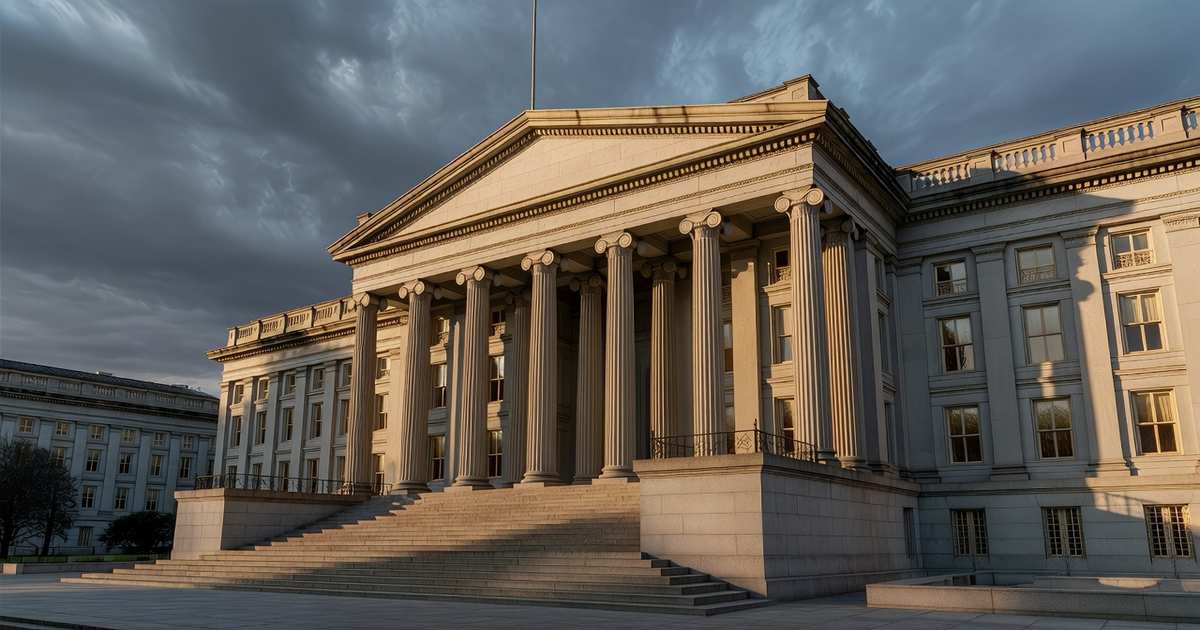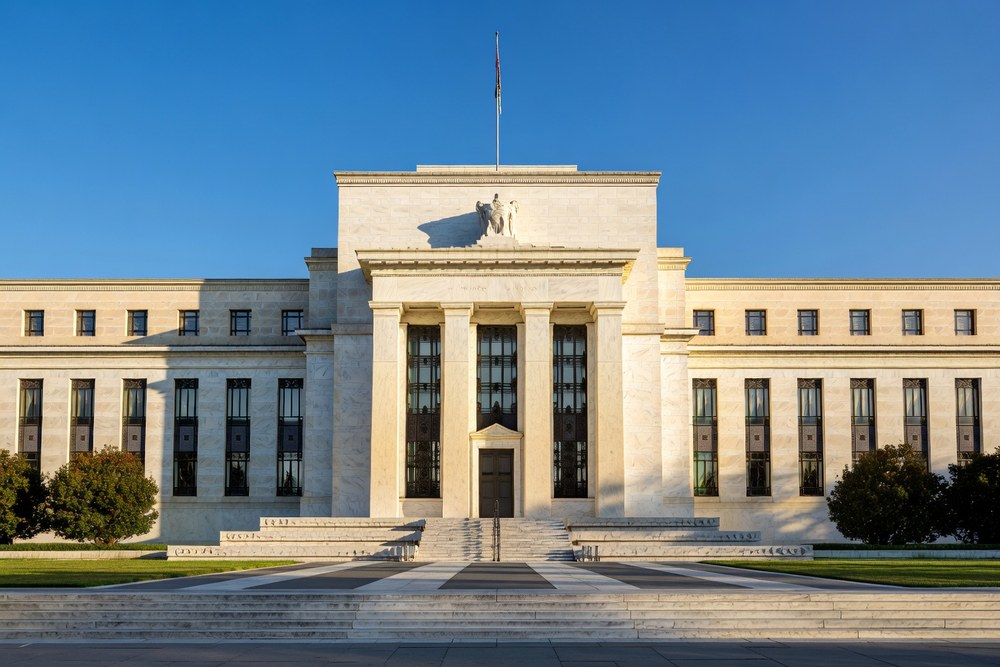
Quantitative tightening (QT) is the process by which the Federal Reserve shrinks its balance sheet — letting Treasury securities and mortgage-backed securities mature without reinvestment, which removes reserves from the banking system. The Fed ran a QT program from June 2022 through December 1, 2025, reducing total securities holdings by approximately $2.2 trillion ($1.6 trillion in Treasuries and $600 billion in agency MBS). The balance sheet shrank from a pandemic-era peak near $9 trillion to roughly $6.58 trillion. The Fed announced the end of Treasury runoff on October 29, 2025, citing money market stress signals — overnight rates began drifting toward the upper bound of the policy range, suggesting reserves were approaching the “ample” floor. MBS runoff continues at $15–20 billion per month, but proceeds are now reinvested into Treasury bills rather than allowed to redeem outright. The practical effect for borrowers: long-end Treasury yields, mortgage rates, and corporate borrowing costs all carry a slightly thinner “term premium” going forward than they did during active QT. The Fed has even resumed modest balance sheet expansion via reserve management purchases starting December 2025 — technically not QE, but functionally similar in its short-term liquidity effect.
- QT shrinks the Federal Reserve’s balance sheet by letting maturing securities roll off without reinvestment — the opposite of quantitative easing (QE).
- The QT2 program ran June 2022 through December 1, 2025, reducing the balance sheet by approximately $2.2 trillion (from ~$9 trillion peak to ~$6.58 trillion).
- Treasury runoff ended December 1, 2025; MBS runoff continues at $15–20 billion per month, with proceeds reinvested into Treasury bills.
- QT removes liquidity from the banking system, which tends to push up term premiums on long-dated Treasuries — meaning higher mortgage rates, corporate bond yields, and long-end consumer borrowing costs while it’s running.
- Bank reserves currently sit at approximately $2.89 trillion; the Fed estimates the “ample” floor near $2.5–2.7 trillion, around 8% of GDP.
What QT Is and How It Works
The Federal Reserve’s balance sheet is the simple accounting of what the Fed owns (assets, mostly Treasury securities and agency mortgage-backed securities) and what it owes (liabilities, mostly bank reserves and currency in circulation). When the Fed buys Treasuries from banks during quantitative easing, it credits those banks with new reserves — essentially creating money to buy the bonds. Bank reserves on the liability side rise; Treasury holdings on the asset side rise by the same amount. The balance sheet expands.
Quantitative tightening is the reverse. As Treasury securities and mortgage-backed securities held by the Fed mature each month, the Fed allows a portion to redeem rather than reinvesting the proceeds in new bonds. The Treasury repays the Fed with cash from its account at the Fed; that cash extinguishes the corresponding bank reserves. Both sides of the balance sheet shrink by the same amount. No bonds are sold into the open market — QT operates entirely through letting existing holdings run off, capped at a stated monthly limit.
The mechanism matters because it tells you what to expect. Active QT is the slow draining of liquidity from the banking system. Banks that previously held excess reserves earning interest at the Fed now hold somewhat less; institutional investors that previously parked cash in Treasury bills face slightly tighter supply; and term premiums on longer-dated Treasury bonds tend to drift higher as the largest single buyer (the Fed) steps back from the market. Mortgage rates, which track the 10-year Treasury yield plus a spread, generally feel that pressure too. This is also why SOFR — the secured overnight financing rate — was sensitive to the late-stage QT period. Repo market conditions reflect reserve scarcity in real time.
The QT2 Program in Numbers

The Fed’s QT2 program — the second post-pandemic balance sheet runoff — began in June 2022 and ended on December 1, 2025. The headline numbers:
- Starting balance sheet: approximately $9.0 trillion (April 2022 peak)
- Ending balance sheet: approximately $6.58 trillion (December 2025)
- Total reduction: approximately $2.42 trillion across all asset categories
- Treasury securities run off: approximately $1.6 trillion
- Agency mortgage-backed securities run off: approximately $600 billion
- Securities holdings as a share of nominal GDP: declined from 33% to 20%
- Monthly cap structure: $5 billion Treasury runoff, $35 billion MBS runoff (final-stage cap, set March 2025)
- Bank reserves at end of QT: approximately $2.89 trillion (vs. roughly $1.6 trillion at the same point during the previous QT cycle in 2019)
Two patterns are worth highlighting. First, MBS runoff consistently undershot its monthly cap throughout the program. The $35 billion ceiling was rarely hit because households held on to low fixed-rate mortgages from the 2020–2021 refinancing wave, slowing prepayment activity and limiting the supply of MBS principal returning to the Fed. Actual MBS runoff averaged closer to $15–20 billion per month in the program’s later years. Second, the Treasury runoff was already throttled to $5 billion per month from March 2025, signaling that the Fed had been gradually preparing to wind down. By comparison, peak monthly QT was a combined $95 billion ($60 billion Treasury, $35 billion MBS) in 2022–2023.
For context, the previous QT cycle (October 2017 – August 2019) reduced the balance sheet by only about $700 billion before being halted abruptly when repo market stress erupted in September 2019. QT2 more than tripled that reduction without triggering the same kind of crisis, partly because the Fed was more cautious this time — telegraphing the end well in advance and slowing runoff before stress emerged.
Why the Fed Ended QT in December 2025
The October 29, 2025 announcement to halt Treasury runoff was driven by signals that bank reserves were approaching what the Fed calls the “ample reserves” floor — the level below which money market rates start drifting upward and short-term funding markets show stress. Several specific data points moved the decision:
Money market rate pressure. The federal funds rate began trading toward the upper end of its target range, and SOFR spent more days above the Interest on Reserve Balances (IORB) rate than was historically typical. Both indicators signal scarcity of reserves — banks willing to pay slightly more than IORB to obtain reserves means there isn’t quite enough sloshing around.
Overnight reverse repo facility approaching zero. The Fed’s ON RRP facility, which had peaked above $2 trillion in 2022 as money market funds parked excess cash with the Fed, declined to nearly zero by late 2025. That facility had been acting as a “buffer” — when reserves got tight, money market funds pulled cash out of ON RRP and lent it into the repo market, replacing the Fed’s draining effect. With the buffer gone, every dollar of QT was now coming straight out of bank reserves.
Treasury supply absorbing reserves. The U.S. Treasury issued unusually large volumes of T-bills in 2024–2025 to rebuild its General Account, which absorbs reserves from the banking system as buyers pay for the bills. Combined with QT, this double-drain on liquidity moved the Fed to act before stress turned into crisis.
The Fed announced the end at the same FOMC meeting that delivered a 25 basis point rate cut, lowering the policy range to 3.75%–4.00%. The combined message — easing both rates and balance sheet pressure — reflected concern about labor-market softening alongside the liquidity signals. For the broader rate-cycle context, the Fed rate forecast for 2026 walks through where short-term rates are likely headed from here, and the Beige Book explainer covers the qualitative read the Fed uses alongside data like reserve levels.
The Real Effect on Borrowing Costs
QT’s effect on consumer rates flows through three channels.
Term premium on long Treasuries. The Fed’s bond holdings represent the largest single sustained source of demand for U.S. Treasuries. When the Fed steps back through QT, the Treasury market has to find other buyers for that supply — primary dealers, pension funds, foreign central banks. Those buyers typically demand a higher yield to compensate for taking on the duration risk. Estimates from Fed staff and academic research generally pin the term premium effect of QT2 at 30 to 60 basis points on the 10-year Treasury yield over the program’s life. With QT now ended, that pressure unwinds gradually — but only as the Fed’s balance sheet stabilizes or grows again.
Mortgage rates via MBS spread. Mortgage rates track the 10-year Treasury yield plus a spread of typically 150–250 basis points. During QT, that spread widened above its long-run average because the Fed was simultaneously letting MBS run off — reducing demand for the very securities that price mortgages. With Treasury runoff now stopped but MBS runoff continuing at $15–20 billion per month, the MBS spread is likely to remain elevated for the foreseeable future. The Fed’s intent is to gradually reduce its MBS holdings to zero over time, replacing them with Treasury holdings — meaning the MBS spread headwind on mortgages persists structurally even though headline QT is over. For practical mortgage timing implications, see our mortgage rate lock guide.
Short-term rates via reserve scarcity. When reserves get tight, overnight funding rates (fed funds, SOFR, repo) drift toward the upper end of the policy range. This affects floating-rate consumer products — credit cards, HELOCs, adjustable-rate mortgages — that price off prime, which in turn moves with the federal funds rate. With QT ended and the Fed actively managing reserves to keep funding markets stable, this short-end pressure has moderated. The current prime rate reflects the policy rate plus the standard 300 basis points, currently sitting at 6.75%.
What’s Still Happening with the Fed’s Balance Sheet

“QT ended December 1, 2025” is correct but oversimplified. Several balance-sheet operations are still underway:
MBS runoff continues. The Fed continues to let agency MBS principal payments redeem at $15–20 billion per month, but instead of allowing the corresponding cash to extinguish reserves, it reinvests the proceeds into Treasury bills. The aggregate balance sheet stays roughly flat; the composition shifts from MBS toward T-bills. The intent over time is to hold a portfolio composed primarily of Treasuries, minimizing the Fed’s footprint in the mortgage market.
Reserve management purchases (RMPs) resumed. Starting in December 2025, the Fed began modest open-market purchases of Treasury bills to add reserves back into the system, offsetting the natural decline that occurs as currency in circulation grows over time. This is technically distinct from QE — RMPs target reserves, not long-term yields — but functionally adds to the balance sheet. Through early 2026, RMP volumes have been small, but the trajectory is upward as Fed officials pre-empt any return of late-2025-style funding stress.
Total balance sheet trajectory. The Fed’s balance sheet now sits roughly flat at $6.58 trillion, with modest expansion likely as RMPs accumulate. Some Fed officials and outside economists have argued for resuming actual QT later in 2026 if money market conditions normalize and reserve demand falls — but absent a meaningful shift in those indicators, the consensus expectation is that QT2 was the last formal runoff program for the foreseeable future.
If you want to track when (or if) QT might resume, three indicators are the early-warning system. First: the Fed’s H.4.1 weekly statistical release at federalreserve.gov, which publishes balance sheet composition every Thursday at 4:30 p.m. ET. Second: the spread between SOFR and IORB — when SOFR consistently trades five or more basis points below IORB for several weeks, reserves are abundant and the case for resuming QT strengthens. Third: speeches from FOMC participants discussing “ample reserves” or “balance sheet normalization” — language about reaching the ample floor or considering further runoff is typically the first signal Fed officials are weighing a restart. None of these would change overnight what your mortgage or HYSA rate looks like, but they tell you whether the next QT cycle is in the near or far distance.
Common Misconceptions About QT
“QT is the Fed selling bonds.” It’s not. QT operates by letting bonds mature without reinvestment — the Fed receives the principal payment from the Treasury or from MBS prepayment activity and simply doesn’t buy a replacement bond. There is no active selling into the market. Outright bond sales would be a much more aggressive policy and have not been part of either QT cycle.
“QT is just QE in reverse.” Mechanically yes, in effect not really. QE during 2020–2021 was an aggressive easing tool deployed to lower long-term rates and support markets in crisis; QT is a slow, cautious normalization tool deployed to gradually return the balance sheet toward a smaller post-crisis size. QE was conducted at peak monthly rates of $120 billion ($80 billion Treasuries, $40 billion MBS); QT2 was capped at much lower amounts and frequently undershot those caps. The asymmetry is by design — easing fast, tightening slow.
“QT directly raises consumer interest rates.” Indirectly, yes; directly, no. QT pushes term premiums up on longer-dated Treasuries, which flows into mortgage rates and corporate bond yields. It does not directly affect short-term rates set by the policy rate (federal funds target). When you see the prime rate change, that’s because of an FOMC rate decision — not QT. The two policy levers (rates and balance sheet) work in parallel but on different parts of the rate curve. For more on how short-term rate moves measure up, see our basis points explainer.
“The balance sheet is back to normal now that QT ended.” No. The Fed’s balance sheet at $6.58 trillion is roughly three times its pre-pandemic level (~$4.2 trillion in early 2020) and four times its pre-2008 level (~$900 billion). What “normal” should look like in the post-2008 ample-reserves regime is debated, but $6.58 trillion is not it. The balance sheet remains structurally larger than it was before the financial crisis because the Fed permanently shifted to the ample-reserves operating framework — but it’s still well above where many economists think the sustainable equilibrium would be.
“QT caused the 2022–2023 inflation.” Backwards. The 2022–2023 inflation surge was the reason the Fed launched QT in the first place. QT was deployed alongside the aggressive rate-hiking cycle to tighten financial conditions and bring inflation back toward the 2% target. The Fed’s view is that QT contributed modestly to the overall tightening but was a smaller force than the 525 basis points of rate increases delivered between March 2022 and July 2023.
What QT Means for Your Money Right Now
For most household financial decisions in April 2026, the relevant fact is that QT is no longer a drag on long-term rates — but the unwinding of its effects will be gradual rather than immediate. Three practical implications:
Mortgage rates have a small downward bias from the policy shift, but only small. The end of Treasury runoff removes one source of upward pressure on the 10-year Treasury yield, but ongoing MBS runoff means the spread between Treasury yields and mortgage rates will remain elevated. Don’t expect a dramatic mortgage-rate decline simply because QT ended; the major mortgage-rate driver remains the trajectory of the 10-year Treasury, which depends primarily on inflation expectations and the Fed’s rate path. The yield curve explainer covers this dynamic in detail.
HYSA and CD rates are mostly Fed-rate-driven, not balance-sheet-driven. Short-term deposit rates respond primarily to changes in the federal funds rate, not to balance sheet operations. The end of QT doesn’t directly mean lower HYSA rates; that will come if and when the Fed cuts further. For current product comparisons, see our CD vs HYSA timing guide.
Credit card and HELOC APRs follow prime, which follows fed funds. QT’s ending is essentially neutral for these products. Watch the Fed meeting schedule and the dot plot at SEP meetings for the policy-rate trajectory that actually moves these consumer rates. The U.S. interest rates dashboard tracks the connections in real time.
Frequently Asked Questions
What is quantitative tightening (QT)?
Quantitative tightening is the process by which the Federal Reserve shrinks its balance sheet by allowing maturing Treasury securities and mortgage-backed securities to roll off without reinvestment. As the bonds mature, the Treasury or the agency repays the Fed with cash; the Fed then extinguishes the corresponding bank reserves rather than using the cash to buy replacement bonds. This removes liquidity from the banking system and tends to push up term premiums on longer-dated Treasury bonds. QT is the opposite of quantitative easing (QE), which expands the balance sheet through bond purchases.
When did the Fed end QT?
The Fed announced the end of Treasury securities runoff on October 29, 2025, with the program officially ending December 1, 2025. The decision came at the same FOMC meeting that delivered a 25 basis point rate cut. The Fed cited money market stress signals — the federal funds rate trading toward the upper bound of the policy range, the overnight reverse repo facility approaching zero, and SOFR drifting above the IORB rate — as evidence that bank reserves were approaching the “ample” floor and that further runoff risked triggering funding market disruption.
How big was the Fed’s QT program?
QT2 ran from June 2022 through December 1, 2025 and reduced the Federal Reserve’s total securities holdings by approximately $2.2 trillion — about $1.6 trillion in Treasury securities and $600 billion in agency mortgage-backed securities. The total balance sheet shrank from a pandemic-era peak near $9 trillion to approximately $6.58 trillion. Securities holdings as a share of nominal GDP declined from 33% to 20% over the program’s life. By comparison, the previous QT cycle (2017–2019) reduced the balance sheet by only about $700 billion before being halted abruptly when repo market stress emerged in September 2019.
Does QT affect mortgage rates?
Yes, indirectly. QT pushes up the term premium on longer-dated Treasury bonds, which raises the 10-year Treasury yield that mortgage rates track. Estimates from Fed staff research place the term-premium effect of QT2 at roughly 30 to 60 basis points on the 10-year over the program’s life. Because mortgage rates equal the 10-year Treasury plus a spread, that translates relatively directly into mortgage pricing. Now that Treasury runoff has ended, that pressure unwinds gradually — but ongoing MBS runoff at $15–20 billion per month continues to keep the mortgage-Treasury spread wider than its historical average.
What’s the difference between QT and QE?
Quantitative easing (QE) expands the Fed’s balance sheet through purchases of Treasury securities and mortgage-backed securities, adding bank reserves and pushing down longer-term interest rates. Quantitative tightening (QT) does the opposite — letting securities mature without reinvestment, reducing reserves, and allowing longer-term rates to drift higher as the term premium rises. QE is typically deployed as an emergency easing tool when short-term rates are at or near zero and conventional rate cuts are exhausted; QT is deployed as a gradual normalization tool to reverse some of the previous QE expansion. The asymmetry is significant: QE has historically been done aggressively (peak $120 billion per month), while QT operates at much smaller monthly caps and runs slowly.
Is the Fed still shrinking its balance sheet?
Not in aggregate. Treasury runoff ended December 1, 2025, and Treasury principal payments are now fully reinvested in new Treasury securities. MBS runoff continues at $15–20 billion per month, but the proceeds are reinvested into Treasury bills rather than allowed to extinguish reserves — so the aggregate balance sheet stays roughly flat. The Fed has additionally resumed modest reserve management purchases (RMPs) of Treasury bills since December 2025 to add reserves back into the system as currency in circulation grows. The composition of the balance sheet is shifting (less MBS, more Treasuries) but the total size is no longer declining.
How big is the Fed’s balance sheet today?
As of April 2026, the Federal Reserve’s total assets sit at approximately $6.58 trillion. That’s down from a pandemic-era peak near $9 trillion in April 2022, but still roughly three times the pre-pandemic level of around $4.2 trillion in early 2020 and approximately seven times the pre-2008 level of around $900 billion. Bank reserves account for roughly $2.89 trillion of the liability side. The Fed publishes weekly balance sheet data in its H.4.1 release every Thursday at 4:30 p.m. Eastern Time, available at federalreserve.gov.
Next Steps
For most households, QT is now a backdrop rather than an active force. The end of Treasury runoff removes one upward pressure on long-term rates, but the bigger drivers going forward are the Fed’s path on the federal funds rate, the trajectory of inflation, and the Treasury’s bill issuance schedule. Track the Fed’s quarterly Summary of Economic Projections at SEP meetings, watch the prime rate as the proxy for short-term consumer borrowing, and follow the 10-year Treasury yield as the proxy for long-term consumer borrowing.
Companion explainers across the cluster: how to read the Fed dot plot, the yield curve explainer, the SOFR guide for understanding short-term funding markets, and the Fed rate forecast for 2026 for the policy-rate path that matters for your variable-rate borrowing and savings.
References
- Board of Governors of the Federal Reserve System. “Policy Normalization.” federalreserve.gov
- Board of Governors of the Federal Reserve System. “FOMC Statement October 29, 2025.” federalreserve.gov
- Board of Governors of the Federal Reserve System. “H.4.1 Factors Affecting Reserve Balances.” federalreserve.gov
- Federal Reserve Bank of St. Louis (FRED). “Assets: Total Assets: Total Assets (Less Eliminations from Consolidation): Wednesday Level (WALCL).” fred.stlouisfed.org
- Congressional Research Service. “The Federal Reserve’s Balance Sheet (IF12147).” congress.gov
- Board of Governors of the Federal Reserve System. “H.15 Selected Interest Rates.” federalreserve.gov
Keep Reading
- Current U.S. Prime Rate Today
- Federal Reserve Meeting Schedule 2026
- Fed Rate Forecast 2026
- U.S. Interest Rates Dashboard
- How to Read the Fed Dot Plot
- Yield Curve Inversion Explained
- What Is SOFR? The Rate That Replaced LIBOR
- Basis Points Explained
- Timing Your Mortgage Rate Lock Around Fed Meetings
- Fed Beige Book Explained