The Federal Open Market Committee meets eight times each year on a schedule published well in advance, and its next session is set for July 28-29. Nineteen policymakers join the discussion; twelve of them vote. The outcome reaches the public in a statement released at 2 p.m. Eastern on the final day, and the effects reach wallets within days. The committee’s June 16-17 meeting held the federal funds target range at 3.50 to 3.75 percent by a unanimous 12-0 vote, which kept the prime rate at 6.75 percent, where it has stood since December 2025. Every remaining decision date for the year is listed on our Fed meeting schedule page.
What actually happens inside those two days is far more structured than the headlines suggest. Staff economists brief the participants, every policymaker speaks in a set order, the chair assembles a consensus, and a formal vote follows on the second morning. The paper trail is just as scripted: a statement at 2 p.m., a press conference the same afternoon, quarterly projections four times a year, and detailed minutes about three weeks later. This guide walks through the full anatomy of an FOMC meeting: who sits at the table, how the 48 hours unfold, what the Fed publishes afterward, and how each step lands on the prime rate and on the loans and deposits priced against it.
Key Takeaways
- The FOMC holds eight scheduled meetings a year; four remain in 2026: July 28-29, September 15-16, October 27-28, and December 8-9.
- Twelve members vote: seven governors, the New York Fed president, and four regional Reserve Bank presidents who rotate annually.
- Decisions are released at 2 p.m. Eastern on the meeting’s final day, followed by the chair’s press conference.
- The June 17 meeting held rates at 3.50 to 3.75 percent unanimously; the median projection points to 3.8 percent by year-end.
- The prime rate tracks the upper bound of the target range plus three percentage points, which is why it sits at 6.75 percent.
Table of Contents
Who Sits at the Table and Who Votes
The committee consists of twelve voting members: the seven governors of the Federal Reserve Board, the president of the Federal Reserve Bank of New York, who holds a permanent seat, and four of the remaining eleven regional Reserve Bank presidents, who serve one-year voting terms on a rotating basis. The rotation draws one president from each of four fixed groups of banks, so every district cycles through on a set schedule. In 2026 the rotating seats belong to Cleveland’s Beth Hammack, Minneapolis’s Neel Kashkari, Dallas’s Lorie Logan, and Philadelphia’s Anna Paulson. Membership turns over at the first regularly scheduled meeting of each year, which means the January 2027 meeting will seat a different quartet of regional voters.
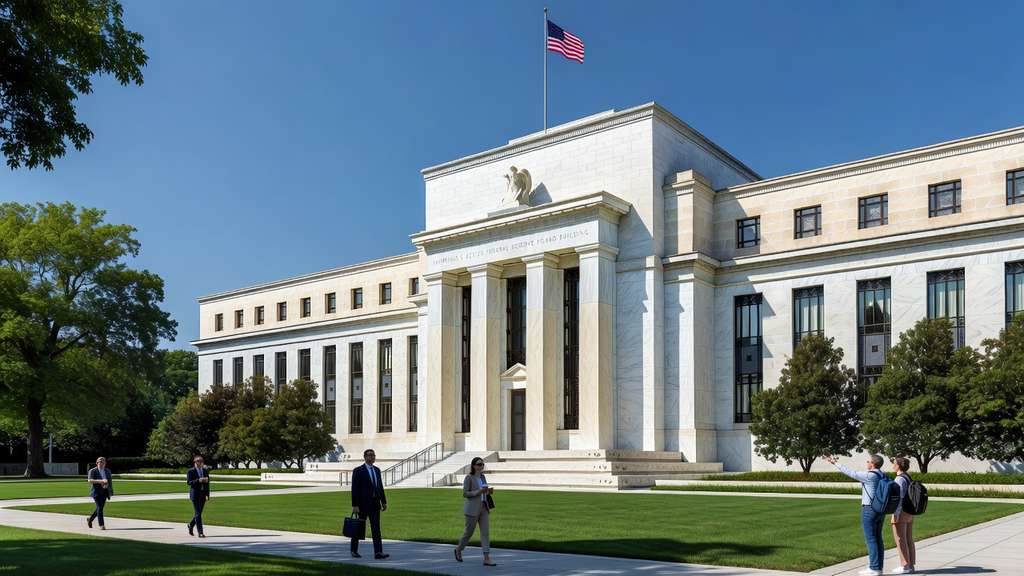
Kevin Warsh chairs the committee, and New York Fed President John Williams serves as its vice chair. The 2026 governor bench includes Michael Barr, Michelle Bowman, Lisa Cook, Philip Jefferson, Christopher Waller, and Jerome Powell, who remains a governor after his term as chair ended earlier this year. The seven regional presidents without a vote still attend, participate fully in the discussion, and contribute to the committee’s assessment of the economy. Alternates, including Richmond’s Thomas Barkin, San Francisco’s Mary Daly, and Chicago’s Austan Goolsbee, stand ready to vote if a seat opens. In practice, the debate involves all nineteen participants; the vote formalizes what the room has already worked out.
The 48-Hour Timeline, From Briefings to the 2 p.m. Statement
The two days in Washington cap weeks of preparation. Ahead of each session, the regional banks compile the Beige Book, a district-by-district survey of business conditions, and Board staff assemble briefing materials and fully drafted policy options. The FOMC’s policy on external communications imposes a quiet period around every meeting, which is why Fed speeches stop in the days before a decision. Day one, typically a Tuesday, is devoted to the economy: senior staff present on financial markets and the outlook, then every participant, voter or not, delivers an assessment in what insiders call the economy go-round.
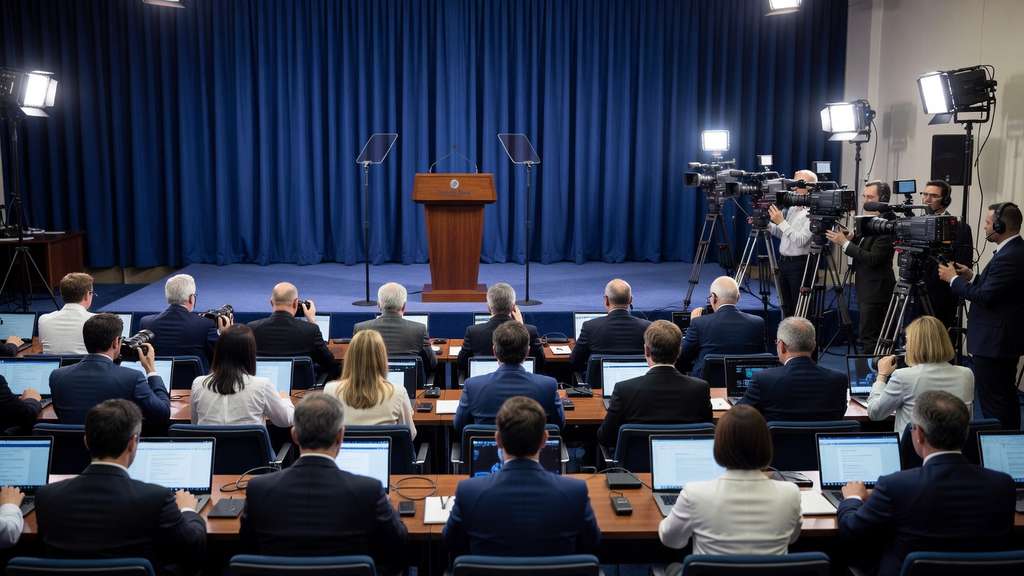
Day two belongs to policy. Participants speak again, this time on what to do with rates, and the chair summarizes the discussion into a proposed action and statement text. The formal vote follows, and at exactly 2 p.m. Eastern the statement crosses the wires alongside an implementation note that instructs the New York Fed’s trading desk on executing the decision. The June 17 release carried both documents, plus a separate table of economic projections. The chair then faces reporters at a press conference the same afternoon, where a single adjective can move markets more than the statement itself.
What the Fed Publishes, and When
The statement is the headline product, and it has been getting shorter. June’s version ran barely a paragraph: the committee held the target range at 3.50 to 3.75 percent, said economic activity is expanding at a solid pace despite elevated uncertainty owing partly to the conflict in the Middle East, and noted that inflation remains elevated relative to the 2 percent goal, in part reflecting supply shocks in sectors including energy. It closed with a five-word promise: “The Committee will deliver price stability.” Four meetings a year, in March, June, September, and December, also produce the Summary of Economic Projections, the document that contains the famous dot plot.
The June dots told a hawkish story: the median participant now sees the federal funds rate at 3.8 percent at the end of 2026, up from 3.4 percent in the March round, implying one quarter-point hike this year. The medians for 2027 and 2028 sit at 3.6 and 3.4 percent, with a longer-run value of 3.1 percent. The last document to arrive is the minutes, a detailed record of the debate published about three weeks after each session. This year’s cadence has been consistent: January’s minutes arrived February 18, March’s on April 8, and April’s on May 20. On that pattern, minutes of the June meeting are due Wednesday, July 8.
What FOMC Week Changes for Your Wallet
The transmission from that boardroom to your statement balance starts with prime. By longstanding convention, banks set the prime rate at the upper bound of the federal funds target range plus three percentage points: 3.75 plus 3.00 equals today’s 6.75 percent. When the FOMC moves, prime moves within a day, and every credit card, HELOC, and variable-rate personal loan indexed to it reprices within one or two statement cycles. Our guide to how the Fed affects loans traces each product’s lag. Fixed-rate borrowing follows a different channel: mortgage rates key off the 10-year Treasury yield, which stood at 4.48 percent on July 1, and can move on the projections even when the target range holds still. Savers sit on the other side of the ledger. Banks price CDs and high-yield savings accounts off the expected path of policy, so a hawkish dot plot can lift deposit offers before any hike happens. Borrowers weighing a fixed-rate consolidation can compare personal loan rates today against what a variable card would cost if the dots prove right.
Pro Tip
The next decision lands at 2 p.m. Eastern on Wednesday, July 29. If you carry a balance on a variable-rate card or HELOC, price a fixed-rate alternative before the meeting rather than after it. The June projections imply one hike this year, and lenders adjust offers quickly once a move looks likely. Our Fed rate forecast tracks how those odds shift week to week.
Frequently Asked Questions
When is the next FOMC meeting?
The next scheduled meeting runs Tuesday and Wednesday, July 28-29, with the statement due at 2 p.m. Eastern on the 29th. Three more sessions follow in 2026: September 15-16, October 27-28, and December 8-9. The September and December meetings include updated economic projections; the July and October meetings do not. That matters for expectations, because July’s outcome will arrive as a statement and press conference only, with no fresh dot plot to reprice against until the September round.
What time does the Fed announce its rate decision?
The statement is released at 2 p.m. Eastern time on the final day of the meeting, together with an implementation note directing the New York Fed’s trading desk. The chair’s press conference follows the same afternoon and often generates larger market swings than the statement itself, since reporters press for guidance the written text avoids. Stock and bond markets react within seconds of the release; consumer rates take longer, with prime typically updating the same day or the next business day after any change.
Does the FOMC set the prime rate directly?
No. The committee sets a target range for the federal funds rate, currently 3.50 to 3.75 percent, and banks set prime themselves. By convention that has held for decades, prime sits three percentage points above the range’s upper bound, which produces today’s 6.75 percent. Because the markup is mechanical, a Fed move passes through to prime almost immediately, and prime in turn drives rates on credit cards, HELOCs, and many small-business loans. The Fed influences those products completely, but it never publishes the prime rate itself.
What is the dot plot and why does it matter?
The dot plot appears in the Summary of Economic Projections four times a year. Each participant marks where they judge the federal funds rate should sit at the end of each year, and the market reads the median dot as the committee’s base case. In June the 2026 median moved to 3.8 percent from 3.4 in March, a signal that one quarter-point increase is now the central expectation. The dots are individual judgments rather than commitments, and chairs routinely caution against reading them as promises.
What are FOMC minutes and when are they published?
The minutes are a detailed narrative of the meeting’s debate, released roughly three weeks after each session. In 2026 the pattern has been steady: the January meeting’s minutes appeared February 18, March’s on April 8, and April’s on May 20, which puts the June meeting’s minutes on track for July 8. Minutes matter because they reveal the range of views behind a vote that is often unanimous. A 12-0 decision can conceal a genuinely split room, and the minutes are where that split shows.
Who votes at FOMC meetings in 2026?
The twelve voters this year are Chair Kevin Warsh, Vice Chair John Williams of New York, and governors Michael Barr, Michelle Bowman, Lisa Cook, Philip Jefferson, Jerome Powell, and Christopher Waller, plus four rotating regional presidents: Beth Hammack of Cleveland, Neel Kashkari of Minneapolis, Lorie Logan of Dallas, and Anna Paulson of Philadelphia. The roster changes at the first meeting of 2027, when a new group of regional presidents rotates in. Nonvoting presidents still attend and speak at every session.
Watching the July 28-29 Meeting
The run-up to the July session now follows the script above: minutes of the June meeting are expected July 8, June CPI lands July 14, and the communications quiet period will silence Fed speakers as the meeting approaches. Markets currently expect a hold, with the hike question deferred to the fall. Track the inputs as they arrive on our interest rates dashboard, follow the policy rate itself on the Fed prime rate tracker, and watch the bond market’s verdict on the Treasury yield curve dashboard.
References
- Federal Reserve Board, “Federal Open Market Committee: About the FOMC,” committee structure, rotation groups, and 2026 membership. federalreserve.gov/monetarypolicy/fomc.htm
- Federal Reserve Board, “Meeting calendars and information,” 2026 meeting dates and minutes release dates. federalreserve.gov/monetarypolicy/fomccalendars.htm
- Federal Reserve Board, “Federal Reserve issues FOMC statement,” June 17, 2026. federalreserve.gov/newsevents/pressreleases/monetary20260617a.htm
- Federal Reserve Board, “Summary of Economic Projections,” June 17, 2026, table 1 medians. federalreserve.gov/monetarypolicy/fomcprojtabl20260617.htm
- Federal Reserve Board, “FOMC Rules and Authorizations,” including the Policy on External Communications of Committee Participants. federalreserve.gov/monetarypolicy/rules_authorizations.htm
- Federal Reserve Bank of St. Louis, FRED series DPRIME (bank prime loan rate, 6.75 percent June 29, 2026). fred.stlouisfed.org/series/DPRIME
- Federal Reserve Bank of St. Louis, FRED series DGS10 (10-year Treasury constant maturity, 4.48 percent July 1, 2026). fred.stlouisfed.org/series/DGS10