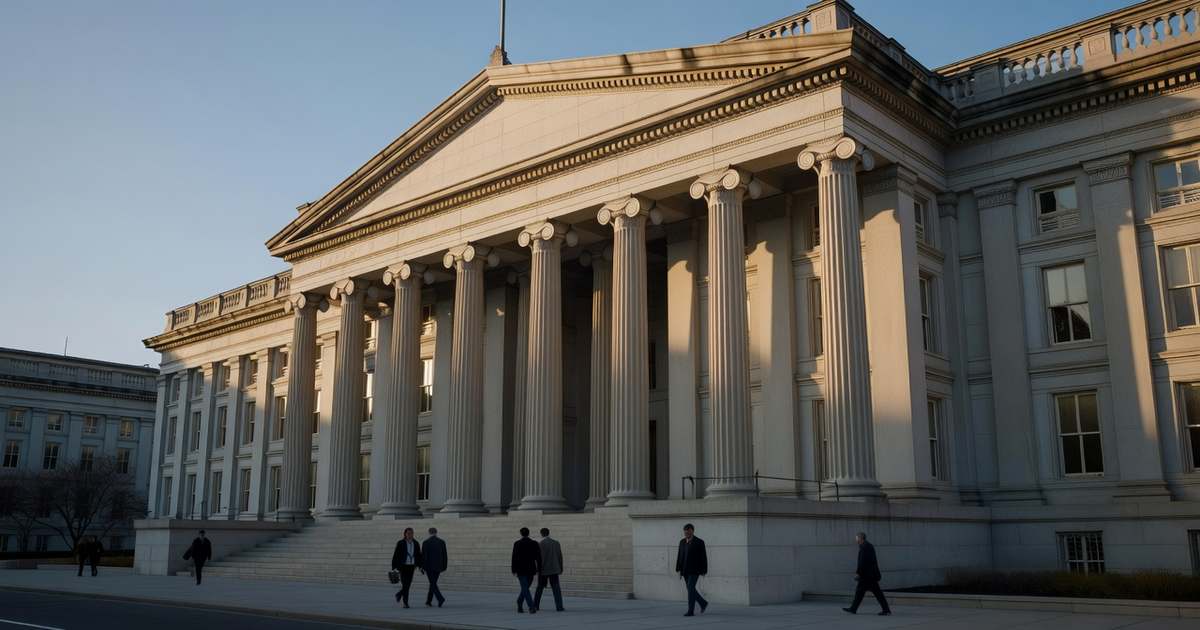
The Federal Reserve Board disclosed on Tuesday, August 25, that the directors of four regional Reserve Banks asked it to raise the discount rate to 4 percent in late July, double the number that made the same request nine days earlier. The disclosure came in the minutes of the Board meetings held July 20 and July 29, 2026, the standing record of how each Reserve Bank board votes on the primary credit rate charged at the discount window. Cleveland and Minneapolis asked for 4 percent at the first meeting. By the second, Kansas City and Dallas had joined them. The Board declined both times and kept the rate at 3.75 percent, the level that has anchored the prime rate at 6.75 percent since December. The vote count matters because it is the broadest public tally of hawkish sentiment inside the Federal Reserve System, and it runs one bank wider than the three dissents recorded at the July FOMC meeting. Policymakers next meet September 15 and 16.
Key Takeaways
- Four Reserve Bank boards asked for a 4 percent discount rate on July 29, up from two on July 20.
- Cleveland and Minneapolis asked first. Kansas City and Dallas joined at the second meeting.
- The Board held the primary credit rate at 3.75 percent and reported no sentiment for a change.
- Three Reserve Bank presidents dissented at the July FOMC meeting, preferring a quarter point increase.
- The prime rate has sat at 6.75 percent for 263 days, unchanged since December 11, 2025.
Table of Contents
What the Minutes Disclosed
The Board publishes these minutes roughly three weeks after each discount rate meeting, and the August 25 release covered two of them. At the July 20 meeting, the directors of the New York, Richmond, Atlanta, Kansas City and Dallas Reserve Banks had voted on July 9 to keep the primary credit rate at 3.75 percent, and the directors of Boston, Philadelphia, Chicago, St. Louis and San Francisco had voted the same way on July 16. Only Cleveland and Minneapolis voted for 4 percent, an increase of a quarter point. The Board recorded no sentiment for a change and approved the existing 3.75 percent rate.

Nine days later the alignment shifted. At the July 29 joint meeting of the Board and the Federal Open Market Committee, only New York, Richmond and Atlanta were on record for 3.75 percent. Cleveland and Minneapolis held their July 16 votes for 4 percent, and Kansas City and Dallas had voted for 4 percent on July 23. The Board again approved 3.75 percent, held the interest rate on reserve balances at 3.65 percent effective July 30, and renewed the formulas that set secondary credit 50 basis points above primary credit and reset seasonal credit every two weeks. Chairman Kevin Warsh, Vice Chair Philip Jefferson, Vice Chair for Supervision Michelle Bowman and Governors Jerome Powell, Christopher Waller, Lisa Cook and Michael Barr voted for both actions.
Which Banks Asked, and Which Ones Vote
A Reserve Bank board asking for a higher discount rate is not the same as a vote on monetary policy, and the two tallies diverge in a specific way this year. The July FOMC statement records three dissents: Beth Hammack of Cleveland, Neel Kashkari of Minneapolis and Lorie Logan of Dallas, each of whom preferred to raise the target range by a quarter point. All three lead banks whose directors also asked for 4 percent. Kansas City is the fourth bank on the discount rate list, and its president holds no vote in 2026. Under the rotation published by the Board, the seat shared by Minneapolis, Kansas City and San Francisco belongs to Minneapolis this year. So the hawkish bloc visible in the July statement understated the count by one. Directors themselves are not economists by trade. They are bankers and business leaders drawn from each District, and the minutes describe what they reported: steady employment, continued artificial intelligence investment, high credit availability, and consumers turning increasingly price conscious in the face of elevated inflation and rising fuel surcharges.
What It Signals Before September 16
The disclosure landed three days before Warsh used his Jackson Hole keynote to sharpen the inflation message. In remarks titled “In Our Time,” delivered August 28, he put responsibility for 65 months of sustained, elevated inflation on the central bank, called the 2 percent objective for the personal consumption expenditures price index a firm and fixed target, and set a standard: policymakers must be confident that underlying inflation is heading to that objective clearly and at sufficient speed, and if they are not, in his words, “we have work to do.” He described himself as committed to a discipline rather than to a decision.

The data he was describing has not settled the question. Headline PCE inflation ran at 3.7 percent in the 12 months through July and the core measure at 3.3 percent, according to the Bureau of Economic Analysis. Consumer price inflation ran at 3.4 percent over the same 12 months, with core at 2.5 percent. Unemployment was 4.1 percent. The bond market moved on the speech: the gap between 10-year and 2-year Treasury yields narrowed to 0.39 percentage point on August 28 from 0.47 the day before, a classic flattening driven by short maturities repricing toward a hike. On August 27 the Treasury curve closed with the 2-year at 4.20 percent, the 10-year at 4.67 percent and the 30-year at 5.19 percent.
What It Changes for Your Rates
The discount rate is not the number on your loan agreement, but it sits one step away from it. The prime rate published in the Fed H.15 release is set by commercial banks at 300 basis points above the top of the federal funds target range, which is 3.50 to 3.75 percent. That arithmetic produces the 6.75 percent prime rate that has held since December 11, 2025, a stretch of 263 days. A quarter point increase in September would lift the range to 3.75 to 4.00 percent and prime to 7.00 percent, usually within a day of the announcement.
That flows straight into variable-rate borrowing. Credit card accounts assessed interest carried an average 20.94 percent in the second quarter, and card issuers reprice within one or two statement cycles of a prime move. Home equity lines and most private student loans follow the same index. Fixed borrowing does not: the average 30-year mortgage was 6.66 percent on August 27, and mortgage rates track the 10-year Treasury rather than prime. Savers sit on the other side of the trade. Deposit pricing at the top of the market moves with the funds rate, so the same decision that raises a card balance can lift yields on high-yield savings accounts and certificates of deposit.
Pro Tip
If you carry a balance on a variable-rate card or a home equity line, price a fixed-rate consolidation offer before September 16 rather than after. Lenders quote fixed personal loan rates off market yields that have already repriced, while your card APR only moves after the Fed acts. Locking a rate now removes the September decision from your monthly payment math entirely, and a quote costs nothing if you decline it.
Frequently Asked Questions
Will the prime rate go up in September 2026?
Nobody can say yet. The prime rate moves only after the Federal Open Market Committee changes its target range, and the next decision comes on September 16, 2026. Prime is 6.75 percent today and would become 7.00 percent if the Committee raises rates by a quarter point.
What is the discount rate, and how is it different from the federal funds rate?
The discount rate, formally the primary credit rate, is what the Fed charges healthy banks that borrow directly from the discount window. It is set by the Board of Governors after each Reserve Bank board recommends a level, and it stands at 3.75 percent. The federal funds rate is what banks charge each other overnight, and the FOMC sets a target range for it rather than a single number. The two processes are separate, which is why Reserve Bank directors can ask for one rate while the Committee holds the other.
What are interest rates projected to be in September 2026?
The only figure that is settled is the current one. The federal funds target range is 3.50 to 3.75 percent, the discount rate is 3.75 percent, and the interest rate on reserve balances is 3.65 percent. Those hold until the FOMC meets on September 15 and 16. Futures markets have been pricing meaningful odds of a quarter point increase since the Jackson Hole speech, but market pricing is a probability rather than a forecast, and it has reversed several times this year.
What is the projected prime rate for 2026?
Prime is mechanical rather than forecast. Banks publish it at 300 basis points above the upper bound of the federal funds target range, so it is 6.75 percent while the range is 3.50 to 3.75 percent. If the Committee raises rates once by a quarter point at any of the three remaining 2026 meetings, prime becomes 7.00 percent. If it holds through December 9, prime finishes the year at 6.75 percent. Track the target range and you have tracked prime.
How much would a quarter point increase add to my credit card payment?
Roughly 25 cents per month for every $1,000 of revolving balance in the first billing cycle, because card APRs are quoted as prime plus a margin and a quarter point is 0.25 percent annually. On a $6,000 balance that is about $1.25 a month at first, though the cost compounds if the balance persists. The average rate on card accounts assessed interest was 20.94 percent in the second quarter, so the increase is small next to the base rate.
Could mortgage rates fall to 4 percent in 2026?
That would take a decline of roughly 266 basis points from the 6.66 percent average recorded on August 27, and nothing in the current data points that way. Mortgage pricing follows the 10-year Treasury yield plus a spread, and the 10-year closed at 4.67 percent on August 27. A 4 percent mortgage would require the 10-year to fall toward 2 percent, a move usually associated with a sharp recession rather than a routine easing cycle.
Watching the September Decision
The discount rate minutes are a lagging record, not a signal about the next meeting. Their value is the count. Four of twelve Reserve Bank boards were on record for a higher rate before Warsh spoke in Wyoming, and the minutes for the September meeting will not appear until late October. Until then the observable series are the target range, the prime rate, the inflation prints due before September 16, and the rate outlook that markets revise around them.
References
- Federal Reserve Board. “Minutes of the Board’s discount rate meetings on July 20 and July 29, 2026.” August 25, 2026. https://www.federalreserve.gov/newsevents/pressreleases/monetary20260825a.htm
- Federal Reserve Board. Discount rate meeting minutes, full text (PDF). https://www.federalreserve.gov/newsevents/pressreleases/files/monetary20260825a1.pdf
- Federal Reserve Board. FOMC statement, July 29, 2026. https://www.federalreserve.gov/newsevents/pressreleases/monetary20260729a.htm
- Warsh, Kevin. “In Our Time.” Jackson Hole, August 28, 2026. https://www.federalreserve.gov/newsevents/speech/warsh20260828a.htm
- Federal Reserve Board. H.15 Selected Interest Rates. https://www.federalreserve.gov/releases/h15/
- Federal Reserve Board. FOMC meeting calendars and membership. https://www.federalreserve.gov/monetarypolicy/fomccalendars.htm
- FRED. Bank Prime Loan Rate (DPRIME). https://fred.stlouisfed.org/series/DPRIME
- FRED. 10-Year minus 2-Year Treasury Constant Maturity (T10Y2Y). https://fred.stlouisfed.org/series/T10Y2Y
- FRED. 30-Year Fixed Rate Mortgage Average (MORTGAGE30US). https://fred.stlouisfed.org/series/MORTGAGE30US
- FRED. Credit Card Interest Rate, Accounts Assessed Interest (TERMCBCCALLNS). https://fred.stlouisfed.org/series/TERMCBCCALLNS
- FRED. Unemployment Rate (UNRATE). https://fred.stlouisfed.org/series/UNRATE
- Bureau of Economic Analysis. Personal Income and Outlays, July 2026. https://www.bea.gov/data/income-saving/personal-income
- Bureau of Labor Statistics. Consumer Price Index Summary, July 2026. https://www.bls.gov/news.release/cpi.nr0.htm