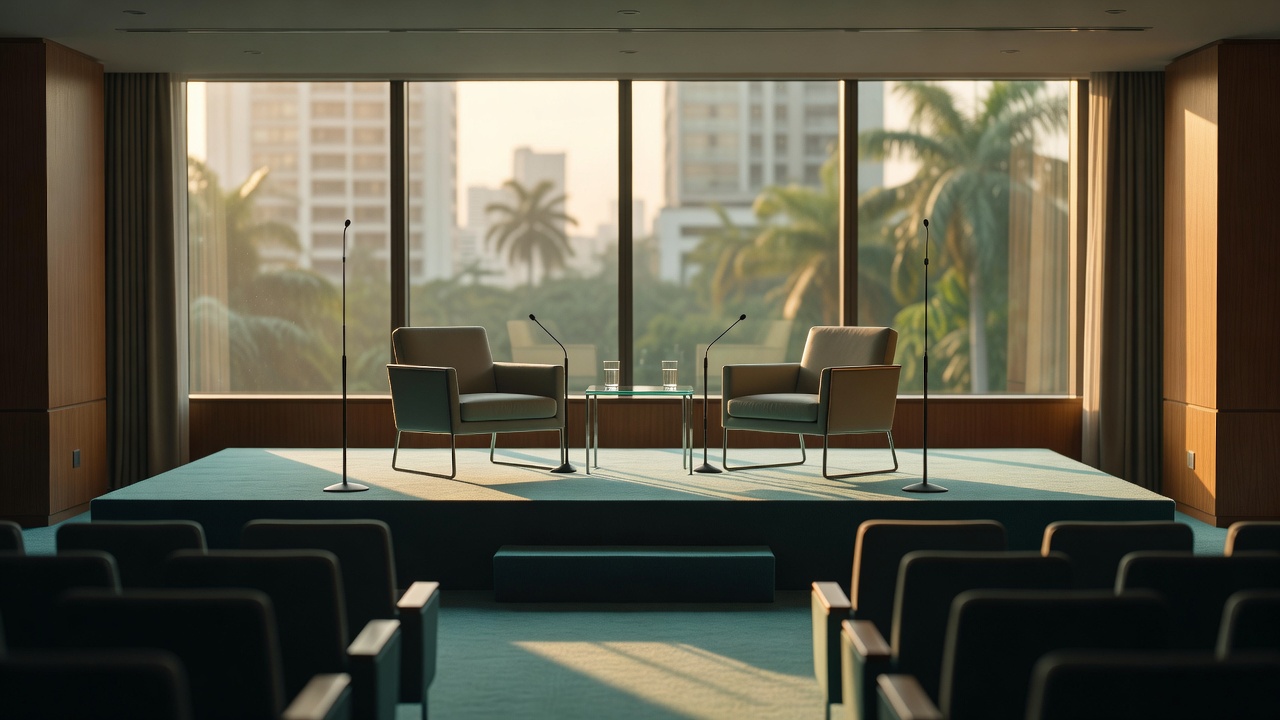
Federal Reserve Chair Kevin Warsh declined to say how he will vote on October 28, telling an audience in Bangkok on Friday that he does not prejudge meetings. The remarks came at the annual meetings of the International Monetary Fund and the World Bank, in a public conversation with IMF Managing Director Kristalina Georgieva, and they were his last scheduled comments before the Federal Open Market Committee’s communications blackout took effect. Under the Fed’s policy on external communications, that blackout begins at 12:00 a.m. Eastern Time on the second Saturday before a meeting, which places the start at Saturday, October 17. Asked about conditions since the September decision, Warsh said only that “the world has broadly conformed to our expectations,” a line that gave traders nothing new on whether the Committee raises rates again this month. The silence lands on top of data that has been anything but quiet. The Bureau of Labor Statistics reported on October 14 that consumer prices rose 0.6 percent in September and 3.7 percent over 12 months, the fastest annual pace of the year. The prime rate has sat at 7.00 percent since the Fed’s September 16 increase, and every credit card balance and variable-rate loan tied to it is waiting on the same answer. The Fed meeting schedule leaves two decision dates before the year ends.
Key Takeaways
- Warsh told the IMF meetings in Bangkok on Friday that he does not prejudge meetings, offering no October signal.
- The FOMC communications blackout began Saturday, October 17, under the Fed’s second-Saturday rule.
- September consumer prices rose 0.6 percent for the month and 3.7 percent over 12 months.
- The prime rate holds at 7.00 percent, with the fed funds target range at 3.75 to 4.00 percent.
- The 10-year Treasury yield fell from 5.21 percent to 5.10 percent between October 13 and October 15.
Table of Contents
What Warsh Said and Did Not Say
Warsh appeared Friday alongside Georgieva at the IMF and World Bank annual meetings in Bangkok. Asked where policy goes from here, he answered with the formulation he has used since taking the chair: “I don’t prejudge meetings.” Pressed on what has changed since the Committee last met, he said, “Over the month or so that’s transpired since then, the world has broadly conformed to our expectations.” He described inflation as the dominant subject among the central bankers he met in Bangkok, saying it is hard to sit in a discussion with them without the price surge coming up, and that his international counterparts are describing the same trend at home. He also pointed to the investment surge in artificial intelligence as probably the most important upside factor in the global economy, while cautioning that the transition is likely to be bumpy.
What he did not do was shut the door or open it. The September statement said inflation remains elevated and that the quarter-point increase would support a timelier return to the Committee’s 2 percent goal, language that pointed toward further tightening without committing to a date. Three of Warsh’s colleagues have been far less guarded since. Vice Chair Philip Jefferson, New York Fed President John Williams and Governor Christopher Waller have each suggested the Committee can hold off in October, with Waller noting that increases do not have to land at consecutive meetings. The minutes of the September meeting showed most officials expected one more increase this year without settling on when. Warsh’s refusal to join either camp leaves the October 28 vote open, and it leaves the Fed rate forecast resting on data already published rather than on guidance still to come.
The Blackout Clock Before October 28
The Fed’s policy on external communications for Committee participants puts a hard stop on public commentary around every meeting. The blackout period “will begin at 12:00 a.m. Eastern Time the second Saturday before a meeting” and ends “at 11:59 p.m. Eastern Time the day after a meeting.” With the FOMC scheduled for October 27 and 28, the second Saturday before the meeting is October 17, so Warsh’s Bangkok appearance on October 16 cleared the deadline by a single day. Nothing further from any participant will reach the public until the statement is released on the afternoon of October 28.
That leaves markets to price the decision from the data alone. The October meeting carries no Summary of Economic Projections, so the next dot plot does not arrive until the December 8 and 9 meeting. Pricing has swung hard in both directions this week. CME FedWatch odds of a quarter-point increase on October 28 sat near 22 percent before the inflation report, jumped to roughly 50 percent on the morning of October 14, and fell back to 31.6 percent by that evening. By Thursday afternoon the figure had slipped to about 28 percent, while December pricing stood near 90 percent. Warsh added one date to the calendar in Bangkok, saying the Fed will hold the first field hearing of its productivity and jobs task force on November 16 in the Bay Area, well after this month’s vote.
The Bond Market Took the Other Side
Treasury yields moved against the hot inflation print rather than with it. The Fed’s H.15 release dated October 16 shows the 10-year constant maturity yield at 5.21 percent on October 13, 5.19 percent on October 14 and 5.10 percent on October 15. The 30-year fell from 5.56 percent to 5.43 percent over the same three sessions. The 20-year dropped from 5.60 percent to 5.48 percent, and the five-year slid from 5.00 percent to 4.91 percent. Long-dated debt rallying in the days after a 3.7 percent annual inflation reading is the market saying it expects the Committee to stay restrictive long enough to bring prices down, rather than saying it fears prices running away.

The front end barely budged. The two-year note went 4.79 percent, 4.82 percent, then 4.77 percent across those three days, and the three-month bill held between 4.09 percent and 4.10 percent. Short maturities track what the Fed is expected to do in the next few months, so their stillness is the clearest reading available of how little Warsh gave away. The effective federal funds rate stayed at 3.88 percent throughout, parked inside the 3.75 to 4.00 percent target range set on September 16 by a 12 to 0 vote. The gap between 10-year and two-year yields closed Friday at 0.35 percentage points, a modest steepening that the Treasury yield curve has been grinding out since the September hike.
What a 7.00 Percent Prime Rate Costs You
The prime rate is the number that reaches household balance sheets fastest. Banks set it at 3 percentage points above the top of the fed funds target range, so the September increase carried it from 6.75 percent to 7.00 percent within a day, and it has stayed there through every session since. Credit card APRs, home equity lines and most variable-rate personal loans reprice off that figure. A quarter-point move on October 28 would add roughly $2.50 a year in interest for every $1,000 of revolving balance, which sounds small until it is applied to a balance that is already carrying a double-digit margin over prime. The mechanics are laid out in our guide to how Fed decisions reach your loans.
Savers sit on the other side of the same trade. Deposit yields have followed the funds rate up, and the pause since September has let the best high-yield savings accounts and certificates of deposit hold their levels rather than drift lower. Fixed borrowing costs answer to the long end instead, which is why the retreat in the 10-year matters more for housing than anything Warsh said: mortgage rates track that yield far more closely than they track the funds rate. Borrowers shopping fixed-rate debt can also compare current personal loan rates, which have moved sideways while the Committee has stayed on hold.
Pro Tip
If you carry a revolving balance, the two weeks before an FOMC meeting are the cheapest time to act, because nothing has repriced yet. Pull your current APR off your statement, check how many points above prime it sits, and ask your issuer for a reduction before October 28. If the answer is no, a fixed-rate consolidation locks your cost regardless of how the vote lands.
Frequently Asked Questions
Will the Fed raise rates in October?
It is not decided. Chair Kevin Warsh gave no signal on October 16, saying he does not prejudge meetings, and CME FedWatch pricing put the odds of a quarter-point increase on October 28 near 28 percent on October 15, down from roughly 50 percent right after the September inflation report.
Will the Fed raise interest rates again in 2026?
Most officials expect one more increase before the year ends, according to the minutes of the September meeting, though the timing remains unsettled. Two decision dates are left: October 27 and 28, and December 8 and 9. Futures pricing has leaned toward December, with roughly 90 percent odds attached to an increase by that meeting as of October 14. The December meeting also carries a Summary of Economic Projections, which gives officials a natural moment to pair a move with updated forecasts.
Did Kevin Warsh raise interest rates?
Yes. The Committee Warsh chairs raised the federal funds target range by a quarter point on September 16, to 3.75 to 4.00 percent, on a 12 to 0 vote. It was the first increase since July 2023. No chair sets rates alone, since each decision is a vote of the full Committee, but the September statement carried his stamp in its closing line that the Committee will deliver price stability. The prime rate followed to 7.00 percent the next day.
What is the prime rate right now?
The bank prime loan rate is 7.00 percent, where it has stood since September 17. The Fed’s H.15 release dated October 16 lists it at 7.00 percent for October 13, 14 and 15. Prime is not set by the Fed directly. Banks peg it 3 percentage points above the upper bound of the federal funds target range, so it moves within a day of any FOMC change and stays flat in between.
How does a Fed hike change my credit card APR?
Almost immediately. Variable-rate cards are written as prime plus a fixed margin, so a quarter-point increase in prime lifts your APR by the same quarter point, usually within one or two billing cycles. Issuers are required to disclose the change but do not need your consent for it. On a $5,000 balance, a quarter point adds about $12.50 of interest a year. The margin itself, often 10 to 20 points, is where most of your rate actually comes from.
When is the next Fed meeting after October?
The FOMC meets December 8 and 9, the last scheduled meeting of 2026. That session includes a Summary of Economic Projections, the quarterly release that shows where each official expects rates to sit at the end of the next several years. The October 27 and 28 meeting has no projections attached, so the statement and the vote tally will be the only new information released that afternoon.
Watching the October 28 Decision
With participants silent until the statement lands, the remaining data releases carry the whole argument. Treasury yields, the September price detail and the weekly claims prints are what the Committee has left to work with, and what borrowers can watch alongside it. Track the number that moves first on our current prime rate page, follow the price data on the inflation tracker, and check the dates on the Fed meeting schedule.
References
- Board of Governors of the Federal Reserve System, H.15 Selected Interest Rates, release dated October 16, 2026.
- U.S. Bureau of Labor Statistics, Consumer Price Index Summary, September 2026, released October 14, 2026.
- Board of Governors of the Federal Reserve System, FOMC statement, September 16, 2026.
- Board of Governors of the Federal Reserve System, FOMC meeting calendar, 2026.
- Board of Governors of the Federal Reserve System, Policy on External Communications of Federal Open Market Committee Participants.
- Federal Reserve Bank of St. Louis, FRED series T10Y2Y, 10-Year minus 2-Year Treasury Constant Maturity Spread.
- U.S. Department of the Treasury, Debt to the Penny.