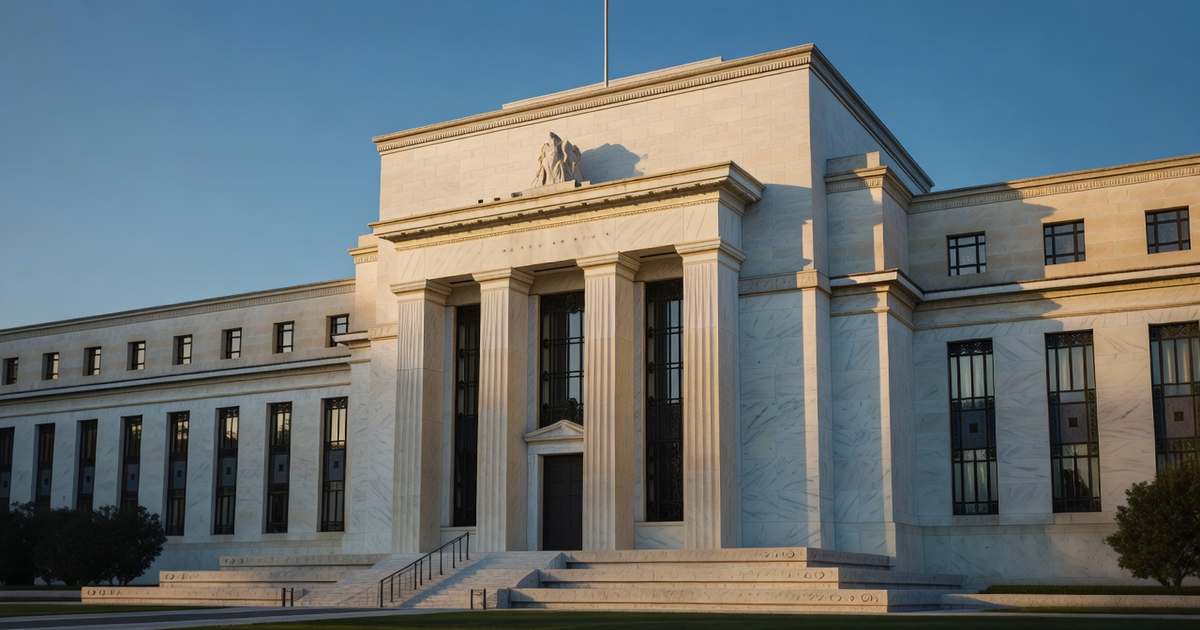
The two-year Treasury yield closed at 4.34% on Friday, August 28, up 14 basis points in a single session, after Federal Reserve Chairman Kevin Warsh told the Jackson Hole symposium that the central bank still has work to do on inflation. That is the largest one-day rise in the two-year note since the June 17 FOMC decision, and it leaves the yield 3 basis points below its 2026 high of 4.37% set on July 23. Warsh delivered the keynote Friday morning at the Federal Reserve Bank of Kansas City symposium in Jackson Hole, Wyoming, on his 100th day as Chairman. He said the 12-month change in the PCE price index stands at 3.7% and the six-month change at 4.1%, and that this summer’s better-than-expected readings do not show underlying inflation trends improving in any meaningful way. Traders heard a policy path biased higher and sold the front end of the curve. The two-year note is the cleanest market read on where the federal funds rate is heading, and every consumer product tied to the prime rate sits downstream of that path. Prime is unchanged at 6.75% and stays there until the FOMC moves it. The next decision lands September 16, the second day of the September FOMC meeting.
Key Takeaways
- The 2-year Treasury yield closed at 4.34% on August 28, its biggest one-day rise since June 17.
- Warsh told Jackson Hole that PCE inflation runs 3.7% over 12 months and 4.1% over six.
- The 2-year to 10-year spread narrowed to 0.39 points from 0.47, the flattest close since late July.
- Ten-year breakevens slipped to 2.31%, so the selloff was in real yields, not inflation expectations.
- Prime holds at 6.75%. The next FOMC decision comes September 16 with a new dot plot.
Table of Contents
What the August 28 Treasury Curve Showed
Treasury’s daily yield curve put the 2-year constant maturity at 4.34% on August 28, up from 4.20% the previous session. The 1-year rose 11 basis points to 4.15%, the 5-year rose 10 basis points to 4.48%, and the 3-month bill rose 6 basis points to 3.90%. Maturities further out moved far less. The 10-year added 6 basis points to 4.73%, the 20-year 3 basis points to 5.21%, and the 30-year 3 basis points to 5.22%. A selloff concentrated in the first five years is the signature of a repricing of the policy path, not of a changed view on growth or inflation a decade out.

The gap between the 2-year and the 10-year narrowed to 0.39 percentage points from 0.47, the flattest close since late July. Against a year earlier the divergence is starker. The 2-year sits 72 basis points above the 3.62% it printed on August 28, 2025, while the 10-year is up 51 basis points from 4.22%. St. Louis Fed data back through 2025 show only two larger single-day increases in the 2-year: a 20 basis point jump on April 9, 2025, and a 15 basis point jump on June 17, 2026, the day the FOMC published its June statement and dot plot. Friday’s move ranks third on that list and second this year.
What Warsh Said About Inflation and Guidance
Warsh spent the first half of the keynote on artificial intelligence and on his objections to routine forward guidance, then turned to the economy. On employment he was comfortable. The jobless rate at 4.1% is low by historical standards, four-week average claims sit near their lowest level in decades, and he called labor markets consistent with full employment. On prices he was not. He cited the 3.7% 12-month change in the PCE price index and the 4.1% six-month change, and said the comparable CPI measures and the core versions of both are also elevated. He then disaggregated the index. Of the 199 components in the PCE basket, 54% rose more than 3% over the past 12 months, below the post-pandemic high near 77% but well above the 32% average of the two decades before the pandemic. Over the past six months the figure is 49% annualized. He added that he would be hard pressed to call broad financial conditions restrictive. His standard was direct: the Fed must be confident that underlying inflation is moving to the 2% objective clearly and at sufficient speed, and otherwise it has work to do.
Why the Front End Moved Most
A two-year note is priced off the average federal funds rate investors expect over the next 24 months, plus a small term premium. The FOMC’s target range is 3.50% to 3.75% and the effective federal funds rate printed 3.63% on August 27. A 2-year yield of 4.34% therefore sits roughly 71 basis points above the current overnight rate, which reads as a market pricing a policy rate higher on average over two years than it is today. Before Friday the same calculation implied about 57 basis points. The speech delivered no promise, and Warsh said plainly that it was not forward guidance. What it removed was the possibility that the summer’s softer inflation prints had settled the argument.

One detail separates a policy repricing from an inflation scare. The 10-year breakeven inflation rate, the gap between the nominal 10-year and its inflation-protected counterpart, fell to 2.31% on August 28 from 2.33% the day before. Nominal yields rose while breakevens fell, so the entire increase came from real yields. Investors did not raise their forecast for inflation. They raised their forecast for how hard the Fed will lean against it. That squares with the July 28 and 29 FOMC vote, which held the target range 9 to 3 with all three dissenters preferring an increase.
What a Higher 2-Year Yield Means for Your Money
The prime rate does not follow the 2-year note. It follows the FOMC, moving in lockstep with the target range and holding at 6.75% until the committee acts, which is why Fed decisions reach your loans on a delay. Credit card APRs are quoted as prime plus a margin, so the average assessed card rate the Fed last measured at 20.94% does not budge before September 16. Mortgages take their cue from the long end instead. The 30-year fixed averaged 6.66% in the week ended August 27, and the 10-year rose only 6 basis points on Friday, so the read-through to current mortgage rates is small.
Deposits are where a 14 basis point move in the 2-year actually bites. Banks price term products against the front of the Treasury curve because that is what they compete with, so a repricing between one and five years feeds straight into what a bank can pay on a one-year or two-year certificate. If the market is right that the next policy move is up, posted CD rates and high-yield savings yields have room to follow. Borrowers face the mirror image: fixed personal loan pricing is set off bank funding costs, and those just rose.
Pro Tip
Track the 2-year Treasury yield, not the 10-year, if what you care about is deposit pricing and the next FOMC move. Treasury publishes the closing curve every business day by mid-afternoon. When the 2-year runs well above the effective federal funds rate, as it does now by roughly 71 basis points, the market is telling you a hike is priced. That is the window to shop a longer CD term rather than roll a short one.
Frequently Asked Questions
Why did the two-year Treasury yield jump on August 28, 2026?
The 2-year Treasury yield rose 14 basis points to 4.34% on August 28, 2026, after Fed Chairman Kevin Warsh told the Jackson Hole symposium that PCE inflation is running 3.7% over 12 months and that the Fed has work to do. Traders repriced the odds of a rate increase.
Will Kevin Warsh raise interest rates?
Warsh has not committed to raising rates, and he used the Jackson Hole keynote to argue against that kind of advance commitment. He said he is committed to a discipline rather than to a decision, and he declined to describe what would trigger a move. What he did say is that inflation remains above the 2% target on every measure he tracks and that the Fed has work to do if it is not falling fast enough. A chairman also does not decide alone. The FOMC held rates 9 to 3 in July.
What is the Fed interest rate prediction for the rest of 2026?
The Treasury market is pricing a higher policy rate rather than a lower one. With the target range at 3.50% to 3.75% and the effective rate at 3.63%, a 2-year yield of 4.34% implies an average funds rate over the next two years roughly 71 basis points above today. Three FOMC meetings remain in 2026, starting September 15 and 16. September also brings a fresh Summary of Economic Projections, where the committee publishes its own rate path. Our 2026 rate forecast page tracks how that pricing shifts.
Does a higher two-year Treasury yield change my credit card APR?
Not directly and not immediately. Variable card APRs are written as the prime rate plus a fixed margin, and prime moves only when the FOMC changes its target range. Prime has been 6.75% since the last policy change and will remain 6.75% regardless of what the 2-year does before September 16. What the yield move tells you is the direction of risk. If the market is right that the committee leans toward an increase, your APR would rise by the same amount prime rises, usually within one or two billing cycles.
Will mortgage rates go under 4%?
Nothing in the current data points that way. The 30-year fixed averaged 6.66% in the week ended August 27, and mortgage pricing keys off the 10-year Treasury plus a spread. The 10-year closed at 4.73% on August 28, up 51 basis points from a year earlier. For a 30-year mortgage to reach 4%, the 10-year would need to fall more than two and a half percentage points, a move that historically accompanies a recession. The Fed is debating whether to tighten, not whether to cut.
Should I lock a CD rate before the September FOMC meeting?
It depends on which way you think the committee leans. If the pricing embedded in a 4.34% two-year yield proves right and the Fed raises rates on September 16, waiting could get you a better yield. If the committee holds again, as it did in July, today’s posted rates may be near the top for this cycle. A middle path is to ladder: put part of the money in a short term now and hold the rest for the decision. Compare current offers on our CD rates page.
Watching the September 16 Decision
The committee receives the August jobs report on September 4 and the August CPI on September 11. Those two prints, not Friday’s speech, will settle the argument Warsh declined to settle. Follow the policy path on our 2026 rate forecast, the curve itself on our Treasury yield curve tracker, and the borrowing side on our national debt tracker.
References
- Federal Reserve Board. Keynote remarks by Chairman Warsh at Jackson Hole, August 28, 2026.
- U.S. Treasury. Daily Treasury Par Yield Curve Rates, August 28, 2026.
- FRED, St. Louis Fed. 2-Year Constant Maturity Rate (DGS2).
- FRED. 10-Year Minus 2-Year Spread (T10Y2Y).
- FRED. 10-Year Breakeven Inflation Rate (T10YIE).
- FRED. Bank Prime Loan Rate (DPRIME), August 26, 2026.
- FRED. 30-Year Fixed Mortgage Average (MORTGAGE30US), week ended August 27, 2026.
- FRED. Credit Card Plan Rates, All Accounts (TERMCBCCALLNS), May 2026.
- Bureau of Labor Statistics. Release Schedule, September 2026.
- Federal Reserve Bank of Kansas City. Jackson Hole Economic Policy Symposium, 2026.
- Federal Reserve Board. FOMC Meeting Calendar.
- Fiscal Data, U.S. Treasury. Debt to the Penny, August 27, 2026.