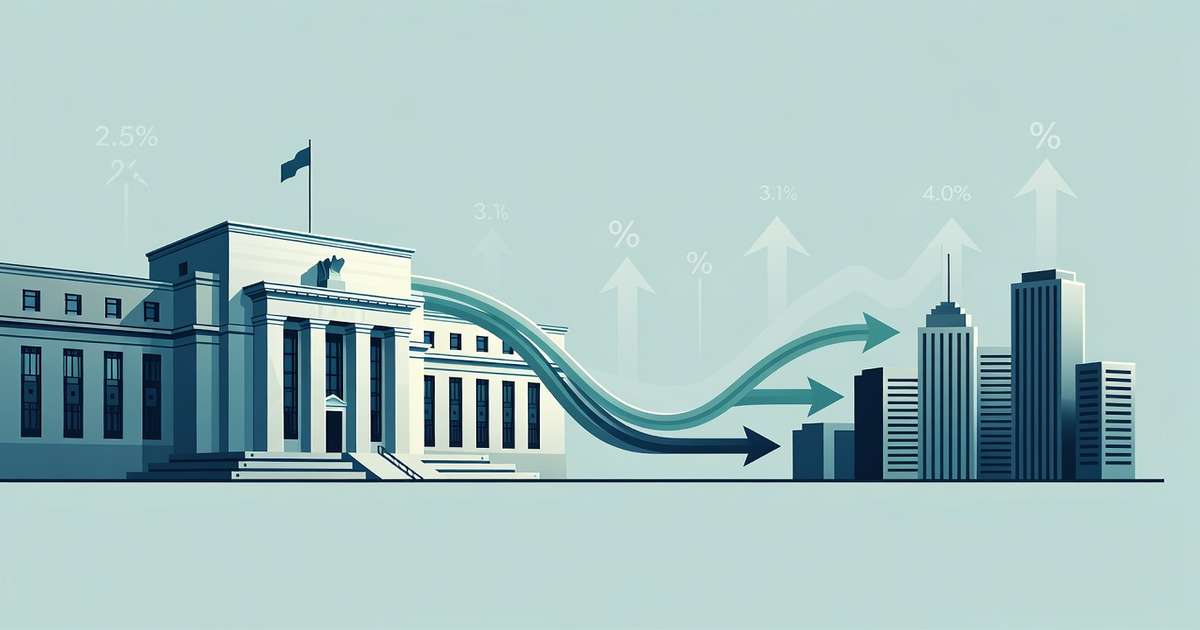
The U.S. prime rate has sat at 6.75% since December 11, 2025, and millions of credit card, home equity, and small business borrowers price their loans off that single number. Yet the prime rate is not set by the Federal Reserve, and it is not set by a vote or a formula written into law. It is a banking convention, published by the nation’s largest commercial banks and reported by financial outlets, that tracks the Federal Reserve’s policy rate with almost mechanical precision. When the Federal Open Market Committee moves the federal funds target, the prime rate moves the same amount, usually within one business day. Understanding that chain, from the FOMC meeting room to the variable rate on your statement, explains why a quarter-point decision in Washington can change what you owe weeks later. This article walks through each link: how the Fed sets its policy rate, why banks add a fixed spread of three percentage points to reach prime, what prime actually prices, and what the current 6.75% reading means for your money ahead of the June 16 to 17, 2026 FOMC meeting. For the live figure, see our current prime rate page and the broader Fed prime rate dashboard.
Key Takeaways
- The prime rate is 6.75% as of June 2026, unchanged since the Fed’s December 2025 cut.
- The Federal Reserve does not set prime; commercial banks publish it as a convention.
- Prime equals the upper bound of the federal funds target range plus 3.00 percentage points.
- That 300 basis point spread has held across the industry since 1994.
- Prime indexes most variable credit card APRs, HELOCs, and many small business loans.
On This Page
It Starts With the Federal Funds Rate
The chain begins inside the Federal Reserve, but not with the prime rate. Eight times a year the Federal Open Market Committee sets a target range for the federal funds rate, the rate banks charge each other for overnight loans of reserve balances. As of June 2026 that range is 3.50% to 3.75%, held steady across the January, March, and April meetings. The effective federal funds rate, the volume-weighted average of actual overnight trades, printed at 3.62% on June 5, 2026, comfortably inside the band. The Fed does not dictate that rate by decree. It steers the market toward its target using open market operations, the interest it pays on reserve balances, and its overnight reverse repurchase facility, which together set a floor and a ceiling for overnight funding.

This overnight rate is the anchor for the entire short end of the interest rate structure. When the FOMC raises or lowers the target range, the cost of the cheapest, shortest borrowing in the financial system moves with it, and every rate that references short-term funding adjusts in turn. The committee’s decisions are published in a statement at 2:00 p.m. Eastern on the second day of each meeting, alongside, four times a year, a Summary of Economic Projections that includes the closely watched dot plot. The next decision lands on June 16 to 17, 2026, the first meeting under Chair Kevin Warsh, and markets widely expect the range to stay at 3.50% to 3.75%. You can track the calendar on our Fed meeting schedule and the policy path on our U.S. interest rates dashboard.
The Three Percentage Point Spread Banks Add
Here is the step that surprises most borrowers. The prime rate is not a Federal Reserve product at all. The Federal Reserve states plainly that it does not set the prime rate, and that each bank sets its own. In practice the largest commercial banks all arrive at the same number because they follow a shared convention: prime equals the upper bound of the federal funds target range plus 3.00 percentage points. With the upper bound at 3.75%, prime computes to exactly 6.75%. That 300 basis point spread has held across the banking industry since 1994, which is why prime has tracked the funds rate move for move for more than three decades.
The figure most lenders and contracts reference is the Wall Street Journal prime rate, a benchmark the paper derives by surveying the 10 largest U.S. banks and changing its published rate when a majority of them move. Because all of those banks anchor to the same federal funds spread, the survey almost always produces a single, unanimous number. The Federal Reserve then records the resulting bank prime loan rate in its weekly H.15 release of selected interest rates, and the St. Louis Fed publishes the daily series as DPRIME. So when you read that prime is 6.75%, three independent sources agree: the banks that post it, the Journal that surveys them, and the Fed that reports it. The last change came on December 11, 2025, when the FOMC delivered the fifth cut of its easing cycle and banks lowered prime by a quarter point the same day.
What the Prime Rate Actually Prices
Prime matters because it is the index sitting underneath a large share of consumer and small business credit. Most variable rate credit cards set their annual percentage rate as prime plus a margin, so a card advertised at prime plus 14.49 points carries a 21.24% APR at today’s 6.75% prime. Home equity lines of credit, many private student loans, and a wide range of small business and commercial loans use the same prime plus margin structure. When prime moves, the rate on those balances reprices, typically within one to two statement cycles for credit cards. The Federal Reserve’s G.19 consumer credit release tracks the average rates households actually pay across these products.

What prime does not directly price is just as important. Fixed rate mortgages take their cue from the 10-year Treasury yield and mortgage-backed securities spreads, not from prime, which is why a 30-year mortgage can move in the opposite direction from a Fed decision. On June 5, 2026 the 10-year Treasury yield closed at 4.55% and the 30-year at 5.01%, both shaped by inflation expectations and the supply of government debt rather than by the overnight funds rate. That separation is the reason our current mortgage rates page and our Treasury yield curve tracker can tell a different story on the same day that prime sits perfectly still.
What 6.75% Prime Means for Your Borrowing
With prime steady at 6.75% and the Fed widely expected to hold its range at the June meeting, the immediate read for borrowers is stability rather than relief. Variable card APRs and HELOC rates are likely to hold near current levels until the committee changes the funds target again. On a $10,000 credit card balance, the quarter-point cut last December trimmed roughly $25 in annual interest, a useful illustration of how modest a single move is and how much the cumulative path matters more than any one meeting. Borrowers carrying revolving balances gain more from paying them down than from waiting on the Fed, since even a full percentage point of prime relief is small next to a 21% APR.
The flip side is that savers still benefit from the higher-for-longer stance. Yields on high-yield savings accounts and certificates of deposit remain elevated while the funds rate stays put, though banks tend to lower deposit rates faster than they raise them once cuts resume. If you are shopping rates now, compare offers on our best CD rates and high-yield savings pages, and review fixed rate options on our personal loan rates page before prime moves again. For a deeper look at the transmission, see how the Fed affects loans.
Pro Tip: Check your credit card agreement for the exact margin it adds to prime. The disclosure states the variable APR as “prime plus X.” Knowing your margin lets you compute your new rate the moment prime changes, rather than waiting for a statement. If your margin is wide, a balance-transfer card with a fixed promotional rate can beat a prime-indexed APR even in a falling rate environment, because your savings come from the spread, not from the Fed.
Frequently Asked Questions
Does the Federal Reserve set the prime rate?
No. The Federal Reserve sets the federal funds target range, and it states explicitly that it does not set the prime rate. Each commercial bank sets its own prime, and the large banks all follow the same convention of pricing it at the upper bound of the funds target plus three percentage points. The result is that prime tracks Fed policy precisely, but the number you see published is a bank-set rate reported by financial outlets and the Fed’s H.15 release, not a rate the central bank decides directly.
Why is the prime rate 6.75% right now?
Because the upper bound of the federal funds target range is 3.75% and banks add a fixed spread of 3.00 percentage points. The sum is 6.75%. Prime reached this level on December 11, 2025, when the FOMC delivered the fifth quarter-point cut of its easing cycle and banks lowered prime the same day. It has stayed there through the January, March, and April 2026 meetings, all of which held the range steady, and markets expect the same outcome at the June 16 to 17 meeting.
How fast does my credit card rate change when prime moves?
Quickly. Most variable rate cards reprice within one to two billing cycles after prime changes, because the card agreement ties the APR to prime plus a fixed margin. When the Fed cut in December 2025 and banks lowered prime by a quarter point, variable APRs fell by the same quarter point on the next or following statement. The change applies to your entire balance, not just new purchases, so the effect on interest charges shows up almost immediately for anyone carrying a balance.
Does prime affect my fixed-rate mortgage?
No. Fixed rate mortgages are priced off the 10-year Treasury yield and mortgage-backed securities spreads, not off prime. That is why a 30-year mortgage rate can rise on a day the Fed holds, or fall while prime is flat. On June 5, 2026 the 10-year Treasury yield was 4.55%, driven by inflation expectations and debt supply. Adjustable-rate mortgages can reference other indexes as well. If you hold a HELOC, however, that line is usually indexed to prime and will move when prime moves.
What is the difference between prime and the federal funds rate?
The federal funds rate is the wholesale rate banks charge each other for overnight loans, set within a target range by the FOMC, currently 3.50% to 3.75%. Prime is the retail benchmark banks publish for their most creditworthy customers, fixed at the funds upper bound plus three points, currently 6.75%. The funds rate is the input; prime is the output. They move together because the spread between them is a stable convention rather than a figure that floats with market conditions.
How high has the prime rate ever been?
The record high is 21.50%, reached on December 19, 1980, during Federal Reserve Chair Paul Volcker’s campaign to break double-digit inflation. The federal funds rate sat above 20% at the time and mortgage rates topped 18%. Today’s 6.75% prime is far below that peak but well above the near-zero policy era that followed the 2008 and 2020 downturns. The long history shows prime swinging widely with the inflation cycle, which is why its current level reflects a Fed still holding rates restrictive against above-target inflation.
Watching the Fed’s Next Move
Prime will not change on its own. It will move only when the FOMC changes the federal funds target, and the next opportunity is the June 16 to 17, 2026 meeting, where a hold is widely expected. The number to watch is not prime itself but the policy rate that drives it and the projections the committee releases. Follow the path on our Fed rate forecast for 2026, the live reading on our current prime rate page, and the consumer effects on our consumer credit rates dashboard.
References
- Board of Governors of the Federal Reserve System, “What is the prime rate, and does the Federal Reserve set the prime rate?” federalreserve.gov/faqs/credit_12846.htm
- Board of Governors of the Federal Reserve System, H.15 Selected Interest Rates. federalreserve.gov/releases/h15/
- Federal Reserve Bank of St. Louis (FRED), Bank Prime Loan Rate (DPRIME). fred.stlouisfed.org/series/DPRIME
- Federal Reserve Bank of St. Louis (FRED), Federal Funds Effective Rate (FEDFUNDS). fred.stlouisfed.org/series/FEDFUNDS
- Board of Governors of the Federal Reserve System, FOMC Meeting Calendars. federalreserve.gov/monetarypolicy/fomccalendars.htm
- Board of Governors of the Federal Reserve System, G.19 Consumer Credit. federalreserve.gov/releases/g19/