
Laura Adams, MBA | Reviewed by Mitch Strohm | Updated: April 1, 2026
I’ve lost count of how many times someone has asked me, “If the Fed cuts rates, will my mortgage payment go down?” The short answer is: probably not, and definitely not the way you’re hoping. The relationship between Federal Reserve policy and the rates you actually pay on loans is one of the most misunderstood topics in personal finance. Some loans track the Fed almost instantly. Others barely notice. And a few don’t care at all. This guide breaks down exactly how each type of loan connects to Fed decisions, what happens when rates change, and—most importantly—how to time your borrowing decisions based on what the Fed is actually doing.
Key Takeaways
- Credit cards, HELOCs, and adjustable-rate mortgages are directly pegged to the prime rate (currently 6.75%), which moves in exact lockstep with Fed decisions. A 25bp Fed cut means your APR drops 0.25% within one to two billing cycles.
- Fixed-rate mortgages track the 10-year Treasury yield (4.30%), not the fed funds rate. That’s why mortgage rates can stay flat or even rise during a Fed cutting cycle—they’re responding to different economic signals.
- Personal loan rates are indirectly affected. Lenders adjust based on market conditions and competitive pressure, so rates drift lower during cutting cycles but not by the full amount of Fed cuts.
- The best time to lock a fixed-rate loan is when the Fed sounds dovish (leaning toward cuts), not after the actual cut. Markets price in rate changes weeks ahead of FOMC decisions.
- Federal student loan rates are set by Congress once per year. The Fed has no direct impact on them, despite what you might read online.
Table Of Contents
- The Fed Rate Transmission Chain: How It Actually Works
- How Do Fed Rate Decisions Affect Mortgage Rates?
- How Do Fed Rate Decisions Affect Personal Loans?
- What Happens to My Loan When the Fed Changes Rates?
- When Is the Best Time to Get a Loan Based on Fed Policy?
- Historical Impact: What Happened During Past Fed Cycles
- Frequently Asked Questions
How Each Loan Type Connects to the Fed
Not all loans are created equal when it comes to Fed sensitivity. This table shows exactly which benchmark rate each loan type follows, how quickly it responds to Fed changes, and the typical spread (markup) above that benchmark. Understanding these connections is the foundation for every borrowing decision you’ll make.
| Loan Type | Rate Benchmark | Fed Connection | Impact Speed | Typical Spread |
|---|---|---|---|---|
| 30-Yr Fixed Mortgage | 10-Year Treasury | Indirect | Weeks before cut | +200–250bp |
| 15-Yr Fixed Mortgage | 10-Year Treasury | Indirect | Weeks before cut | +150–200bp |
| 5/1 ARM | SOFR | Direct | Next rate adjustment | +175–225bp |
| HELOC | Prime Rate | Direct | 1–2 billing cycles | +50–150bp |
| Credit Card | Prime Rate | Direct | Next statement | +1200–1500bp |
| Personal Loan (fixed) | Market rates + credit | Indirect | Months | +500–2000bp |
| Auto Loan (new) | Treasury yields | Indirect | Weeks | +200–400bp |
| Federal Student Loan | Set by Congress | None | N/A | Fixed by law |
The Fed Rate Transmission Chain: How It Actually Works
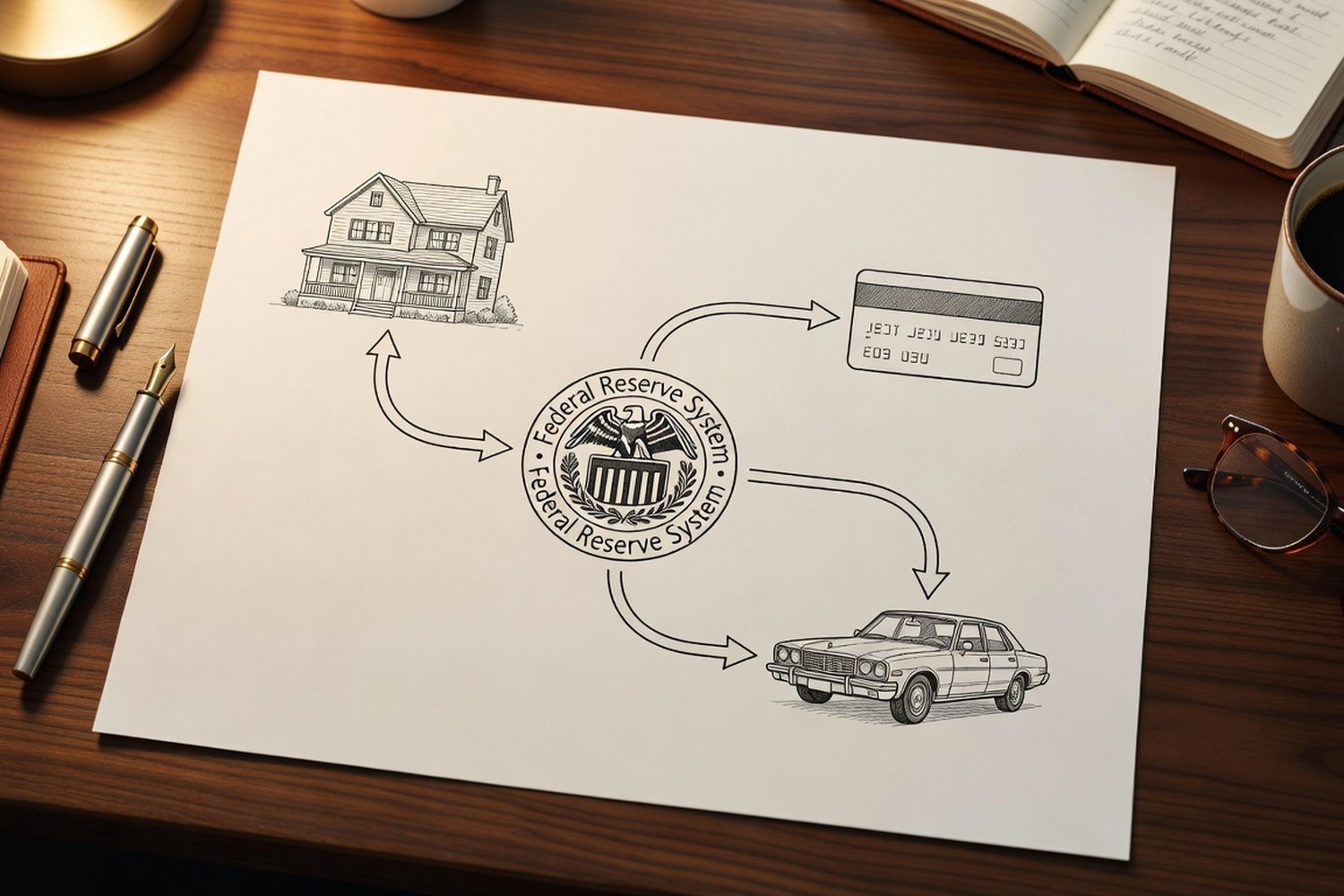
Let me walk you through the chain of events that happens when the Federal Reserve changes interest rates, because most explanations skip the middle steps that matter most. The Fed sets one rate: the federal funds rate. That’s the rate banks charge each other for overnight loans. Right now it’s 3.50–3.75%. From that single decision, a cascade of rate changes ripples through the entire financial system, but the speed and magnitude of that ripple depends entirely on which loan product you’re looking at.
The most direct connection runs through the prime rate. Every major bank in the country sets its prime rate at exactly the fed funds target upper limit plus 3 percentage points. So with the fed funds rate at 3.50–3.75%, the prime rate is 6.75%. When the Fed cuts by 25 basis points, the prime rate drops by exactly 25 basis points. No delay, no interpretation, no wiggle room. This is why credit cards, HELOCs, and most variable-rate consumer loans respond immediately to Fed changes—their rates are contractually tied to prime. I’ve reviewed hundreds of credit card agreements over the years, and virtually every one says something like “your APR equals the prime rate plus X%.”
The indirect connection is more interesting and more consequential for most borrowers. Fixed-rate mortgages, the most common loan product in America, don’t track the fed funds rate at all. They track the 10-year Treasury yield, which is set by market forces: inflation expectations, government debt supply, global capital flows, and general risk appetite. The Fed influences these factors, but doesn’t control them. That’s why you sometimes see the counterintuitive scenario where the Fed cuts rates but mortgage rates go up—it happened in late 2024 when the Fed’s first cut actually spooked bond markets about future inflation, pushing the 10-year yield higher.
How Do Fed Rate Decisions Affect Mortgage Rates?
This is the single most important question in personal finance right now, and the answer is more nuanced than the headlines suggest. Let me break it down by mortgage type because they’re fundamentally different products with different rate mechanisms, even though they all help you buy a house.
Fixed-rate mortgages (30-year and 15-year): These track the 10-year Treasury yield, currently at 4.30%. The typical spread between the 10-year yield and the 30-year mortgage rate is 200–250 basis points, which puts today’s 6.38% rate right in the expected range. When the Fed signals rate cuts, the 10-year yield sometimes drops in anticipation, which can push mortgage rates lower before the Fed actually does anything. But this isn’t guaranteed. During the current cutting cycle, the 10-year yield has actually risen from 3.6% in September 2024 to 4.3% today, despite five Fed cuts. The result? Mortgage rates are roughly where they were when the cutting started. This has frustrated a lot of would-be homebuyers who were told “just wait for the Fed to cut.”
Adjustable-rate mortgages (ARMs): These are a completely different animal. After the fixed period ends (5 years for a 5/1 ARM), the rate resets annually based on a benchmark, usually SOFR (currently 3.68%). Since SOFR tracks overnight lending rates that are directly influenced by the fed funds rate, ARM adjustments respond predictably to Fed policy. If the Fed cuts 25bp, your ARM rate at the next adjustment will likely be about 25bp lower. This makes ARMs a better deal in cutting environments and a worse deal in hiking environments—exactly as you’d expect.
Home equity lines of credit (HELOCs): These are the most Fed-sensitive mortgage product. HELOC rates are explicitly pegged to prime rate, so when the Fed moves, your HELOC rate moves within one to two billing cycles. With the prime rate at 6.75%, the average HELOC sits around 8.25% (prime + 1.5%). The five Fed cuts since 2024 have already reduced HELOC rates by about 1.25 percentage points from their peak. If you’ve got a HELOC, you’ve already benefited from Fed policy more than most borrowers realize. Track the latest on our mortgage rates hub.
Pro Tip: If you’re shopping for a mortgage, watch the 10-year Treasury yield, not the fed funds rate. When the 10-year dips below 4.0%, mortgage rates tend to follow within days. Set a rate alert with your lender and be ready to lock quickly—these windows don’t stay open long. You can monitor daily yield movements on our Treasury yield curve tracker.
How Do Fed Rate Decisions Affect Personal Loans?
Personal loans are the trickiest product to connect to Fed policy because they don’t track any single benchmark rate. Unlike credit cards (prime) or mortgages (10-year Treasury), personal loan rates are set by individual lenders based on a cocktail of factors: their own cost of funds, competitive dynamics, credit risk appetite, and general market conditions. The Fed’s influence flows through indirectly and with a significant lag.
Here’s what actually happens when the Fed cuts. Banks’ cost of funding drops because they can borrow from each other more cheaply. That lower cost eventually gets passed on to borrowers, but not immediately and not in full. Lenders absorb some of the benefit as additional profit margin, especially when demand for loans is strong. During the current cutting cycle, the average personal loan APR has dropped from about 12.9% to roughly 12.5%—a half-point decline despite 1.25 percentage points of Fed cuts. That pass-through ratio of about 40% is actually typical based on historical patterns.
The bigger factor for your personal loan rate is your credit profile. The spread between what an excellent-credit borrower pays (around 7–9% APR) and what a fair-credit borrower pays (18–25% APR) dwarfs any Fed-related rate movement. A 25bp Fed cut might save you $12 per year on a $10,000 loan at 12%. Improving your credit score by 50 points could save you $500 per year on the same loan. That’s why I always tell people: focus on your credit first, Fed policy second. Compare current offerings from top lenders like SoFi, Upstart, and Best Egg to see how rates vary by credit tier.
What Happens to My Loan When the Fed Changes Rates?
Let me make this as concrete as possible. Forget the theory for a second and look at what actually changes in your monthly payment when the Fed cuts rates by 25 basis points (0.25 percentage points). The answer depends entirely on what kind of debt you’re carrying.
| Your Debt Type | Balance | Current APR | New APR After 25bp Cut | Annual Savings |
|---|---|---|---|---|
| Credit Card | $5,000 | 20.97% | 20.72% | $12.50 |
| HELOC | $50,000 | 8.25% | 8.00% | $125 |
| ARM (at adjustment) | $300,000 | 5.90% | 5.65% | $528 |
| 30-Yr Fixed Mortgage | $300,000 | 6.38% | 6.38% | $0 (no change) |
| Personal Loan (fixed) | $15,000 | 12.50% | 12.50% | $0 (already locked) |
The pattern here is stark. If you have a $300,000 ARM, a single 25bp cut saves you $528 per year. That’s meaningful. But your credit card with a $5,000 balance? It saves you $12.50—barely enough to buy lunch. And your fixed-rate mortgage and locked personal loan? Nothing changes at all. The rate you agreed to when you signed the paperwork is the rate you’ll pay regardless of what the Fed does. This is why financial advisors talk about the distinction between fixed and variable rates so often: it’s the single biggest factor determining whether Fed policy matters to your wallet.
Here’s a nuance most people miss: even for variable-rate products, the Fed’s influence has a ceiling. Credit card issuers aren’t going to lower your rate below their minimum margin. Most cards have a contractual floor APR, and many have penalty rates that don’t adjust at all. Plus, if you’re carrying a promotional 0% APR balance, Fed changes don’t affect you until the promo expires. Always read your cardholder agreement to understand exactly how your rate is calculated.
When Is the Best Time to Get a Loan Based on Fed Policy?
This is where knowing the transmission chain pays off in real dollars. The optimal timing for getting a loan depends on which type of loan you need, and the strategies are almost opposite for different products. I’ve watched thousands of borrowers get this wrong by applying a one-size-fits-all “wait for the Fed to cut” approach, so let me lay out the actual playbook.
For fixed-rate mortgages: The best time to lock is when the Fed is making dovish noises but hasn’t cut yet. Bond markets are forward-looking—they start pricing in expected cuts weeks or months before they happen, which pushes the 10-year yield down and brings mortgage rates with it. By the time the Fed actually announces a cut, the mortgage rate decline has already happened. If you wait until the day of the FOMC announcement, you’ve missed the window. Watch for key phrases in Fed communications like “prepared to adjust” or “balance of risks has shifted”—those are your signals to start shopping. Our Fed rate forecast page tracks these signals daily.
For HELOCs and variable-rate debt: Timing matters less because your rate will automatically adjust with the Fed. If you need a HELOC, get it when you need it. The rate will take care of itself as the Fed moves. What does matter is your credit score at the time of application, because the spread above prime is determined by your creditworthiness. A borrower with a 780 FICO might get prime + 0.5% while someone at 680 gets prime + 2%. That 1.5% spread persists for the life of the line, regardless of what the Fed does.
For personal loans: The best time is when your credit profile is strongest, full stop. The rate difference between a 720 FICO and a 780 FICO at the same lender is typically 3–5 percentage points—far larger than any Fed-related rate movement. If you’re considering a personal loan, spend 30 days improving your credit (pay down balances, dispute errors, avoid new inquiries) rather than trying to time the Fed. Once you’re ready, prequalify with multiple lenders to compare offers, which you can do without affecting your score. Start with our lender reviews to find the best fit.
Pro Tip: If you’re carrying high-rate variable debt (credit cards at 20%+), don’t wait for Fed cuts to bring your rate down. Consolidate into a fixed-rate personal loan at 8–15% now. You’ll save money immediately AND eliminate the uncertainty of future Fed decisions. The worst financial position is hoping for rate relief that may never come while paying 21% interest.
Historical Impact: What Happened to Loan Rates During Past Fed Cycles
History gives us the best evidence for how loans respond to Fed policy. Let me walk through the two most recent and relevant cycles, because they prove exactly the points I’ve been making throughout this guide.
The 2022–2023 hiking cycle: The Fed raised the federal funds rate from near zero to 5.25–5.50% in the most aggressive tightening campaign since the Volcker era. Credit card APRs marched in lockstep, climbing from around 16% to above 22%. HELOC rates surged from roughly 4% to over 9%. These variable-rate products tracked perfectly. But here’s the key data point: 30-year mortgage rates actually peaked at 7.79% in October 2023, two months before the Fed finished hiking. The mortgage market priced in the full cycle before it was complete. By the time the Fed held steady in early 2024, mortgages had already started drifting lower. This is the forward-looking behavior I keep emphasizing.
The 2024–2026 cutting cycle: The Fed has cut five times, bringing the rate from 5.25–5.50% down to 3.50–3.75%. Credit card APRs dropped about 1.25 points. HELOCs fell by roughly the same. But fixed mortgage rates have been stubbornly flat. In September 2024, when the first cut hit, the 30-year mortgage was at 6.35%. Today, after five total cuts totaling 175 basis points, it’s at 6.38%. Flat. Why? Because the 10-year Treasury yield has risen on the back of persistent inflation concerns and massive government borrowing. The Fed can control the short end of the yield curve, but the long end has a mind of its own.
Personal loans showed a mixed response during both cycles. During the hiking period, average APRs rose about 3 percentage points—less than the 5.25 points of Fed hikes. During the cutting period so far, they’ve dropped about 0.5 points against 1.75 points of Fed cuts. The pass-through is always partial and delayed, which confirms that personal loan pricing is driven more by credit market conditions and lender competition than by Fed policy alone. The bottom line from history: variable-rate borrowers should care deeply about Fed cycles, fixed-rate borrowers should focus on the bond market instead, and personal loan shoppers should focus on their own credit profile above all else.
Frequently Asked Questions About How the Fed Affects Loans
How do Fed rate decisions affect mortgage rates?
Fixed-rate mortgages (30-year and 15-year) are tied to the 10-year Treasury yield, not the fed funds rate, which means they respond indirectly to Fed policy. When the Fed signals future rate changes, bond markets adjust the 10-year yield in anticipation, and mortgage rates follow that Treasury movement rather than the Fed’s actual decision. During the current cutting cycle, the Fed has cut 175 basis points but mortgage rates have barely budged because the 10-year yield has risen on inflation concerns.
Adjustable-rate mortgages (ARMs) and HELOCs are a different story. These track SOFR and the prime rate respectively, both of which move in direct lockstep with the fed funds rate. A 25bp Fed cut translates to a 25bp reduction in your ARM rate at the next adjustment period or your HELOC rate within one to two billing cycles. This direct connection makes ARMs and HELOCs far more sensitive to Fed policy than fixed-rate mortgages.
How do Fed rate decisions affect personal loans?
Personal loan rates are indirectly affected by Fed policy. Unlike credit cards or HELOCs, personal loans don’t track any single benchmark rate. Instead, lenders set rates based on their cost of funds (which does decline when the Fed cuts), competitive dynamics, and individual borrower credit risk. Historically, about 30–40% of a Fed rate change eventually passes through to personal loan rates, but with a lag of several months.
The far bigger determinant of your personal loan rate is your credit score and debt-to-income ratio. The difference between what an excellent-credit borrower pays (7–9% APR) and what a fair-credit borrower pays (18–25% APR) is 10–16 percentage points—vastly more than any Fed-related rate movement. Improving your credit profile will almost always save you more money than waiting for a Fed cut.
What happens to my loan when the Fed changes rates?
It depends on whether your loan has a fixed or variable rate. For variable-rate products like credit cards, HELOCs, and adjustable-rate mortgages, your interest rate will change within one to two billing cycles after a Fed decision. The adjustment is usually the exact amount of the Fed’s change (25 basis points per typical move). For fixed-rate products like standard mortgages and fixed personal loans, absolutely nothing happens—the rate you locked in when you signed the loan agreement stays the same regardless of what the Fed does.
For a concrete example: if the Fed cuts 25bp and you have a $50,000 HELOC at prime + 1.5%, your rate drops from 8.25% to 8.00%, saving you about $125 per year. But if you have a $300,000 fixed mortgage at 6.38%, your payment doesn’t change by a single penny. The lesson: always know whether your debt is fixed or variable before trying to predict how Fed policy will affect your finances.
When is the best time to get a loan based on Fed policy?
The optimal timing depends on the loan type. For fixed-rate mortgages, the best window opens when the Fed signals future cuts through dovish language but hasn’t actually cut yet—that’s when bond markets start pricing in lower rates, pushing mortgage rates down ahead of the formal decision. By the time the cut is announced, the mortgage rate decline has already been captured. Watch for phrases like “balance of risks has shifted” or “prepared to adjust” in Fed communications.
For variable-rate products like HELOCs, timing the Fed matters less because your rate automatically adjusts. Get the loan when you need it, and focus on negotiating the best spread above prime. For personal loans, the best time is when your credit score is at its peak—the rate difference between credit tiers (often 5–15 percentage points) overwhelms any Fed-related rate movement. Spend a month optimizing your credit profile before applying rather than trying to time a Fed meeting.
Does a Fed rate cut mean my mortgage payment goes down?
Not if you have a fixed-rate mortgage, which is what roughly 90% of American homeowners carry. Your monthly payment is locked in for the life of the loan and won’t change regardless of what the Fed does. The only way to get a lower payment is to refinance into a new loan at a lower rate, which involves closing costs of 2–5% of the loan amount.
If you have an adjustable-rate mortgage (ARM), then yes—your payment will decrease at the next rate adjustment after a Fed cut. A 25bp cut on a $300,000 ARM saves roughly $44 per month. And if you have a HELOC, your interest charges will decrease within one to two billing cycles. But remember: mortgage rates for new fixed-rate loans don’t necessarily follow Fed cuts because they track the 10-year Treasury, not the fed funds rate.
How quickly do credit card rates change after a Fed decision?
Very quickly. Most credit card issuers adjust APRs within one to two billing cycles after a Fed rate change, though a few update as soon as the next statement. Credit card rates are contractually tied to the prime rate, which moves immediately when the Fed changes the federal funds rate. If the Fed cuts 25bp on a Wednesday, the prime rate drops 25bp that same day, and your card issuer updates your APR accordingly at the next cycle.
Keep in mind a few caveats. First, card issuers lower rates more slowly than they raise them—that’s a well-documented phenomenon called “asymmetric rate pass-through.” Second, some cards have floor rates below which they won’t go. Third, promotional and penalty APRs may not adjust at all. Check your cardholder agreement for the specific formula used to calculate your rate, which is usually expressed as “prime rate plus X%.” For the best credit card rates available today, see our comparison page.
Should I refinance before or after the Fed cuts rates?
Counterintuitively, before is often better. Mortgage rates typically drop in the weeks leading up to a Fed cut as bond markets price in the expected action. Once the cut is announced, much of the rate decline has already occurred, and sometimes rates actually tick back up on a “buy the rumor, sell the news” dynamic. If your break-even period (the time for monthly savings to recoup closing costs) is under 24 months at current rates, refinancing now makes mathematical sense regardless of future Fed actions.
There’s also an opportunity cost to consider. Every month you wait for a potentially lower rate, you’re paying interest at your current higher rate. If you’re currently at 7.5% and could refinance to 6.38%, waiting six months for a potential further 25bp decline costs you about $1,900 in extra interest on a $300,000 loan. That $1,900 buys you the chance at maybe saving $50 per month if the rate does drop 25bp. The math rarely favors waiting unless rates are actively trending downward and you expect significant movement. Use our mortgage calculator to run your specific numbers.
Why didn’t my personal loan rate drop when the Fed cut?
If you already have a fixed-rate personal loan, the rate can’t change—it was set when you signed the agreement and stays fixed for the life of the loan regardless of Fed actions. This is actually a feature, not a bug: you’re protected from rate increases in exchange for not benefiting from decreases. The only way to get a lower rate is to refinance into a new loan, which may or may not be worth it depending on the remaining balance and term.
If you’re shopping for a new personal loan and noticed rates haven’t dropped as much as the Fed has cut, that’s normal. Personal loan rates are influenced by the Fed but not directly pegged to it. Lenders factor in their funding costs (which did drop), credit risk premiums (which haven’t changed), and competitive dynamics (which vary by lender). Historically, only about 30–40% of Fed rate changes pass through to personal loan pricing, and with a lag of 3–6 months. Shopping multiple lenders is a more effective strategy for getting a better rate than waiting for the Fed.
What’s the difference between the prime rate and the federal funds rate?
The federal funds rate (currently 3.50–3.75%) is the rate banks charge each other for overnight loans. It’s set by the Federal Reserve’s FOMC committee at its eight annual meetings. The prime rate (currently 6.75%) is the base rate that banks charge their most creditworthy commercial customers. It’s always exactly 3 percentage points above the upper bound of the fed funds target range—this has been the standard spread since 1994.
For consumers, the prime rate matters more because it’s the actual benchmark used in most variable-rate loan agreements. When your credit card says your APR is “prime + 14.22%,” that means 6.75% + 14.22% = 20.97%. When the Fed cuts 25bp, prime drops to 6.50%, and your APR becomes 20.72%. The prime rate dashboard on our site tracks both rates and their historical relationship in real time.
How does the Fed rate affect student loan rates?
Federal student loans have fixed rates that are set once per year by Congress based on the 10-year Treasury yield at a specific May auction, plus a legislated spread. Once set, your rate doesn’t change for the life of that particular loan. The Fed has no direct influence, and a Fed rate cut in October won’t affect the rate on a loan you took out in August. The current rate for undergraduate Direct Loans is 6.53%, which was set based on the May 2025 Treasury auction.
Private student loans are a different story. Some have variable rates tied to SOFR or the prime rate, which means they do respond to Fed changes. Others have fixed rates that, like personal loans, are indirectly influenced by market conditions. If you have private variable-rate student loans, the five Fed cuts since 2024 have already reduced your rate by about 1.25 percentage points. If you’re considering consolidating federal loans into a private loan to get a lower rate, be very careful—you’d be giving up federal protections like income-driven repayment and potential forgiveness programs.
Sources & References
- Federal Reserve H.15 Selected Interest Rates — Daily prime rate, Treasury yields, and key benchmarks
- FRED: Bank Prime Loan Rate — Historical prime rate data from 1955 to present
- CFPB: Credit Card Interest Rate Explainer — How APR is calculated from prime rate
- Freddie Mac: Primary Mortgage Market Survey — Weekly mortgage rate data since 1971
- NY Fed: Secured Overnight Financing Rate (SOFR) — Daily SOFR rates and methodology
- FRED: Commercial Bank Credit Card Interest Rate — Average credit card APR data
- Federal Reserve FOMC Calendar — Official meeting dates and statements
- Bureau of Labor Statistics: Consumer Price Index — Inflation data driving Fed decisions
- FRED: 30-Year Fixed Rate Mortgage Average — Weekly mortgage rate history
- Federal Student Aid: Interest Rates — How federal student loan rates are set
Keep Reading
- Current Prime Rate — Today’s prime rate and what drives it
- Fed Rate Forecast 2026 — CME FedWatch probabilities and scenario analysis
- U.S. Interest Rates Dashboard — All key rates in one place
- Treasury Yield Curve Monitor — Daily yield curve data and mortgage rate signals
- Mortgage Rates Today — Current mortgage rates compared
- Best Personal Loans — Compare top lenders by rate and credit tier
- Best Credit Cards — Low APR and balance transfer offers
- Mortgage Calculator — Calculate payments at any rate scenario
Financial Disclaimer
This article is for informational purposes only and should not be construed as financial advice. Interest rates quoted are approximate averages as of the date shown and vary by lender, credit profile, loan amount, and other factors. The relationship between Federal Reserve policy and consumer loan rates involves complex market dynamics that may produce results different from historical patterns. Always consult with a qualified financial advisor before making major borrowing or refinancing decisions. PrimeRates.com is operated by Manatee Group LLC and is not affiliated with the Federal Reserve, any government agency, or any lending institution mentioned in this article.