
By Mitch Strohm
Reviewed by Laura Adams, MBA | Updated March 20, 2026
Key Takeaways
- Truly “no credit check” business loans are rare — most alternative lenders still run a soft pull. What they really offer is approval based on revenue and cash flow rather than your FICO score.
- Merchant cash advances, invoice factoring, revenue-based financing, and PayPal Working Capital all focus on business performance over personal credit history.
- These products fund fast (often same-day) but cost more — expect effective APRs of 20% to 150%+ versus 7%–15% from traditional bank loans.
- Minimum requirements are typically 3–6 months in business and $10,000+ monthly revenue. Some lenders accept credit scores as low as 500 or skip the check entirely.
- Building business credit while using no-credit-check financing positions you for cheaper loans down the road — treat these as a bridge, not a permanent strategy.
Table of Contents
What “No Credit Check” Actually Means
Let’s clear something up first: almost every lender checks something. When lenders advertise “no credit check,” they typically mean one of two things. Either they run a soft credit inquiry that doesn’t affect your score, or they skip the personal credit review entirely and evaluate your business based on revenue, bank statements, and cash flow patterns instead.
That distinction matters. A soft pull shows lenders your credit profile without leaving a mark on your report. Lenders like Credibly, Kapitus, and many merchant cash advance providers use this approach — they’ll see your score, but a low number won’t automatically disqualify you if your business revenue is strong. True no-credit-check lenders like Giggle Finance and PayPal Working Capital don’t pull your personal credit at all. They base decisions entirely on your business activity.
Why does this category exist? Because roughly 43% of small business loan applications get denied by traditional banks, according to Federal Reserve data. The primary reason? Insufficient credit history or low scores. That leaves millions of profitable, revenue-generating businesses unable to access capital through conventional channels — even when they can clearly afford to repay a loan.
No-credit-check financing fills that gap. It’s not free money and it’s not cheap money, but for a business that’s generating consistent revenue and needs capital to grow, it can be the difference between stalling out and scaling up.
Best No-Credit-Check Financing Options
Not all no-credit-check products work the same way. The right choice depends on your business type, how you generate revenue, and how fast you need the money.
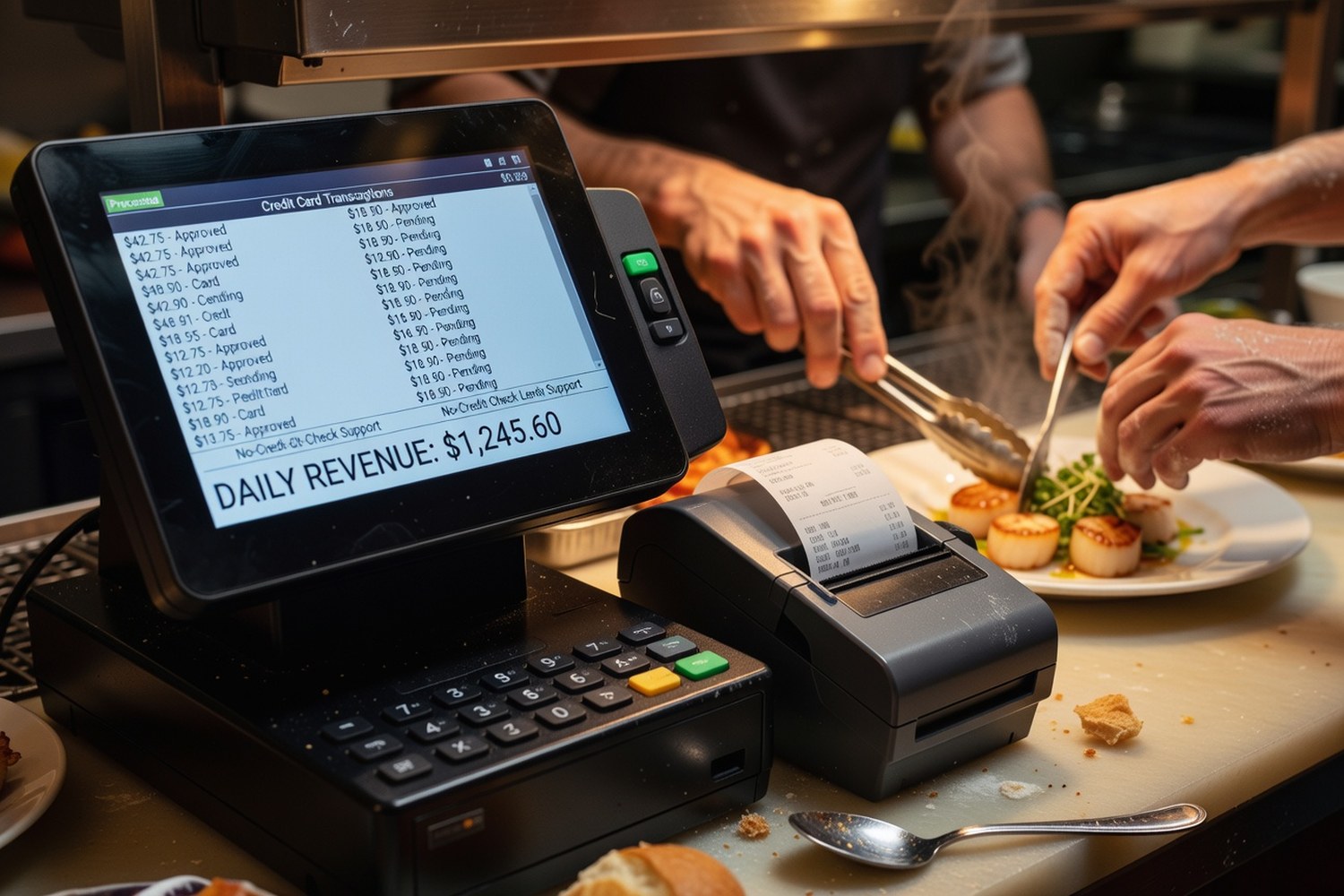
Merchant cash advances (MCAs) are the most accessible option for businesses that process credit card sales. The lender advances you a lump sum and collects repayment by taking a fixed percentage of your daily card transactions. No credit check, no collateral, funding in 24–48 hours. The catch? Factor rates of 1.2 to 1.5 mean you’re paying back $12,000–$15,000 on every $10,000 borrowed — and the effective APR can top 100% on shorter terms. MCAs work best for restaurants, retail stores, and any business with steady card volume.
Revenue-based financing is similar to MCAs but pulls repayment as a percentage of total monthly revenue (not just card sales), making it viable for businesses that receive payments by check, ACH, or cash. Repayment flexes with your income — slow months mean smaller payments. Factor rates typically run 1.15 to 1.45, and most lenders require 3–6 months of bank statements rather than a credit score.
Invoice factoring is the sleeper option most business owners overlook. If you sell to other businesses (B2B) and have unpaid invoices, a factoring company buys those invoices at 80%–95% of face value and collects directly from your customers. Your credit doesn’t matter — the factor evaluates your customers’ creditworthiness. Fees run 1%–5% per month depending on invoice age and customer reliability. This is often the cheapest no-credit-check option for service businesses, manufacturers, and contractors with reliable corporate clients.
PayPal Working Capital requires no credit check at all — eligibility is based entirely on your PayPal Business account sales history. Loan amounts range from $1,000 to $200,000 (up to $300,000 for repeat borrowers), and funds deposit in minutes. The cost is a single fixed fee disclosed upfront — no compounding interest. You choose what percentage of daily PayPal sales goes toward repayment. If you already process through PayPal, this is hard to beat for convenience.
Kiva microloans are the only truly interest-free option. The nonprofit platform lets you crowdfund loans up to $15,000 from individual lenders. There’s no credit check, no interest, and no fees. The trade-off: you need to recruit friends and family to kickstart your loan campaign, and funding takes weeks, not hours. It’s not fast, but for a patient business owner with a compelling story, $15,000 at 0% is unbeatable.
💡 Pro Tip
If you process credit card sales, get your last three months of processing statements before you apply. Lenders offering no-credit-check MCAs base your loan amount on average monthly card volume — typically 1x to 1.5x your monthly processing. Knowing your number upfront tells you exactly how much you can realistically borrow.
Compare No-Credit-Check Lenders
| Lender / Product | Type | Amount | Credit Check? | Speed |
|---|---|---|---|---|
| Giggle Finance | MCA | Up to $10K | None | Same day |
| PayPal Working Capital | Fixed-fee loan | $1K – $200K | None | Minutes |
| Credibly | MCA / Term loan | $5K – $600K | Soft pull only | Same day |
| FundThrough | Invoice factoring | Up to $10M | None | 1–3 days |
| Kiva | Microloan (0% interest) | Up to $15K | None | 2–4 weeks |
| Fora Financial | Term loan | $5K – $1.5M | Soft pull (min 570) | 24 hours |
Lender details as of March 2026. Terms, amounts, and requirements are subject to change. Verify directly with lenders before applying.
How to Qualify Without a Credit Score
When personal credit isn’t the deciding factor, lenders shift their focus to your business fundamentals. Here’s what actually gets you approved.
Monthly revenue is king. Most no-credit-check lenders want to see at least $10,000 per month in gross revenue, verified through 3–6 months of bank statements. Higher revenue means larger loan offers and (sometimes) lower costs. A business doing $50,000/month has dramatically more options than one doing $12,000.
Time in business matters. Six months is the typical minimum for MCAs and revenue-based lending. Twelve months opens the door to better terms. Kiva has no minimum, but the crowdfunding process favors businesses with a track record and a compelling story.
Bank account health tells the real story. Lenders analyze your bank statements for average daily balance, deposit consistency, overdrafts, and NSF (non-sufficient funds) returns. Frequent negative balances or returned payments are red flags — even without a credit check. Keep at least a two-week operating cushion in your account for the three months before you apply.
Industry affects your options. Restaurants, retailers, medical practices, and construction companies have the most choices. “High risk” industries — cannabis, firearms, gambling, adult entertainment — face restricted access and higher costs even from alternative lenders.

What No-Credit-Check Loans Really Cost
Here’s where the math gets uncomfortable. No-credit-check financing is expensive — and the way costs are presented can make it hard to compare.
Factor rates vs. APR: Most MCAs and revenue-based lenders quote a factor rate (like 1.3) instead of an APR. A factor rate of 1.3 on a $50,000 advance means you repay $65,000. That sounds like 30% — but because the balance reduces as you repay, the effective APR is actually closer to 50%–60% on a 12-month term. On a 6-month term, it can exceed 100%. Always ask for the total repayment amount and calculate the effective APR yourself, or use a business loan calculator.
Invoice factoring fees are charged per invoice, not annually. A 3% monthly fee sounds small until you realize that’s 36% annualized. On the flip side, factoring fees only apply to invoices you actually factor — if you only need to factor $20,000 in invoices during a slow month, you’re paying 3% on $20,000, not on a full loan balance.
PayPal’s fixed fee is the most transparent pricing model. You see the exact fee upfront — there’s no compounding, no daily deductions that obscure the cost. A $30,000 loan with a $2,400 fee is $2,400 no matter how long repayment takes. That transparency is worth something.
💡 Pro Tip
Before signing any no-credit-check loan, ask the lender for the total dollar amount you’ll repay. Then divide (total repayment – loan amount) by the loan amount, multiply by 365, and divide by the expected repayment period in days. That gives you an approximate annualized cost you can compare across lenders — regardless of whether they quote factor rates, fixed fees, or APR.
Building Business Credit While You Borrow
No-credit-check financing should be a stepping stone, not a permanent address. The goal is to use it to stabilize and grow your business while simultaneously building the credit profile that qualifies you for cheaper loans later.
Open a business credit card. Secured business cards from Capital One Spark and Brex require minimal credit history. Use it for recurring expenses, pay in full every month, and you’ll start building a business credit file within 6 months.
Register with Dun & Bradstreet. Get a free D-U-N-S number at DNB.com. Many vendors and suppliers report payment history to D&B. Paying invoices on time builds your Paydex score — the business equivalent of a FICO score.
Choose lenders that report to bureaus. Some alternative lenders report your payment history to business credit bureaus. Ask before you borrow. On-time payments on a $20,000 MCA that reports to Experian Business or Equifax Business build your profile while you operate.
Graduate to traditional lending. After 12–18 months of clean payment history and growing revenue, apply for an SBA microloan or a bank line of credit. The rate difference — 8% vs. 40% — pays for itself immediately.
Red Flags and Predatory Lenders
The no-credit-check space attracts both legitimate lenders and outright predators. Here’s how to tell them apart.
“Guaranteed approval” is a lie. No legitimate lender guarantees approval without reviewing something — revenue, bank statements, time in business. If someone promises a loan with zero verification, they’re either charging astronomical fees or running a scam.
Upfront fees before funding are a scam. Legitimate lenders deduct origination fees from loan proceeds. They never ask you to wire money, buy gift cards, or pay “processing fees” before you receive funds. This is the single most common small business lending scam.
Watch for “stacking” pressure. Some brokers will encourage you to take multiple MCAs simultaneously — known as stacking. Each advance takes a cut of your daily sales, and combined repayment obligations can exceed your daily revenue. This is how businesses spiral into default.
Read the confession of judgment clause. Some MCA contracts include a “confession of judgment” that lets the lender seize your bank account without going to court if you default. Several states have banned or restricted these clauses, but they still appear in contracts. Read every page before you sign. The CFPB and your state attorney general can help if you encounter predatory terms.
Frequently Asked Questions
Can I get a business loan with no credit check?
Yes. Merchant cash advances, PayPal Working Capital, invoice factoring, and Kiva microloans either skip the credit check entirely or use only a soft pull that doesn’t affect your score. Approval is based on your business revenue and cash flow rather than personal credit history.
What’s the easiest business loan to get with bad credit?
Merchant cash advances have the lowest barriers — many require only 3 months in business and $10,000/month in revenue with no minimum credit score. PayPal Working Capital is even easier if you already have a PayPal Business account with sales history. For interest-free options, Kiva offers microloans up to $15,000 with no credit check and 0% interest.
How much can I borrow without a credit check?
Amounts range from $1,000 (PayPal, Giggle Finance) to $10 million+ (FundThrough invoice factoring). Most MCAs and revenue-based lenders offer 1x to 1.5x your average monthly revenue. A business generating $40,000/month might qualify for $40,000–$60,000 from an MCA lender.
Are no-credit-check business loans expensive?
Generally yes. The convenience and accessibility come at a premium. MCA factor rates of 1.2–1.5 translate to effective APRs of 40%–150%+. Invoice factoring runs 1%–5% per month. PayPal’s fixed fees are more transparent but still higher than bank loan rates. Kiva is the exception — 0% interest, though funding is slower.
Will a no-credit-check loan help build my credit?
Only if the lender reports to business credit bureaus — and most MCA providers don’t. Ask before you borrow. Lenders like Credibly and some term loan providers do report payment history. You can also build credit independently by opening a secured business credit card and registering with Dun & Bradstreet.
References
- Federal Reserve — Small Business Lending Survey
- U.S. Small Business Administration — Loan Programs
- Consumer Financial Protection Bureau — Consumer Resources
- SCORE — Free Business Mentoring
Keep Reading
- Best Business Loans: Compare Top Lenders
- Bad Credit Business Loans (500+ Score)
- Merchant Cash Advance: Pros, Cons & Alternatives
- Emergency Business Loans: Fast Funding
- Same-Day Business Loans
Rates and terms are subject to change. This content is for informational purposes only and does not constitute financial advice. Always review loan terms carefully before signing. Last updated: March 2026.