
- Veterinary practices are considered low-risk borrowers — lenders view DVMs favorably because of stable demand, high earning potential, and recession-resistant revenue
- SBA 7(a) loans offer the best terms for practice acquisitions: up to $5 million, rates of prime + 2.75% to 6.25%, and terms up to 25 years for real estate
- Specialty lenders like U.S. Bank Practice Finance, Bank of America Practice Solutions, and Huntington offer up to 100% financing for qualified veterinarians
- Equipment financing uses the equipment itself as collateral — digital X-ray, ultrasound, and surgical systems can be financed with no additional collateral required
- The average veterinary practice acquisition costs $500,000-$1.5 million, with most lenders requiring 10-20% down for conventional loans and as little as 0-10% for SBA
- Why Veterinary Practices Get Favorable Loan Terms
- Best Loan Types for Veterinary Practices
- Top Lenders for Veterinary Practice Loans
- Lender Comparison Table
- How to Qualify and What Lenders Look For
- Financing a Practice Acquisition vs. Startup
- Mistakes That Cost Veterinary Borrowers Money
- Frequently Asked Questions
Why Veterinary Practices Get Favorable Loan Terms
Here’s something most business owners would envy: veterinarians are among the most bankable borrowers in healthcare. Pet spending in the U.S. topped $147 billion in 2025, with veterinary care accounting for roughly one-third of that — and the industry is growing at 7-8% annually, outpacing the broader economy. Lenders know this, and it shows up in the terms they offer.
Three factors make vets attractive to lenders. First, demand is non-cyclical. People don’t skip their dog’s cancer treatment because the stock market dipped. Second, veterinary revenue is diversified across wellness exams, dental cleanings, surgeries, emergency care, pharmacy sales, and boarding — no single revenue stream dominates. Third, DVMs have high earning potential ($100,000-$200,000+) with specialized credentials that make career pivoting unlikely. You’re not going to abandon a practice you spent 8 years of school preparing for.
The practical result? Practice-specific lenders like U.S. Bank, Bank of America, and Huntington offer up to 100% financing for acquisitions — a term you’ll almost never see in general business lending. SBA lenders approve veterinary applications at rates above the national average. And equipment financing for vet practices typically requires zero additional collateral because the diagnostic and surgical equipment holds its value.
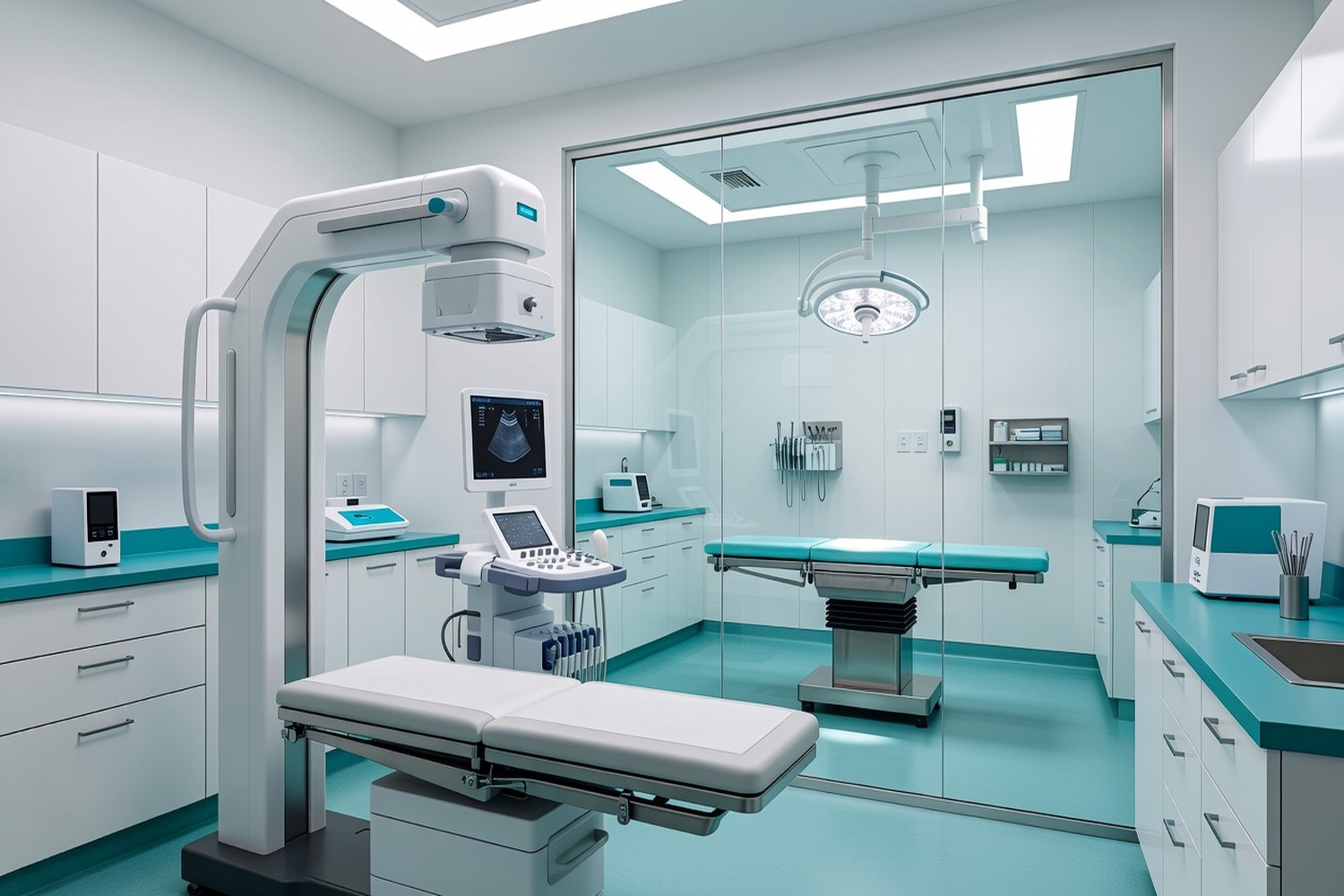
Digital radiology, ultrasound, and surgical equipment can be financed with the equipment itself serving as collateral.
Best Loan Types for Veterinary Practices
SBA 7(a) loans ($50,000-$5,000,000). This is the gold standard for practice acquisitions, major expansions, and real estate purchases. Current rates max out at prime + 2.75% to prime + 6.25% (roughly 9.50-13% as of March 2026), with terms up to 25 years for real estate and 10 years for equipment or working capital. The SBA guarantees 75-85% of the loan, which makes lenders more willing to approve borderline applications. The trade-off: 30-90 days to close, substantial paperwork, and a personal guarantee. For acquisitions over $350,000, SBA 7(a) almost always delivers the lowest total cost.
Practice-specific conventional loans. U.S. Bank, Bank of America Practice Solutions, and Huntington all operate dedicated veterinary lending divisions with underwriters who understand practice valuation, production metrics, and the unique cash flow patterns of animal hospitals. These loans offer up to 100% financing for qualified DVMs, interest-only periods of 6-12 months during ramp-up, and terms up to 15 years. Rates are competitive with SBA (often 7-10% for strong borrowers) and closing is faster — typically 3-4 weeks vs. 6-12 weeks for SBA.
Equipment financing ($10,000-$2,500,000). Veterinary equipment is expensive. A digital radiography system runs $40,000-$80,000. An ultrasound unit costs $25,000-$60,000. Anesthesia machines, surgical tables, dental stations — it adds up fast. Equipment loans use the equipment as collateral, which means no additional liens on your practice or personal assets. Terms typically run 24-84 months with rates from 6-12% for qualified borrowers. U.S. Bank offers application-only equipment financing up to $200,000 for existing clients.
Lines of credit ($25,000-$250,000). Veterinary practices deal with variable cash flow — a slow January followed by a packed spring allergy season. A business line of credit bridges those gaps without the commitment of a term loan. Draw what you need for inventory (pharmaceuticals, vaccines, supplies), payroll during slow months, or emergency equipment repairs. Rates run 8-18% depending on credit, and you only pay interest on what you use.
Top Lenders for Veterinary Practice Loans
U.S. Bank Practice Finance is the most comprehensive option for veterinarians at every stage. They offer startup financing, acquisition loans up to 100%, equipment financing, real estate loans with 25-year terms, and working capital — all through a dedicated veterinary lending team. Their application-only equipment financing up to $200,000 is particularly useful for quick upgrades. U.S. Bank also structures multi-practice financing for DVMs expanding into corporate-style ownership of multiple locations.
Bank of America Practice Solutions partners with AVMA and AAHA, offering members a 50% discount on administration fees. Their practice specialists attend major veterinary trade shows, which means you can discuss financing face-to-face before committing. Preferred Rewards for Business members get an additional 0.25-0.35% rate discount. BofA is strongest for established practices with 3+ years of operating history and strong revenue.
Huntington Bank stands out for first-time practice owners. Their Financial Pulse Program provides coaching for the first 18-24 months of ownership — a Pulse Specialist helps with marketing, staffing, budgeting, and patient attrition. That ongoing support can be the difference between a smooth launch and a cash-flow crisis. Huntington offers up to 100% financing with competitive rates and weekly progress updates during the loan process.
Live Oak Bank is an SBA preferred lender that consistently ranks among the top SBA 7(a) originators nationally. They process SBA loans faster than most banks because of their preferred status, and their veterinary division understands practice valuation at a level most generalist lenders don’t. If you’re going the SBA route for an acquisition over $500,000, Live Oak should be on your shortlist.
Lender Comparison Table
| Lender | Loan Types | Max Amount | Rate Range | Terms | Best For |
| U.S. Bank | Practice, Equipment, RE | $2.5M+ (equip to $2.5M) | Competitive fixed/adj. | Up to 25 yr | All stages |
| Bank of America | Practice Solutions | Varies | AVMA discount avail. | Up to 25 yr | AVMA/AAHA members |
| Huntington Bank | Practice, Startup, RE | Up to 100% financing | Competitive | Up to 25 yr | First-time owners |
| Live Oak Bank (SBA) | SBA 7(a), 504 | Up to $5M | Prime+2.75%-6.25% | Up to 25 yr | Large acquisitions |
| Online lenders | Term, LOC, MCA | $5K-$500K | 15-40%+ | 6 mo-5 yr | Emergency/bridge |
Rates as of March 2026. Exact rates depend on credit, practice revenue, and loan structure. Contact lenders for current quotes.
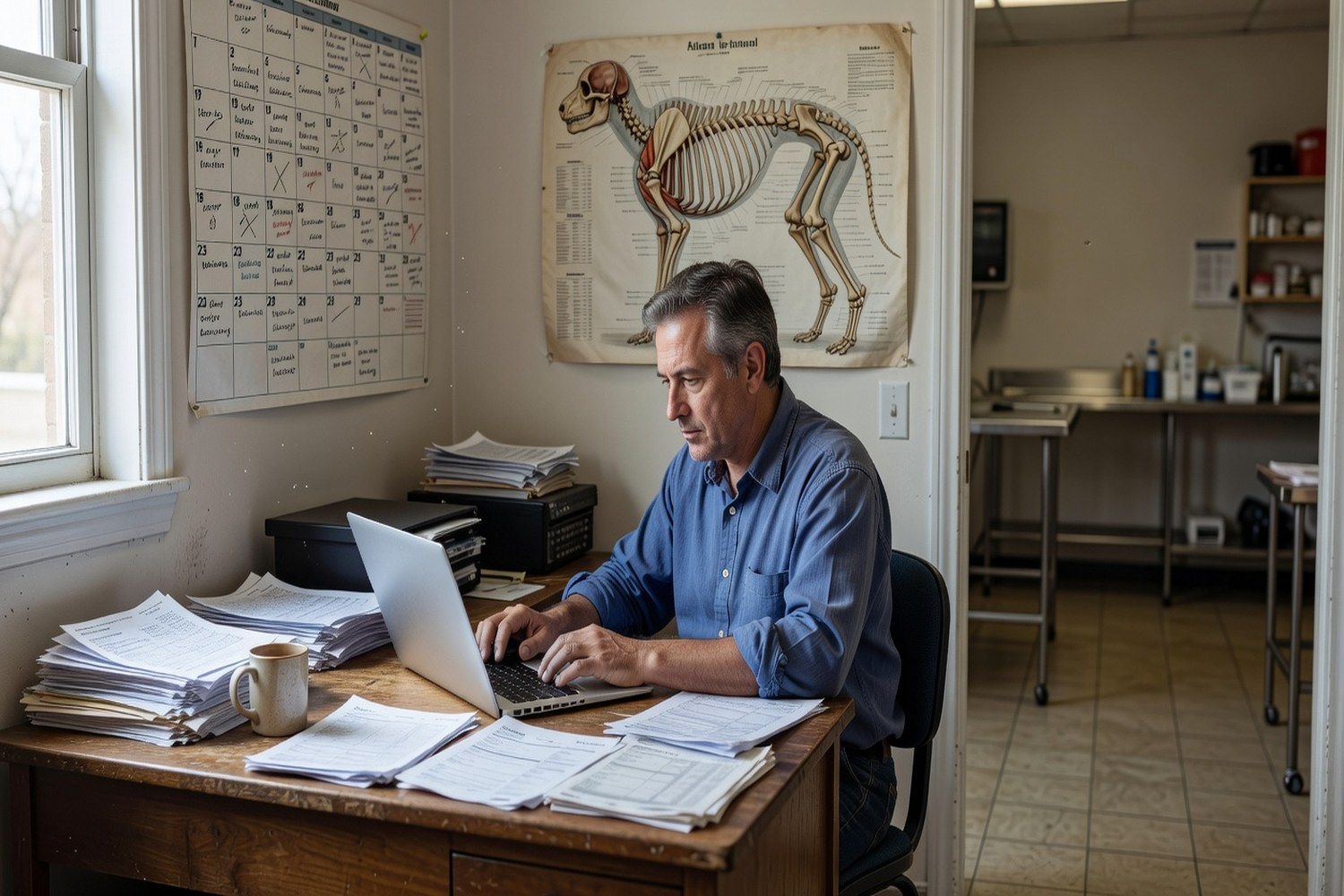
Understanding practice valuation metrics helps you negotiate better loan terms and avoid overpaying for an acquisition.
How to Qualify and What Lenders Look For
DVM credential is your biggest asset. Unlike most business loan applicants, veterinarians bring a professional degree that lenders view as a strong signal of earning potential and career stability. This is why practice-specific lenders offer terms that general business lenders can’t match. Your DVM alone doesn’t guarantee approval, but it gets you in the door at institutions that would turn away other borrowers with the same financial profile.
Credit score requirements. Practice-specific lenders typically want 680+ for conventional practice loans and 650+ for SBA. Online lenders work with scores as low as 550-600, but at significantly higher rates. If your personal credit is below 680, spend 3-6 months paying down credit card balances before applying — the rate improvement from 660 to 700 can save $15,000-$30,000 over the life of a large practice loan.
Practice financials matter more than personal income. For acquisitions and existing practice loans, lenders evaluate the practice’s revenue trends, EBITDA, accounts receivable, and new client acquisition rate. A practice generating $800,000+ in annual revenue with stable or growing trends is significantly easier to finance than a declining practice at $400,000. Request 3 years of tax returns and internal P&L statements from any practice you’re considering acquiring.
Business plan is non-negotiable for startups. If you’re building from scratch, lenders want to see a detailed business plan with market analysis (how many pets per household in your service area, competitor density, drive-time analysis), projected financials for 3-5 years, staffing plans, and your marketing strategy. The AVMA and SCORE both offer free templates and mentorship for veterinary business plans.
Financing a Practice Acquisition vs. Startup
Acquisitions are dramatically easier to finance. When you buy an existing practice, lenders can evaluate actual revenue, client base, equipment condition, and staff retention — all concrete data points. A practice doing $1.2 million in annual revenue with $200,000 in EBITDA and 2,500 active clients is a known quantity. Lenders will finance 80-100% of the purchase price for qualified DVMs because the practice’s cash flow covers the debt service.
The typical acquisition costs $500,000-$1.5 million for a single-doctor practice, with larger multi-doctor hospitals running $2-5 million. Valuation usually lands at 60-80% of annual gross revenue, or 4-7x EBITDA. If you’re offered a practice at 100%+ of gross revenue, the seller’s expectations are probably too high — or there’s something exceptional about the location, equipment, or client base that justifies the premium.
Startups require more skin in the game. Building from the ground up means lenders have no revenue history to evaluate. Expect to put down 15-25% of total project costs for a conventional loan, or 10-15% for SBA. Total startup costs for a veterinary practice run $400,000-$1,000,000 depending on location, build-out complexity, and equipment needs. Leasehold improvements alone can hit $150,000-$300,000 for a 3,000-square-foot clinic.
The upside of starting fresh? You choose the location, design the facility, select every piece of equipment, and build the culture from day one. U.S. Bank and Huntington both offer startup financing up to 100% for well-qualified DVMs with strong business plans. Huntington’s Financial Pulse Program provides ongoing coaching that’s particularly valuable during the first 18-24 months when cash flow is tightest.
Mistakes That Cost Veterinary Borrowers Money
Accepting the first lender’s offer without shopping. Practice-specific lenders compete aggressively for veterinary clients. The rate difference between U.S. Bank, Bank of America, and Huntington on the same practice acquisition can be 0.5-1.5 percentage points — which translates to $25,000-$75,000 over a 15-year loan. Get quotes from at least three practice lenders plus one SBA lender before committing.
Underestimating working capital needs. New practice owners consistently underbudget for the first 6-12 months. You’ll need capital for drug inventory ($30,000-$60,000), staff payroll before revenue ramps ($50,000-$100,000), marketing to build the client base ($15,000-$25,000), and unexpected repairs or equipment failures. Build $100,000-$200,000 in working capital into your total financing package — not as a separate, higher-rate loan after the fact.
Using a merchant cash advance for anything. MCAs charge effective APRs of 40-150% and pull repayment daily from your card processing revenue. On a $50,000 MCA with a 1.3 factor rate, you’ll repay $65,000 — that $15,000 premium could have funded a part-time technician for 6 months. MCAs exist for businesses that can’t qualify for anything else. Veterinary practices almost always have better options.
Skipping the interest-only period. Many practice lenders offer 6-12 months of interest-only payments at the start of a loan. New practice owners sometimes skip this to “start paying down principal faster.” That’s mathematically admirable but practically dangerous — those first 12 months are when cash flow is most unpredictable. Take the interest-only period, build your cash reserve, and accelerate principal payments once revenue stabilizes.
Frequently Asked Questions
How much does it cost to buy a veterinary practice?
Single-doctor practices typically sell for $500,000-$1.5 million, valued at 60-80% of annual gross revenue or 4-7x EBITDA. Multi-doctor hospitals range from $2-5 million. Down payments are 0-20% depending on the lender and loan type.
Can a new graduate get a veterinary practice loan?
Yes, but options are more limited. Huntington and U.S. Bank both finance startups and acquisitions for new DVMs. Expect to provide a strong business plan, have personal credit above 680, and potentially put down 15-25%. Huntington’s Financial Pulse Program specifically supports first-time owners.
What credit score do I need for a veterinary practice loan?
Practice-specific lenders typically want 680+ for conventional loans. SBA lenders generally require 650+. Online alternative lenders work with 550+, but at higher rates. Above 720, you’ll access the best rates and up to 100% financing.
SBA loan or conventional practice loan for a vet practice?
SBA loans offer lower rates and longer terms but take 6-12 weeks to close. Conventional practice loans from U.S. Bank or Huntington close in 3-4 weeks with potentially 100% financing. For acquisitions over $500,000, compare both — the SBA’s lower rate often saves more over the life of the loan despite the slower process.
How long does it take to get a veterinary practice loan?
Practice-specific conventional loans: 3-4 weeks. SBA 7(a) through a preferred lender like Live Oak Bank: 4-8 weeks. Standard SBA: 6-12 weeks. Equipment financing: 1-2 weeks. Online lenders: 1-3 days, but at significantly higher rates.
References
- U.S. Small Business Administration, “7(a) Loan Program,” sba.gov
- American Veterinary Medical Association, “AVMA Economic Data,” avma.org
- Bureau of Labor Statistics, “Veterinarians: Occupational Outlook,” bls.gov
- American Pet Products Association, “Industry Trends & Statistics,” americanpetproducts.org
Keep Reading
- Best Business Loans: Compare Rates & Apply Online
- SBA Loans: Compare 7(a), 504 & Microloan Programs
- Medical Small Business Loans & Practice Financing
- Best Long-Term Business Loans: 3, 5, and 10+ Year Options
- Bad Credit Small Business Loans (500+ Credit Score)
Rates and terms are subject to change. This is not financial advice. All information is for educational and comparison purposes only. Verify current rates directly with each lender before committing to any veterinary practice financing.