
- $300,000 is squarely in mid-market small business lending territory — SBA 7(a) remains the cheapest option at 9.75%-13.75%, with a 75% government guarantee and terms up to 10 years for working capital
- The SBA guarantee fee at $300K is 3% of the guaranteed portion ($225,000 x 3% = $6,750) — substantial, but still far cheaper than the rate premium you’d pay with an online lender
- Bank term loans for well-established businesses (5+ years, 700+ credit, $750K+ revenue) offer 7-11% with 5-10 year terms — sometimes beating SBA rates for existing customers
- At $300K, collateral is almost always required — expect a personal guarantee plus a blanket lien on business assets, or specific collateral like equipment or commercial real estate
- The monthly payment on a $300K SBA loan at 11% over 10 years is $4,132 — your business should generate at least $41,000-$52,000/month in revenue ($490K-$620K annually) to carry this safely
Who Needs a $300K Business Loan
Three hundred thousand dollars is where small business financing starts looking like real capital deployment. At $100K or $150K, you can scrape by with a single product — one SBA loan, one line of credit, maybe an equipment lease. At $300K, you’re doing something material: buying a building, launching a franchise, acquiring another business, or scaling operations in a way that fundamentally changes your company’s trajectory. The businesses that borrow $300K aren’t winging it — they have P&L statements, they know their margins, and they can articulate exactly how this capital generates return.
The typical $300K borrower is a business doing $600K-$1.5M in annual revenue with 3-7 years of operating history. They’ve probably borrowed before — maybe a $50K line of credit or a $100K term loan — and now they need more firepower. A restaurant group opening a second concept. A medical practice buying its office building instead of renting. A construction company adding a $200K piece of heavy equipment plus $100K in working capital to take on larger contracts. An e-commerce brand purchasing $300K in inventory for the holiday season.
Here’s what I want to flag right away: at $300K, the cost spread between financing options is massive. An SBA 7(a) at 11% over 10 years costs $396,000 total. An online lender at 25% over 3 years costs $408,979 — and with payments nearly triple the SBA option ($11,361/month vs. $4,132/month). Same amount borrowed, but the online option requires $135K more in monthly cash flow capacity to service. This is why rushing to the fastest-available lender at $300K is one of the most expensive mistakes a business owner can make. An extra 2-3 weeks of patience saves five figures.

At $300K, the spread between cheapest and most expensive financing exceeds $100,000 in total cost — always compare SBA, bank, and online options.
Loan Types Ranked by Cost
1. SBA 504 — 5%-7% fixed (real estate and fixed assets only). If your $300K is for commercial real estate or major equipment, the 504 program delivers the lowest rate on the market. You put 10% down ($30K), a bank funds 50%, and a Certified Development Company funds the SBA-backed 40%. Rates tied to the 10-year Treasury produce effective rates of 5-7% fixed — far below any variable-rate alternative. Terms: 10-25 years. The trade-off: very specific use restrictions, 60-90+ day timeline, and a CDC partner required. But for qualifying projects, the savings over an SBA 7(a) can reach $30,000-$50,000 in total interest.
2. SBA 7(a) — 9.75%-13.75%. The workhorse of small business lending at $300K. At this size ($150K-$700K tier), the SBA guarantee is 75% and the max rate is prime + 5.5% for terms over 7 years = 12.25%, or prime + 6% for shorter terms = 12.75%. Guarantee fee: 3% of the guaranteed portion ($225K x 3% = $6,750). Terms: up to 10 years for working capital, 25 years for real estate. The SBA 7(a) is the default recommendation for most $300K borrowers because it combines competitive rates with the most flexible use terms.
3. Bank term loan — 7%-12%. Community banks and credit unions that know your business can sometimes beat SBA rates — especially for existing customers. A bank that holds your $80K average monthly deposits and has already extended you a $100K line of credit has institutional knowledge about your cash flow that reduces their perceived risk. At $300K, bank commercial lending teams handle the deal (not branch managers), and they can structure creative terms: step-up payments, seasonal adjustments, or interest-only periods. Timeline: 2-4 weeks.
4. Equipment financing — 5%-20%. If the $300K is for specific assets, equipment financing using the assets as collateral typically offers rates 3-5 points below unsecured alternatives. A $300K fleet of delivery trucks, a $250K manufacturing line, or $300K in medical imaging equipment all qualify. Some equipment lenders go up to 100% financing (no down payment) for borrowers with strong credit.
5. Business line of credit — 8%-25%. Lines up to $250K-$500K are available from Bluevine, Fundbox, and traditional banks. At $300K, a line of credit works best for revolving needs — seasonal inventory, bridging receivables, or staged project draws — rather than a single lump-sum purchase. You only pay interest on drawn amounts, so the effective cost can be lower than a term loan if you manage draws carefully.
6. Online term loan — 15%-35%. OnDeck, Funding Circle, Credibly, and Lendio all fund $300K. On $300K at 25% over 3 years, total interest is $108,979. That’s $108K you wouldn’t pay if you went SBA. Online lending at $300K is almost never the right answer unless you’re facing a genuinely time-critical opportunity that generates returns exceeding the premium — and even then, take the online loan as a bridge and refinance to SBA within 90 days.
Lender Comparison Table
| Loan Type | APR Range | Max Term | Speed | Total Cost (est.) | Mo. Payment (est.) |
| SBA 504 | 5%-7% | 10-25 yr | 60-90 days | $355K (6%/10yr) | $3,332 |
| SBA 7(a) | 9.75%-13.75% | 10-25 yr | 30-90 days | $396K (11%/10yr) | $4,132 |
| Bank Term | 7%-12% | 5-10 yr | 2-4 weeks | $374K (9%/5yr) | $6,229 |
| Equipment | 5%-20% | 3-7 yr | 3-10 days | $356K (7%/5yr) | $5,941 |
| Online Term | 15%-35% | 1-5 yr | 1-3 days | $409K (25%/3yr) | $11,361 |
Total cost = principal + interest at representative rates. SBA rates based on current prime of 6.75%. Bank rates per Federal Reserve Small Business Lending Survey Q3 2025. March 2026.
What $300,000 Actually Costs
At $300K, I’m going to put the total interest numbers in perspective because the scale can be hard to grasp. These aren’t rounding errors — they’re the equivalent of one or two full-time employee salaries.
SBA 504 at 6% over 10 years: $3,332/month. Total interest: $99,806. Total cost: $399,806. This is the cheapest path if your use qualifies (real estate or major fixed assets). The monthly payment fits a business doing $400K+ in annual revenue. You put $30K down and finance the rest at a rate that’s lower than most mortgage rates.
SBA 7(a) at 11% over 10 years: $4,132/month. Total interest: $195,863. Total cost: $495,863 (plus $6,750 guarantee fee). The interest is roughly double the 504 option because the rate is nearly double. But 7(a) can be used for anything — working capital, inventory, debt consolidation, mixed-purpose — while 504 is restricted to fixed assets.
Bank term at 9% over 7 years: $4,720/month. Total interest: $96,525. Total cost: $396,525. This is actually a surprising result — the bank option has lower total interest ($96K vs. $196K for SBA 7(a)) because the shorter term means less time for interest to accumulate. The trade-off is a higher monthly payment ($4,720 vs. $4,132). If your cash flow handles $4,720/month, the 7-year bank option beats SBA 7(a) on total cost by nearly $100K.
Online lender at 25% over 3 years: $11,361/month. Total interest: $108,979. Total cost: $408,979. The monthly payment is staggering — $11,361 requires $113K-$142K in monthly revenue to stay within safe ratios. That’s $1.36M-$1.7M annual revenue. And the total interest ($109K) exceeds what a 504 borrower pays ($100K) despite being paid over 3 years instead of 10. The math at $300K makes online lending almost indefensible except as a very short-term bridge.
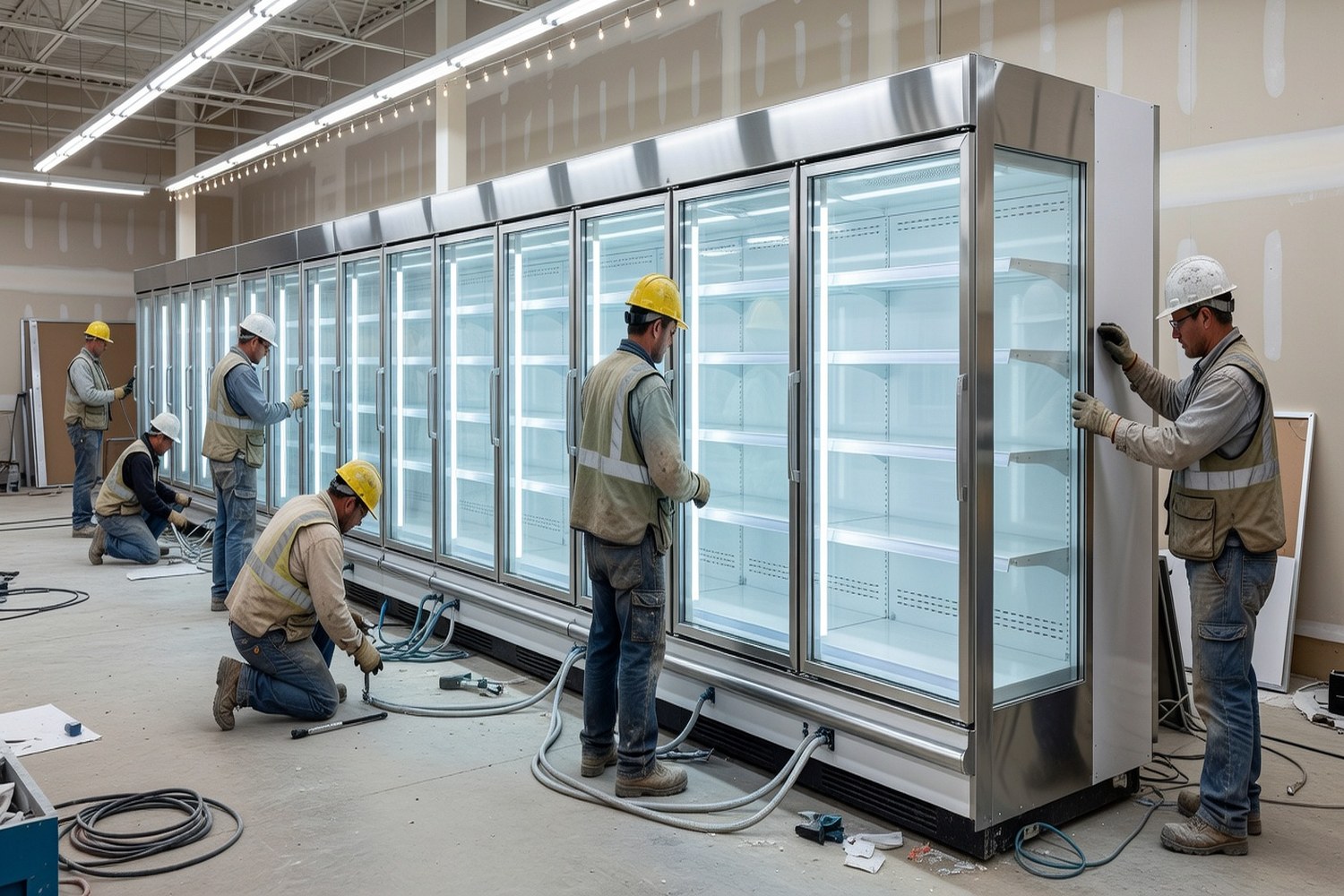
Equipment and buildout projects at $300K often qualify for SBA 504 rates — the cheapest financing available to small businesses.
Qualification Requirements
Revenue. At $300K, most lenders want to see $600,000-$1,000,000+ in annual revenue. The SBA 7(a) payment of $4,132/month (at 11%/10yr) should stay under 8-10% of gross monthly revenue = $41,320-$51,650/month, or $496K-$620K annually. Banks and online lenders at this size typically require $750K+ revenue. The higher your revenue relative to the loan, the more room you have to negotiate rate.
Credit score. SBA: 680+ personal credit, with 720+ getting meaningfully better rates. At $300K, the rate spread between 680 and 740 can be 1.5-2.5 percentage points, which translates to $20,000-$40,000 in total interest over a 10-year term. Banks: 700+ for best rates. Online: 600-620 minimum but with painful rates.
Time in business. Three years minimum is the practical threshold for most lenders at $300K. Under 3 years, you’ll likely be limited to online lenders (expensive) or a combination of SBA plus personal assets as collateral. The SBA technically has no minimum time-in-business requirement, but lenders making $300K SBA loans overwhelmingly prefer 3+ years of operating history with stable or growing revenue.
Collateral. At $300K, unsecured is essentially off the table. Expect a personal guarantee from all 20%+ owners (SBA requires this), plus either a blanket lien on business assets or specific collateral. SBA lenders won’t decline solely for lack of collateral if the business has strong cash flow, but they’ll take what’s available. Banks at this size almost always require specific pledged collateral. Equipment financing uses the purchased equipment itself.
DSCR. The standard: 1.25x minimum. For the SBA $4,132/month payment, that means $5,165/month in net operating income after all other expenses and debt. Most lenders at $300K want to see a DSCR closer to 1.4-1.5x for comfortable approval. Below 1.15x, getting $300K approved from any legitimate lender becomes very difficult.
The SBA Path at $300K
At $300K, the SBA 7(a) is the default starting point for most borrowers. Here’s what the process actually looks like at this loan size — including the parts that SBA marketing materials don’t emphasize.
Guarantee structure. At $300K, the SBA guarantees 75% = $225,000. The lender is exposed to $75,000 of their own capital. The guarantee fee you pay: 3% of $225,000 = $6,750, typically rolled into the loan or paid at closing. Annual servicing fee: 0.55% of the outstanding guaranteed balance, charged to the lender (sometimes passed to you).
SBA Express vs. Standard 7(a). At $300K, you’re within the SBA Express limit ($500K). Express loans use the same rate caps but offer 36-hour SBA turnaround instead of 5-10 business days for the SBA portion of underwriting. The trade-off: Express loans only carry a 50% guarantee (vs. 75% standard), which means your lender takes more risk and may price accordingly. For borrowers with strong credit and collateral, Express at $300K can cut 2-3 weeks off the process with minimal rate impact.
Timeline reality. Standard 7(a) at $300K: 45-90 days from application to funding. SBA Express: 30-60 days. SBA Preferred Lender: sometimes 20-30 days because they have delegated authority to approve without SBA review. The single biggest factor in speed is how quickly you get documentation to the lender. Have everything ready before you start the application. Missing a single document can add 2 weeks.
What kills $300K SBA applications. Insufficient cash flow (DSCR below 1.15x). Tax liens or judgments (must be resolved or in payment plan). Recent bankruptcy (SBA requires it be discharged for 3+ years). Incomplete documentation (lenders won’t chase missing documents — they move to the next application). And asking for $300K without a clear, specific use of funds — at this size, “general business purposes” isn’t persuasive.
How to Apply
Step 1: Define purpose with line-item specificity. At $300K, lenders expect a use-of-funds breakdown: “$300K: $180K commercial buildout, $70K equipment, $50K working capital reserve.” Vague requests at this size get declined or delayed for additional documentation requests.
Step 2: Prepare full documentation before any application. At $300K, the documentation bar is high. Gather: 3 years of business and personal tax returns, current YTD profit and loss + balance sheet, 12 months of business bank statements, personal financial statement (SBA Form 413), business plan or project narrative with financial projections, debt schedule (all existing loans with balances, rates, monthly payments), copies of business licenses, leases, and major contracts, and collateral documentation (equipment lists, property appraisals, A/R aging report).
Step 3: Apply to 3 lenders simultaneously. One SBA Preferred Lender or SBA Express lender. One community bank or credit union where you have an existing relationship. One marketplace or online lender (Lendio, Fundera) for a competing offer. At $300K, having 3 offers isn’t just comparison shopping — it’s genuine leverage for rate negotiation.
Step 4: Compare total cost of capital. SBA guarantee fee ($6,750), bank origination fees ($1,500-$6,000), online origination fees (1-6% = $3,000-$18,000), equipment financing fees (0-2%). Ask every lender: “What is my total cost of capital — principal plus all interest and fees — over the full loan term?” Compare that single number across every offer.
Frequently Asked Questions
What credit score do I need for a $300,000 business loan?
SBA: 680+ personal, with 720+ getting meaningfully better rates. Banks: 700+ for best terms. Online lenders: 600-620 minimum but at 20-35% APR. At $300K, the rate difference between 680 and 740 credit can save $20,000-$40,000 in total interest over 10 years.
What revenue does my business need for $300K?
Most lenders want $600,000-$1,000,000+ annual revenue. The SBA monthly payment at 11% over 10 years is $4,132, which should stay under 8-10% of monthly gross revenue. A DSCR of 1.25x or higher is standard.
How long does it take to get a $300K business loan?
Online lenders: 1-3 days. Bank term loans: 2-4 weeks. SBA Express: 30-60 days. Standard SBA 7(a): 45-90 days. SBA Preferred Lenders can be faster at 20-30 days. Speed depends heavily on how quickly you provide documentation.
SBA 504 vs. 7(a) at $300K — which should I choose?
If your $300K is for commercial real estate or major fixed assets: 504 (5-7% fixed, lowest cost). If you need working capital, inventory, debt consolidation, or mixed purposes: 7(a) (9.75-13.75%, more flexible use). You can’t use 504 for working capital — it’s restricted to fixed assets.
Can I get a $300K business loan with bad credit?
Extremely difficult from legitimate lenders. Some online lenders accept 600+ but charge 25-35% — on $300K that’s $109K+ in interest over 3 years. At $300K, there’s essentially no path to affordable financing below a 650 score. Improve credit before applying if possible.
References
- SBA, “7(a) Loan Program,” sba.gov
- SBA, “504 Loan Program,” sba.gov
- Federal Reserve Bank of Kansas City, “Small Business Lending Survey Q3 2025,” kansascityfed.org
- SBA, “7(a) Fees Effective October 1, 2025 for FY2026,” sba.gov
Keep Reading
- Best Small Business Loans: Compare Rates & Apply Online
- SBA Loans: Compare 7(a), 504 & Microloan Programs
- $200K Business Loans
- $250K Business Loans
- Best Long-Term Business Loans
Rates and terms are subject to change. This is not financial advice. All information is for educational and comparison purposes only. SBA rates based on current prime rate of 6.75% as of March 2026. Always compare multiple lenders and verify current terms directly before committing to business financing.