
How Personal Loans Affect Your Credit Score
A personal loan affects your credit score at three distinct stages: the application (hard inquiry, typically –5 to –10 FICO points), the new account opening


Last Updated: April 2026
Upgrade is a San Francisco-based fintech lender that’s been around since 2014, and they’ve built a reputation for straightforward personal loans without the usual bank red tape. Here’s the thing: when you apply for an Upgrade loan, you’re not dealing with complicated underwriting or months of waiting. The process is surprisingly simple.
You start by telling Upgrade what you need the money for—whether it’s paying off credit cards, funding a home renovation, or covering unexpected expenses. From there, you get an instant quote showing your APR and monthly payment. No hard inquiry yet. If you like what you see, you move forward, and Upgrade pulls your credit. Within 1-2 business days (sometimes faster), the money hits your account.
What makes Upgrade stand out is the flexibility. You can set up the loan however you want—pick your term length from 24 to 84 months, and adjust your monthly payment accordingly. Upgrade handles all the paperwork, sends funds directly to you or to creditors if you’re consolidating debt, and lets you pay it off early without penalty. No surprise fees, no gotchas. Every payment lowers your balance at a fixed rate.
Upgrade’s pricing is competitive but not the cheapest on the market. We’re talking fixed APRs ranging from 9.99% to 35.99%—a pretty wide band that reflects their willingness to lend to folks with credit scores as low as 580. That’s a big deal because many competitors start at 600 or 650.
Here are the key numbers you need to know:
| Feature | Upgrade Details |
|---|---|
| APR Range | 9.99% – 35.99% (fixed) |
| Loan Amounts | $1,000 – $50,000 |
| Loan Terms | 24 to 84 months (2–7 years) |
| Origination Fee | 1.85% – 9.99% (deducted from loan) |
| Min Credit Score | 580 |
| Funding Speed | 1–2 business days (often within 24 hours) |
| Prepayment Penalty | None |
| Late Fee | Up to $25 |
The origination fee is built into your loan, so if you borrow $20,000 and the fee is 5%, you’ll actually receive $19,000 upfront. That stings a bit, but the fixed rate means your payment never changes, which is great for budgeting.
One more thing worth noting: Upgrade doesn’t charge you for making extra payments or paying off the loan early. If you get a bonus or windfall and want to crush the debt faster, you can do that penalty-free. That’s customer-friendly, and frankly, not every lender does this.
This is where Upgrade gets really interesting. The Upgrade Card isn’t just a credit card—it’s a hybrid product that blurs the line between a credit card and a personal loan. Here’s how it works: you get a credit card with a variable APR (like any other card), but Upgrade also lets you convert any purchase into a fixed-rate installment plan right from the app.
Let’s say you need a new roof for $8,000. You swipe the Upgrade Card, and boom—Upgrade gives you the option to instantly convert that charge into a 48-month installment plan at a fixed rate. No hard inquiry. Your credit score doesn’t take another hit. You just pay a fixed monthly amount until it’s done, while your credit card continues to work normally for everyday purchases.
This is a game-changer for home improvement projects because you get the flexibility of a credit card combined with the predictability of a loan. You also get free credit monitoring and credit health tools bundled in, which helps you track your progress month over month.
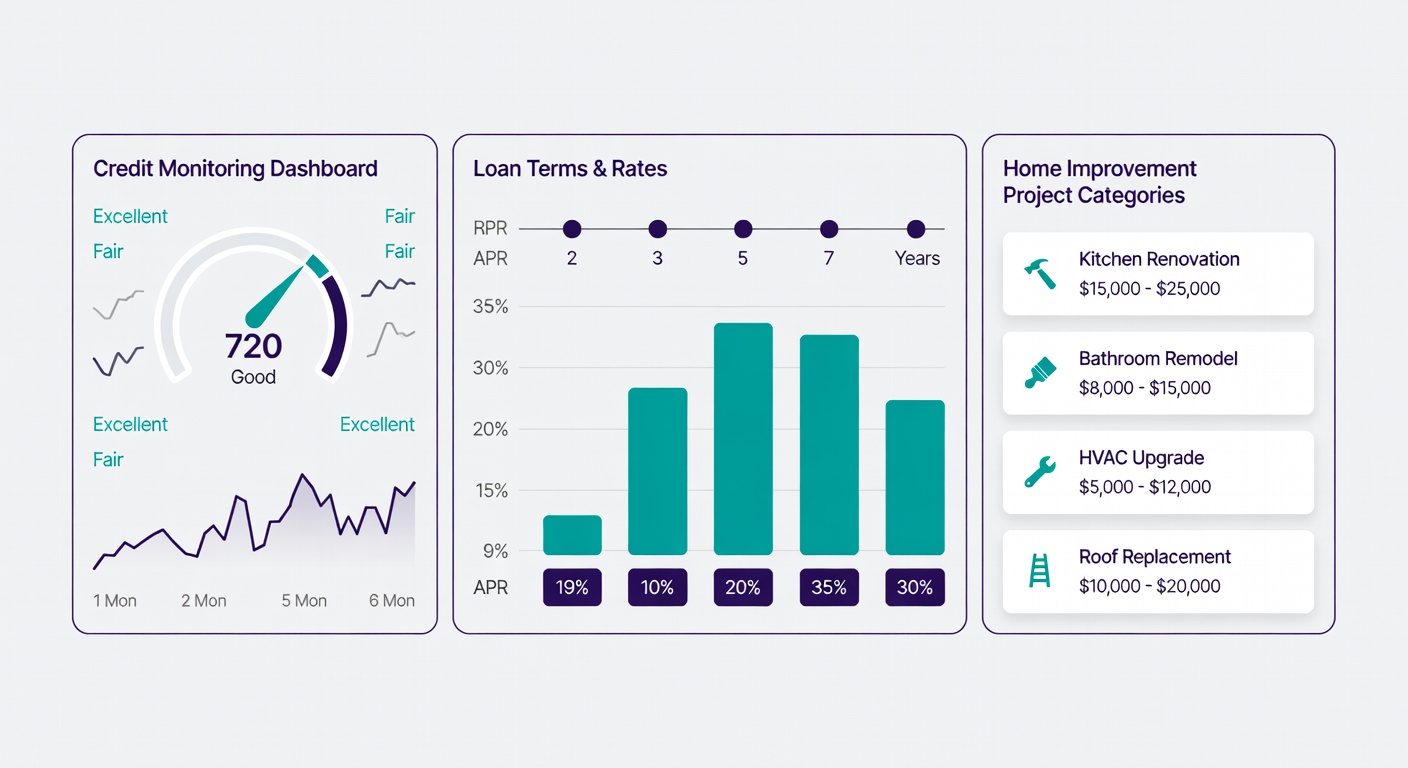
The Upgrade Card’s installment feature is perfect if you’re not sure about the final cost of a project. Buy now, lock in a fixed rate later—it gives you time to shop around and compare contractors without worrying about your credit score taking multiple hits.
If you’re planning a kitchen renovation, replacing the roof, building a deck, or overhauling your bathroom, Upgrade is legitimately one of the best options out there. Here’s why: home improvement is expensive, and most homeowners don’t have $15,000–$40,000 sitting in savings. Upgrade steps in with fast approval, flexible terms, and no collateral required (unlike a home equity loan).
The process is straightforward. You apply for a personal loan, tell Upgrade it’s for home improvement, and once approved, you have a few options. You can take the money and pay your contractor directly. Better yet, Upgrade offers direct creditor payments, which means you can give Upgrade the contractor’s information, and they send the payment straight over. This protects you because the lender and contractor are both in the loop, and it reduces your risk of getting scammed.
For a $25,000 kitchen remodel with Upgrade at 15% APR over 5 years, you’re looking at roughly $590 per month. That’s manageable for most homeowners, and you know exactly what you’re paying every single month—no variable rates, no surprises. Plus, you get the credit monitoring tools to watch your score improve as you pay down the loan.
The catch? Upgrade isn’t a secured lender, so they won’t give you the rock-bottom rates you might get with a home equity line of credit (if you have significant equity). But if you don’t have equity, or you want to avoid the risk of putting your home on the line, Upgrade’s unsecured loan is a solid middle ground.
The application is online, mobile-friendly, and takes about 5 minutes. You’ll need your Social Security number, employment info, income, and details about what you’re borrowing for. Upgrade runs a soft pull initially—this doesn’t hurt your credit. If you like the quote, you authorize a hard pull, and they make a final decision.
Here’s the timeline: apply in the morning, get approved by afternoon, and have money in your account within 1-2 business days. Some people report getting funded the same day, though that’s the exception. Once the loan is in your account, you set up automatic payments (or pay manually), and you’re done.
One pro tip: if your credit score is on the lower end (580–620), Upgrade might ask you to verify employment or provide extra documentation. That adds a day or two, but it’s worth it because they’re willing to lend when others won’t. If you’re joint-borrowing with a spouse, both of you need to apply, and both credit scores will factor into the approval.
How does Upgrade stack up against SoFi, Upstart, Best Egg, and LendingClub? Let’s break it down by the metrics that matter most:
| Lender | APR Range | Min Credit | Origination Fee | Key Feature |
|---|---|---|---|---|
| Upgrade | 9.99% – 35.99% | 580 | 1.85% – 9.99% | Hybrid credit card + loan |
| SoFi | 8.99% – 28.99% | 680 | None | Low rates, no origination fee |
| Upstart | 7.70% – 35.99% | 300 | 0% – 12% | AI-powered, lowest min credit |
| Best Egg | 7.99% – 29.99% | 640 | None – 8.99% | Secured loans available |
| LendingClub | 9.87% – 35.89% | 600 | 1% – 6% | Joint applications, peer-to-peer |
SoFi is cheaper if you have excellent credit (680+), but they won’t touch you if you’re below that. Upstart has the lowest credit floor at 300, which is wild, but their AI underwriting means you might qualify for a loan you didn’t expect. Best Egg offers secured options if you have collateral. LendingClub is good for joint applications. Upgrade’s sweet spot? People with fair credit (580–660) who want flexibility and bundled tools like credit monitoring.
Upgrade accepts credit scores as low as 580, which opens the door to borrowers that most mainstream lenders turn away. The Upgrade Card hybrid product is genuinely innovative—it lets you defer big purchases into installment plans without multiple hard inquiries, which is a huge advantage for home improvement projects. Free credit monitoring and hardship programs come standard, so you’re not paying extra for financial wellness tools.
Fast funding is another win. Money typically lands in your account within 1-2 business days, sometimes faster. No prepayment penalties means you can pay off the loan early if you come into money, without getting dinged for it. Direct creditor payments give you peace of mind if you’re consolidating debt or paying contractors. And here’s the cherry on top: Upgrade is BBB-accredited with over $30 billion in credit extended, so they have a long track record.
The origination fees range from 1.85% to 9.99%, which is substantial. On a $20,000 loan, that’s $370–$2,000 off the top. SoFi and Best Egg offer no origination fees, so if you have strong credit, you’re better off there. The APR floor at 9.99% isn’t bad, but SoFi starts at 8.99%, so rate-wise, you’re not getting the best deal if your credit is excellent.
Customer service gets mixed reviews online. Some people report great experiences, others say hold times are long. The Upgrade Card’s installment feature is cool, but it doesn’t work everywhere—some merchants decline it, and that’s a limitation. Finally, if you’re looking for a secured loan (one backed by collateral), Upgrade doesn’t offer that. You’re locked into unsecured lending, which means higher rates across the board.
If you’re on the fence between Upgrade and SoFi, check your actual APR quotes side-by-side. Upgrade’s willingness to lend to lower credit scores means rates can vary wildly. Sometimes a fair-credit applicant gets a better rate at Upgrade than expected. Always compare your personal quotes before deciding.
Here’s something that catches a lot of people off guard: Upgrade offers fixed-rate loans, which means the prime rate (the rate banks charge each other) doesn’t directly affect your monthly payment after you lock in your loan. Your rate is locked. Done. That’s actually one of the big advantages of a personal loan versus a variable credit card or HELOC.
That said, the broader economy and Federal Reserve decisions do influence Upgrade’s rates in a subtle way. When the Fed raises the prime rate, it typically signals that the overall economy is cooling or inflation is rising. In response, lenders like Upgrade might tighten their underwriting, which means fewer people qualify or those who do get higher rates. Conversely, if the Fed is cutting rates, lenders loosen up a bit, and approval odds and rates improve.
So while your personal loan rate doesn’t fluctuate month-to-month, the prime rate environment shapes the initial rate Upgrade quotes you. If you’re considering borrowing and the Fed is in a hiking cycle, you might see higher starting rates than if rates were stable. That’s why timing matters when you apply—not just for personal reasons, but for getting the best rate available at that moment.
Upgrade personal loans have evolved to serve a wide range of borrowers, from those with fair credit to those with excellent scores. In 2026, the key things to know are that Upgrade’s APRs range from 9.99% to 35.99%, with origination fees from 1.85% to 9.99%—you’re paying for access, but you get flexibility and speed. The company lends up to $50,000 over terms from 2 to 7 years, and they fund most loans within 1-2 business days.
What makes Upgrade stand out this year is their Upgrade Card hybrid product and the free credit monitoring that comes with every account. They also offer hardship programs if life throws you a curveball, and they’ve maintained their BBB accreditation with over $30 billion in credit extended to date. The upgrade personal loan review community widely recognizes them as a legitimate player in the personal loan space, especially for borrowers who don’t qualify for the absolute lowest rates.
A personal loan is absolutely a solid option for home improvement, and in many cases, it’s better than the alternatives. Unlike a home equity line of credit (HELOC), a personal loan doesn’t put your home at risk if you can’t pay. Unlike a credit card, a personal loan gives you a fixed rate and a clear payoff date, so you’re not sitting there paying 18% interest while you debate whether the contractor did the work right. For projects like kitchen remodels, new roofs, deck additions, and HVAC replacements, a personal loan offers predictability.
The main caveat is that unsecured personal loans carry higher interest rates than secured options. If you have home equity and your credit is strong enough to qualify for a HELOC, that might be cheaper. But if you don’t have equity, or you want to avoid the risk, or you just want fast funding without the appraisal process, a personal loan gets the job done. Upgrade specifically supports home improvement with direct creditor payments, so they’re set up to handle this use case well.
Upgrade’s minimum credit score is 580, which is one of the lowest thresholds in the industry. If your score is in the 580–640 range, you’re not automatically disqualified like you would be at SoFi (680 minimum) or Best Egg (640 minimum). That’s a huge advantage if you’re rebuilding credit or if you’ve had some rough patches.
The trade-off is that the lower your score, the higher your APR will be. Someone with a 580 score might be quoted 32%–35.99%, while someone with a 720 score might get 12%–18%. Upgrade runs a soft inquiry first, so you can see your quote without it hurting your credit. If you don’t like the rate, you walk away, and nothing changes on your report.
No, Upgrade does not charge prepayment penalties. If you come into money—a tax refund, a bonus, an inheritance—you can throw it at your Upgrade loan and pay it off early without incurring any fees. This is huge because some lenders penalize you for paying off early (they want to collect all that interest), but Upgrade doesn’t play that game.
That flexibility is one of the reasons Upgrade works well for home improvement loans. If you finish the project early and money is tight, you can make minimum payments. But if you come into extra cash later, you can accelerate the payoff without penalties. It puts you in control of your timeline.
Upgrade typically funds loans within 1-2 business days. In some cases, you might see money in your account within 24 hours, but don’t count on it. The timeline depends on when you apply (weekends and holidays slow things down), whether you submit all required documents promptly, and your bank’s processing speed.
Compared to traditional banks (which take 5-10 business days) or online lenders like Upstart (which can take 3-5 days), Upgrade is competitive. If speed is critical for a home improvement project, Upgrade is a good bet. Just don’t apply on a Friday at 5 PM and expect money Monday morning.
The Upgrade Card is a hybrid credit card and personal loan product. You use it like a normal credit card for everyday purchases, but any charge can be converted into a fixed-rate installment plan directly from the app. No hard inquiry. No credit score ding. If you’re shopping for contractors and haven’t settled on the final cost, you can charge the purchase, and then lock it into installments later once you know exactly what you’re paying.
For home improvement projects, this is incredibly useful. You swipe the card at Home Depot for materials, materials could get an automatic quote to convert that purchase into a 24- to 84-month plan at a fixed rate. You get the convenience of a card with the predictability of a personal loan. The variable card APR applies to balances you don’t convert, so managing it well is important, but the conversion feature is genuinely innovative.
If you miss a payment, Upgrade charges a late fee of up to $25 (depending on how late you are). More importantly, a missed payment gets reported to the credit bureaus, which tanks your credit score. After 30 days, it shows as a 30-day late. After 60-90 days, you’re in serious trouble. At that point, Upgrade can declare the loan in default and take legal action to collect.
The silver lining: Upgrade offers hardship programs if you hit financial difficulties. Contact them proactively if you’re struggling, and they might work with you on a temporary payment reduction or modified plan. Ignoring the problem and hoping it goes away is the worst approach. Communication is key, and Upgrade tends to be more flexible if you reach out early.
Yes, Upgrade supports joint applications. Both you and your spouse (or any co-borrower) need to apply, and both of your credit scores and financial profiles factor into the approval decision. If both of you have solid credit, you might qualify for a better rate than either of you could get solo. If one of you has weaker credit, the other’s strong score might help offset that.
Joint applications are useful for married couples who are funding a home improvement project together. Just remember that both of you are equally responsible for repaying the loan. If one person stops paying, it affects both credit scores and both of you can be sued for collection. Make sure you’re on the same page financially before going this route.
Yes, Upgrade charges origination fees ranging from 1.85% to 9.99% of your loan amount. This fee covers underwriting, credit checks, loan documentation, and funding. It gets deducted from your loan upfront, so if you borrow $20,000 with a 5% origination fee, you receive $19,000 and owe $20,000. It stings, but it’s transparent and fixed—no hidden charges later.
Some lenders (like SoFi) don’t charge origination fees at all, so if your credit is strong enough to qualify for them, you might save money there. But Upgrade’s willingness to lend to lower credit scores comes with that fee. It’s a trade-off: you get access to credit you might not get elsewhere, and Upgrade covers their risk by charging an upfront fee. Understand what you’re getting for it before you apply.
Upgrade is a legitimate, regulated lender. They’re a fintech company based in San Francisco, founded in 2014, and they’re BBB-accredited with an A+ rating. They’ve extended over $30 billion in credit, so they have a long track record. The company is regulated by the Consumer Financial Protection Bureau (CFPB) and state lending authorities, so there are safeguards in place.
That said, always apply directly through Upgrade’s official website or app, not through third-party brokers or links you click from random emails. Watch out for emails claiming to be from Upgrade offering pre-approved loans or asking for personal information. Legitimate lenders don’t operate that way. If you’re applying through the official Upgrade site and you’re getting clear terms and a real quote, you’re in safe territory.
A personal loan affects your credit score at three distinct stages: the application (hard inquiry, typically –5 to –10 FICO points), the new account opening

The most common personal loan fee is the origination fee, which ranges from 1% to 10% of your loan amount and gets deducted before you

A personal loan is the cheaper choice for borrowing $3,000 or more when you need longer than 60 days to repay — the average personal

You can prequalify for a personal loan in under five minutes at most online lenders — SoFi, Upstart, Prosper, Best Egg, and Upgrade all let

Most personal loan lenders approve borrowers with a debt-to-income ratio (DTI) under 50%, though the best rates and terms go to applicants below 36%. SoFi,

The prime rate forecast for 2026 is one of the most closely watched financial data points of the year — and for good reason. Every