
The prime rate directly determines your credit card APR because most variable-rate credit cards calculate interest as prime + a fixed margin. With the current prime rate at 6.75% and an average margin of 14.22%, the typical credit card charges 20.97% APR according to the Federal Reserve’s G.19 report. Every 0.25% change in the prime rate shifts your APR by the same amount — on a $5,000 balance, that is about $12.50/year per quarter-point move.
Key Takeaways
- Your credit card APR = prime rate (6.75%) + your card’s margin (typically 12%–23%). To find your margin, subtract 6.75% from your current APR.
- The average U.S. credit card APR is 20.97% as of November 2025, down from 22.76% in September 2024, reflecting the five Fed rate cuts that dropped prime from 8.50% to 6.75%.
- The 1.75% drop in prime since September 2024 saves credit card holders approximately $87.50/year per $5,000 in revolving balance.
- Your margin is fixed for the life of the account (unless your card terms specify otherwise), so only the prime component changes when the Fed acts.
- Fixed-rate credit cards (rare but they exist) are NOT affected by prime rate changes. Check your Schumer Box to confirm whether your card is variable or fixed.
On This Page
How the Prime Rate Sets Your Credit Card APR
Nearly every credit card in the United States uses a variable APR tied to the prime rate. When you received your card, the issuer assigned you a margin based on your creditworthiness at the time of approval. This margin is disclosed in the Schumer Box — the standardized disclosure table required by the Truth in Lending Act (TILA).
Your APR formula is straightforward: APR = WSJ prime rate + your margin. With prime at 6.75%, here is what different margins produce:
- Excellent credit (750+): Prime + 11%–14% margin = 17.75%–20.75% APR
- Good credit (700–749): Prime + 14%–18% margin = 20.75%–24.75% APR
- Fair credit (650–699): Prime + 18%–22% margin = 24.75%–28.75% APR
- Secured/rebuilding: Prime + 20%–23% margin = 26.75%–29.75% APR
The margin stays fixed. Only the prime component moves. When the Fed cut rates five times from September 2024 through December 2025, every variable-rate credit card APR dropped by 1.75% — regardless of the cardholder’s credit score. Use the Prime Rate Credit Card Calculator to model the exact impact on your balance.
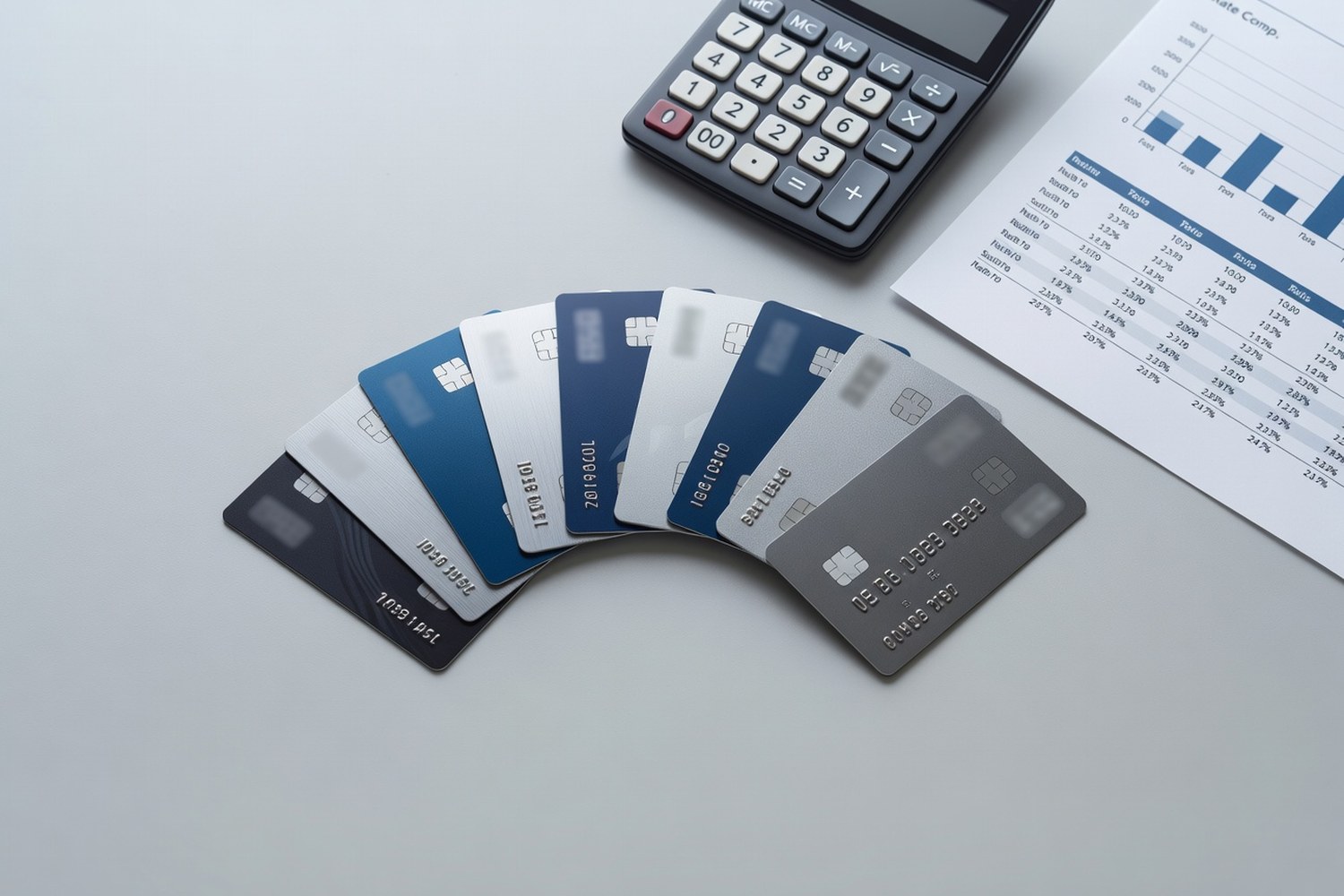
The Math: Prime + Margin = Your APR
Here is a concrete example. Suppose your Chase Freedom Unlimited card has a variable APR of 21.49%. Your margin is 21.49% − 6.75% = 14.74%. This margin was set when you were approved and does not change unless Chase modifies your account terms (which requires 45 days’ written notice under the CARD Act).
If the Fed cuts 0.25% at the June 2026 FOMC meeting, prime drops to 6.50%. Your new APR: 6.50% + 14.74% = 21.24%. On a $5,000 revolving balance, that 0.25% reduction saves $12.50/year ($1.04/month). Small per quarter-point, but cumulative — the five cuts since September 2024 saved $87.50/year on that same $5,000 balance.
| Date | Prime Rate | Your APR | Monthly Interest on $5K | Annual Interest on $5K |
|---|---|---|---|---|
| Jul 2023 (peak) | 8.50% | 23.24% | $96.83 | $1,162 |
| Sep 2024 (1st cut) | 8.00% | 22.74% | $94.75 | $1,137 |
| Nov 2024 | 7.50% | 22.24% | $92.67 | $1,112 |
| Jun 2025 | 7.25% | 21.99% | $91.63 | $1,100 |
| Oct 2025 | 7.00% | 21.74% | $90.58 | $1,087 |
| Dec 2025 (now) | 6.75% | 21.49% | $89.54 | $1,075 |
Total savings from 5 cuts: $87/year on a $5,000 balance. On the average American credit card balance of $6,501 (per NY Fed Household Debt data), the savings total $113/year. Not life-changing, but entirely passive — your rate dropped automatically without any action from you.
Dollar Impact of Recent Rate Changes on Different Balances
The 1.75% cumulative drop in prime affects larger balances proportionally more. Here is what the easing cycle saved across different revolving balances:
| Revolving Balance | APR Drop (1.75%) | Annual Savings | Monthly Savings |
|---|---|---|---|
| $2,000 | 1.75% | $35 | $2.92 |
| $5,000 | 1.75% | $88 | $7.29 |
| $10,000 | 1.75% | $175 | $14.58 |
| $20,000 | 1.75% | $350 | $29.17 |
| $50,000 | 1.75% | $875 | $72.92 |
If you carry $20,000+ across multiple cards, the prime rate environment matters significantly. A balance transfer to a 0% introductory APR card eliminates the prime rate variable entirely for 12–21 months, saving far more than waiting for additional Fed cuts. Compare options at our credit card comparison page.
When and How Your Rate Adjusts
Timing. After the Fed announces a rate change (typically 2:00 PM ET on FOMC decision day), your credit card issuer updates the prime rate used for your account. The new rate takes effect on your next billing cycle start date — not immediately. If your billing cycle closes on the 15th and the Fed cuts on the 10th, your new rate applies starting the 16th. If the Fed cuts on the 20th, you wait until the next cycle (next month’s 16th).
No action required. The adjustment is automatic. You do not need to call your issuer, request a rate change, or opt in. The CARD Act of 2009 requires issuers to apply rate decreases on the same schedule as rate increases — they cannot delay passing along a cut while immediately applying a hike.
Verification. Check your most recent statement or log into your card’s online portal. Your APR should show 6.75% + your margin. If it still reflects the old 7.00% prime (rate of 7.00% + margin), your next cycle has not started yet. If it shows the old rate after a full billing cycle has passed since December 11, 2025, contact your issuer — the CFPB complaint portal can assist if they do not comply.
How to Protect Yourself From Rising Rates
While the current rate trend is downward, the Fed could reverse course if inflation resurges. Here is how to insulate your finances from future prime rate increases:
Pay down variable-rate balances aggressively. Every dollar of revolving credit card debt is exposed to prime rate risk. If prime rises 1% (from 6.75% to 7.75%), a $10,000 balance costs an additional $100/year. Prioritize paying off credit card debt over other obligations because it carries both the highest rate and the most rate sensitivity. Use the Credit Card Payoff Calculator to set a target date.
Lock in a balance transfer. A 0% introductory APR balance transfer card freezes your interest at zero for 12–21 months regardless of what the Fed does. Transfer fees of 3%–5% are a one-time cost vs ongoing variable interest. On $10,000 at 21.49% APR, 18 months of 0% saves $3,224 in interest minus a $300–$500 transfer fee. Explore offers at PrimeRates credit cards.
Consider a fixed-rate personal loan for consolidation. If you carry $10,000+ across multiple cards, a fixed-rate personal loan at 8%–15% APR locks your rate for 3–5 years. You pay less interest AND eliminate prime rate exposure. A $15,000 personal loan at 10% fixed for 3 years costs $484/month vs minimum payments on cards at 21%+ that could take 8–12 years. Use the Debt Consolidation Calculator to compare.
Build an emergency fund. The CFPB recommends 3–6 months of expenses in savings. An emergency fund prevents you from adding to credit card balances during unexpected expenses, which compounds the damage when rates rise. Even $1,000 in savings reduces the probability of new credit card debt by 44%, according to Federal Reserve household survey data.
Frequently Asked Questions
How does the prime rate affect my credit card APR?
Most credit card APRs equal the WSJ prime rate plus a fixed margin. At 6.75% prime with a 14.74% margin, your APR is 21.49%. When the Fed cuts 0.25%, your APR drops to 21.24% on your next billing cycle. The adjustment is automatic with no action required from you.
Why did my credit card interest rate go up?
If the Fed raised the federal funds rate, prime increased and your variable APR rose automatically. Other causes: a penalty APR triggered by a late payment (up to 29.99%), or the end of a promotional 0% intro period. Check your statement for the reason and contact your issuer if it seems incorrect.
Can I get a lower credit card interest rate?
Yes, through three methods: wait for the Fed to cut rates (your APR drops automatically), ask your issuer for a margin reduction (especially effective if your credit has improved), or transfer your balance to a 0% introductory APR card. The margin reduction approach saves the most because it is permanent.
What is the average credit card interest rate right now?
The average U.S. credit card APR is 20.97% as of November 2025 per Federal Reserve G.19 data. This reflects the five rate cuts since September 2024. Cards for excellent credit average 17%–20%, good credit 20%–24%, and fair credit 24%–29%.
Do all credit cards use the prime rate?
Nearly all variable-rate cards reference the WSJ prime rate. A small number of fixed-rate cards exist (some credit union cards), which are not affected by prime changes. Your card agreement and Schumer Box disclose whether your rate is variable (prime-based) or fixed.
How much does a 0.25% rate cut save on credit card interest?
On a $5,000 revolving balance, a 0.25% APR reduction saves approximately $12.50/year ($1.04/month). On $10,000, savings are $25/year. On the average U.S. balance of $6,501, savings are $16.25/year per quarter-point cut. Small individually, but cumulative across multiple cuts.
Related Resources
- Current Prime Rate: 6.75% — Live rate and FOMC outlook
- The Prime Rate: Complete Guide
- Prime Rate by Bank — Do rates differ by bank?
- How the Prime Rate Affects Loans, Credit Cards, and Mortgages
- Prime Rate Forecast 2026
References
- Federal Reserve — G.19 Consumer Credit (Average CC APR)
- Federal Reserve — H.15 Selected Interest Rates
- Federal Reserve — Survey of Household Economics
- NY Fed — Household Debt and Credit Report
- CFPB — Credit Card Tools and Schumer Box
- CFPB — CARD Act Key Terms
- CFPB — Regulation Z (Truth in Lending)
- CFPB — Submit a Complaint
- AnnualCreditReport.com — Free Credit Reports
- FDIC — Quarterly Banking Profile
Calculators
- Prime Rate Credit Card Calculator
- Prime Rate Impact Calculator
- Credit Card Payoff Calculator
- Balance Transfer Calculator
- Debt Consolidation Calculator
- Credit Score Simulator