
How Personal Loans Affect Your Credit Score
A personal loan affects your credit score at three distinct stages: the application (hard inquiry, typically –5 to –10 FICO points), the new account opening


The word “barn” covers everything from a $12,000 open-sided equipment shed to a $250,000 heated equestrian facility with a riding arena. Before you look at financing, you need a realistic number — not a range so wide it’s useless.
A basic pole barn shell (post-frame construction, metal siding and roofing, no concrete, no electrical) runs $10-$25 per square foot. That’s $12,000-$30,000 for a 1,200 sq ft structure — think equipment storage, hay barn, or covered work area. Add a concrete slab ($5-$8/sq ft, or $6,000-$10,000 for 1,200 sq ft) and you’re at $18,000-$40,000. This is the most common barn financing range — and it’s perfectly suited to a personal loan.
A standard finished barn with concrete floor, electrical service, insulation, overhead doors, and basic interior walls runs $30-$65 per square foot. For a 30×40 (1,200 sq ft) barn: $36,000-$78,000. This covers most workshop barns, heated storage buildings, and agricultural barns with lighting and ventilation. At this price point, you’re choosing between a personal loan and a home equity loan.
A barndominium or equestrian facility runs $80-$200+ per square foot. A 2,000 sq ft barndominium: $160,000-$400,000. An 8-stall horse barn with riding arena: $100,000-$300,000. These projects need construction loans, home equity, or USDA financing — personal loans won’t cover the cost.
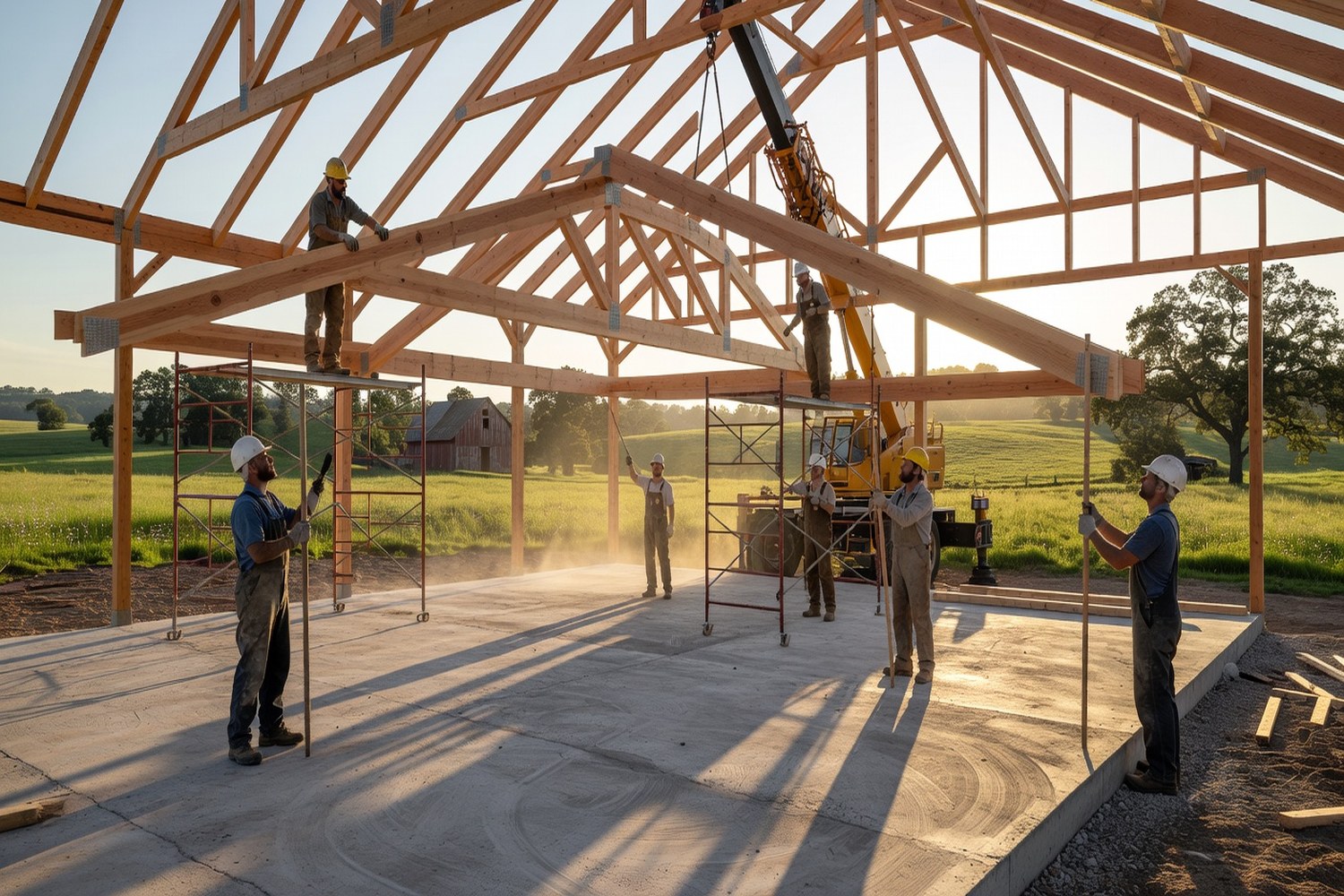
Barn construction costs range from $12,000 for a basic pole barn shell to $200,000+ for a finished barndominium — the financing method depends on your project scope.
1. Personal loan (best for barns under $50K). No collateral, no appraisal, no construction draw schedule. You get a lump sum in 1-3 days and pay the builder directly — or buy a pole barn kit and build it yourself. LightStream offers up to $100K for home improvement. HFS Financial specializes in barn loans with rates from 7.8% and terms up to 20 years. On a $35,000 barn at 9% over 84 months: $566/month, $12,544 total interest. The simplicity is the real advantage here: no inspectors, no staged draws, no weeks waiting for funding.
2. Home equity loan/HELOC (best for $40K+ barns with property equity). Rates run 7-9% — typically 2-4% below personal loans. A $60,000 barn at 7.5% over 15 years: $556/month. Trade-off: your house is collateral, closing takes 2-4 weeks, and you’ll need an appraisal. Best for larger projects where the lower rate justifies the complexity.
3. Construction loan (best for barndominiums over $80K). Funds disbursed in stages as construction progresses. Rates are typically variable (prime + 1-2%) and convert to a permanent mortgage after construction. Most useful for barndominiums that will be primary residences. Requires detailed plans and 10-20% down.
4. USDA/FSA agricultural loans (best for working farms). If your barn is for agricultural use on a qualifying rural property, USDA Farm Service Agency loans offer subsidized rates and longer terms. FSA farm ownership loans go up to $600,000. These are for active agricultural operations — not hobby farms.
5. Barn company financing (compare, don’t auto-accept). Morton, Lester, DIY Pole Barns, and most kit suppliers offer financing through partner lenders. Always pre-qualify independently first, then compare. Builder financing is convenient but often 1-3% more expensive than what you’d get on your own.
| Option | Rate | Amount | Term | Best For |
| LightStream | 6.49%-25.49% | $5K-$100K | 2-12 years | Lowest rate, no fees |
| HFS Financial | 7.8%+ | Up to $200K | 1-20 years | Barn specialist, long terms |
| Acorn Finance | 6.99%+ | Up to $100K | 2-12 years | Multi-lender marketplace |
| Home Equity | 7%-9% | Up to 85% LTV | 5-30 years | $40K+ barns with equity |
| USDA/FSA | Subsidized | Up to $600K | Up to 40 years | Working farms only |
| Upgrade | 8.49%-35.99% | $1K-$50K | 2-7 years | Fair/bad credit (580+) |
Rates reflect general ranges as of early 2026. USDA/FSA rates vary by program. Pre-qualify to see your specific offer.
LightStream — best overall for barn financing under $100K. Their “home improvement” category covers outbuildings and structures. Rates from 6.49% with autopay, same-day funding, zero origination fees. On $40,000 at 7.5% over 84 months: $616/month, $11,728 total interest. Rate Beat Program guarantees they’ll beat any competitor by 0.10%. Requires roughly 695+ credit.
HFS Financial — the barn financing specialist. HFS has built a niche specifically in pole barn and outbuilding lending, partnering with Morton, Timberline, and dozens of kit companies. Rates from 7.8%, terms up to 20 years, loans up to $200K. That 20-year term is unique — it keeps monthly payments manageable on $50K-$100K barn projects. Soft credit check to pre-qualify.
SoFi — best for barn projects with timeline uncertainty. Barn construction is weather-dependent and permit delays are common in rural counties. SoFi’s unemployment protection and no-fee structure provide a safety net. Rates from 8.74%, up to $100K, same-day funding. On $25,000 at 9.5% over 60 months: $525/month, $6,490 total interest.
Pole barn / post-frame ($10-$30/sq ft shell, $20-$65/sq ft finished). The most popular and cost-effective barn type. Vertical posts set in the ground or on concrete piers, with horizontal girts supporting metal siding and roofing. No continuous foundation needed — saving $8,000-$15,000 compared to a traditional barn. A 30×48 pole barn (1,440 sq ft) shell with concrete slab: $25,000-$45,000. Add insulation, electrical, overhead door, and walk door: $35,000-$65,000.
Traditional timber-frame barn ($40-$100/sq ft). Post-and-beam construction using heavy timbers with mortise-and-tenon joinery. Structurally superior and visually stunning — with prices to match. A 30×40 timber-frame barn: $48,000-$120,000. Often chosen for aesthetics or historical property requirements. Finance with home equity or construction loan.
Barndominium ($80-$200/sq ft). A pole barn or metal building converted to residential living space with full plumbing, HVAC, kitchen, and bathrooms. A 2,000 sq ft barndominium: $160,000-$400,000. These are financed as construction-to-permanent loans, not personal loans.
Horse barn / equestrian facility ($50-$150/sq ft). Stall barns with wash racks, tack rooms, feed rooms, and often attached riding arenas. A 6-stall barn: $60,000-$120,000. Full equestrian facility with covered arena: $150,000-$500,000+. Finance through agricultural lenders or home equity.
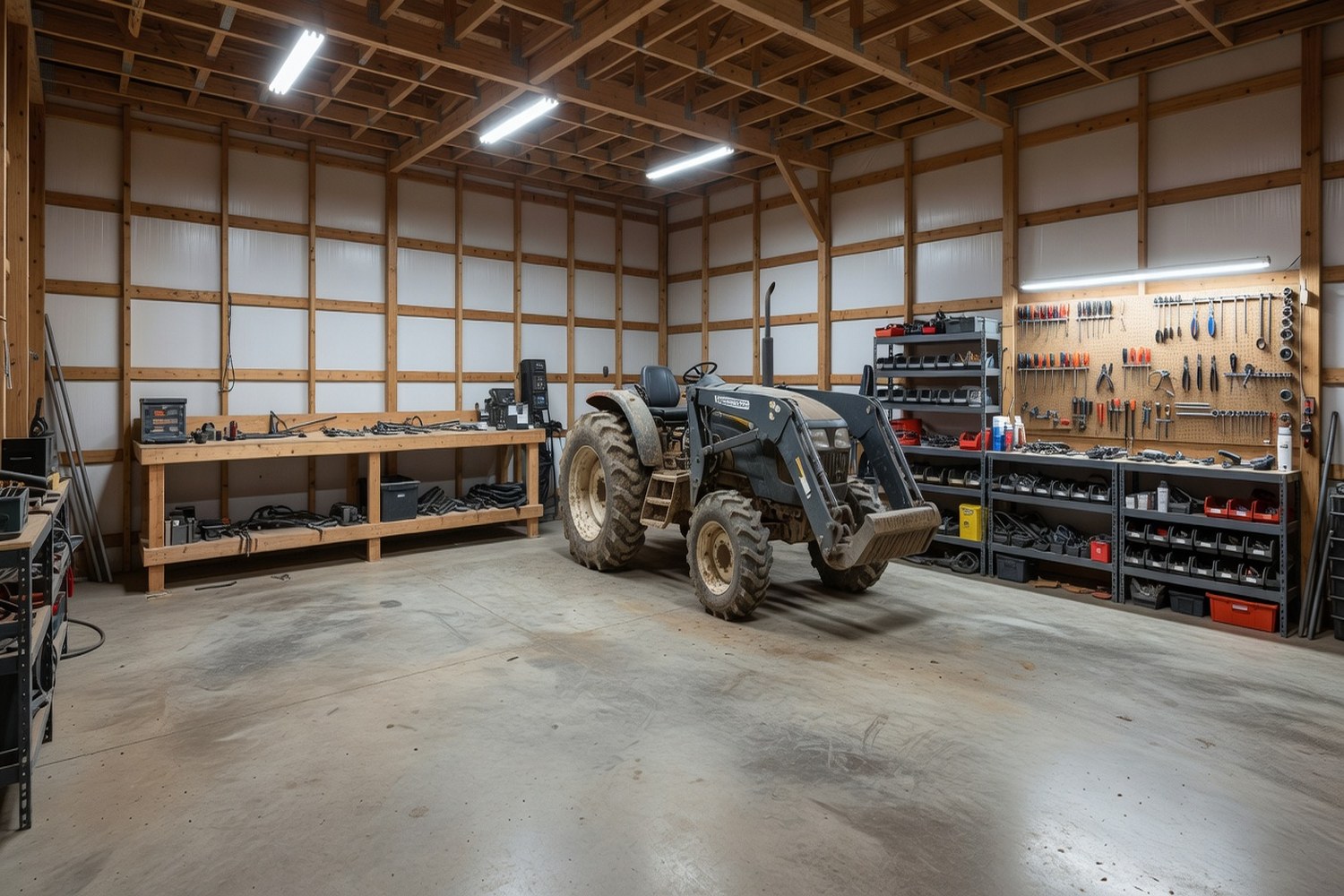
A finished pole barn workshop — the $35,000-$65,000 range where personal loans offer the best balance of speed, simplicity, and cost.
If your barn serves an agricultural purpose on qualifying rural land, government-backed programs offer rates and terms no commercial lender matches.
USDA Farm Service Agency (FSA) Farm Ownership Loans. Up to $600,000 for purchasing land, constructing farm buildings, and improvements. Fixed rates set quarterly by the Treasury — historically 3-5%, well below market. Terms up to 40 years. Requires: the property must be a working farm and you must be the operator. Apply through your local FSA county office.
FSA Farm Operating Loans. Up to $400,000 for equipment, livestock, and minor building improvements. These can cover a smaller agricultural barn as part of a broader farm operating plan. Same below-market rates.
USDA Rural Development Section 504 Loans. For very low-income rural homeowners — loans up to $40,000 at 1% interest for up to 20 years to address health and safety hazards, which can include replacing structurally unsound buildings.
State agricultural programs. Many states offer grants and low-interest loans for farm buildings. Check your state Department of Agriculture — programs can provide $5,000-$50,000 in grants or subsidized loans. These are often undersubscribed because farmers don’t know they exist.
Step 1: Define the project and get 2-3 quotes. Contact barn builders or kit companies for detailed quotes including materials, labor, concrete, electrical, and site prep. Total project cost is the number to finance.
Step 2: Check USDA/FSA eligibility. If you’re on rural land with an agricultural operation, a 5-minute call to your county FSA office can save thousands. If you don’t qualify, move to commercial financing.
Step 3: Pre-qualify at 3+ lenders. LightStream (best rates), HFS Financial (barn specialist), and your local credit union. If credit is below 650, add Upgrade and Acorn Finance. Takes 15-20 minutes total.
Step 4: Compare against builder financing. If your kit company offers partner lending, compare against your own pre-qualification. Use whichever is cheaper.
Step 5: Add 15-20% contingency. Barn construction surprises include soil issues, trenching for electrical, and weather delays. Finance at 1.15x to 1.20x the quoted amount.
Step 6: Time the loan to construction start. Apply 2-4 weeks before scheduled construction. Don’t fund months early while the barn sits unbuilt.
For barns under $50K: a personal loan from LightStream (6.49%+) or HFS Financial (7.8%+, terms up to 20 years). For barns over $50K with home equity: a home equity loan at 7-9%. For agricultural barns on working farms: USDA/FSA loans with subsidized rates. Always pre-qualify at 3+ lenders.
Pole barn shell: $12,000-$30,000 for 1,200 sq ft. Finished pole barn with concrete and electrical: $35,000-$65,000. Timber-frame: $48,000-$120,000. Barndominium: $160,000-$400,000. Horse barn: $60,000-$120,000. Add 15-20% for site prep and contingencies.
Yes. LightStream offers up to $100K, HFS Financial up to $200K with 20-year terms. No collateral required, funding in 1-3 days. You receive the money directly and pay the builder on your schedule.
Usually yes. Some rural counties exempt small agricultural structures, but most require permits for any building with a foundation, electrical, or plumbing. Check with your county building department before financing.
Yes. USDA FSA farm ownership loans (up to $600K at subsidized rates) and FSA farm operating loans (up to $400K) cover agricultural buildings on working farms. State agricultural grants ($5K-$50K) are also available in many states. Contact your county FSA office for eligibility.
Rates and terms are subject to change. This is not financial advice. All information is for educational and comparison purposes only. Barn costs vary by region, materials, and scope. USDA/FSA eligibility depends on property classification and operator status. Always get multiple quotes and verify current rates before committing.
A personal loan affects your credit score at three distinct stages: the application (hard inquiry, typically –5 to –10 FICO points), the new account opening

The most common personal loan fee is the origination fee, which ranges from 1% to 10% of your loan amount and gets deducted before you

A personal loan is the cheaper choice for borrowing $3,000 or more when you need longer than 60 days to repay — the average personal

You can prequalify for a personal loan in under five minutes at most online lenders — SoFi, Upstart, Prosper, Best Egg, and Upgrade all let

Most personal loan lenders approve borrowers with a debt-to-income ratio (DTI) under 50%, though the best rates and terms go to applicants below 36%. SoFi,

The prime rate forecast for 2026 is one of the most closely watched financial data points of the year — and for good reason. Every